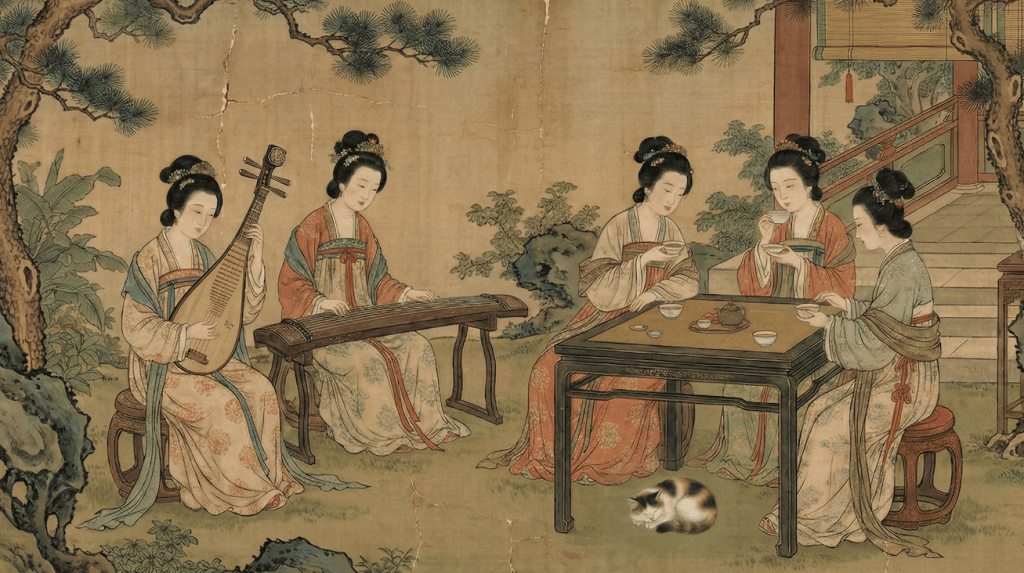
Around the world, billions of people drink tea. The word for “tea” appears in almost every language on Earth, yet it comes in only two sounds: te and cha.
The word te originated in the Min Nan dialect (闽南语) spoken in Fujian (福建), a coastal province in southeastern China. In the early 1600s, Dutch traders sailing from Fujian’s ports learned the word te from Chinese merchants. They carried both the leaves and the name across the seas. Through the Dutch thee, it became tea in English, thé in French, and tee in German. Closer by in Southeast Asia, Min Nan traders exchanged tea with merchants in the area that is modern-day Malaysia and Indonesia, giving rise to the local word teh.
While te sailed the seas, cha traveled mostly over land. The sound cha came from Mandarin and Cantonese Chinese (茶) and moved westward along the Silk Road. While the Silk Road opened during the Han dynasty (206 BCE–220 CE), the earliest evidence of tea trade along its routes did not appear until the Tang dynasty (618 – 907 CE), when caravans carried tea bricks westward through the Tibetan Plateau toward Central Asia. Persians called it چای (chay), which spread as чай (chai) in Russian and شاي (shai) in Arabic. In India, the same word became चाय (chai), carried through Persian and Urdu into the subcontinent’s many languages. Ironically, the tea itself arrived India much later. In the 19th century, British agents smuggled tea seeds and cultivation knowledge out of China to establish plantations in Assam and Darjeeling. Centuries earlier, in the opposite direction, the word cha had already taken root across East Asia. It entered Korea during the Silla dynasty (7th – 9th centuries) as 차 (cha) and reached Japan during the Heian period (8th – 9th centuries) as お茶 (ocha), with the respectful “o” added before cha.
As the saying goes, all roads lead to Rome. When it comes to tea, all leaves trace back to China.
What many people don’t realize is that nearly all tea, whether green, white, yellow, oolong, black, or dark, comes from the exact same species of plant, Camellia sinensis. The differences come only from how the leaves are prepared (topic for another time).
Scientists have sequenced tea plants, Camellia sinensis, from all over the world and found that the greatest genetic diversity occurs in Yunnan, China. In genetics, this observation tells a story of origin. Imagine you have a deck of cards, each representing a different gene. The plant’s original home holds the full deck. When humans carry tea plants to new places, only part of that deck travels with them. Over time, those distant populations keep playing with fewer cards, resulting in a less diverse genetic profile. This is why scientists believe that Yunnan is the most likely birthplace of tea and tea cultivation.
Chinese legend credits the discovery of tea to Emperor Shennong, the “Divine Farmer,” who lived nearly five thousand years ago. One day, as the story goes, a few wild leaves drifted into his pot of boiling water, releasing a fragrance so pleasant that he decided to taste it, and tea was born. While the tale is beloved, archaeology offers a more tangible record of the early days of tea consumption. In 2016, scientists analyzing remains from the tomb of Emperor Jing of Han (141 BCE) near Xi’an, China identified tea leaves containing caffeine, theanine, and catechins, a combination of chemicals unique to Camellia sinensis. If you aren’t familiar with China’s geography, Xi’an lies more than a thousand miles from tea’s homeland in Yunnan. How the leaves traveled such a distance so early is still a mystery today, but what is clear is that by the 2nd century BCE, tea had already entered the world of the royal courts of China.
You might have noticed my choice of words “tea consumption”, and not “tea drinking”. The truth is, we don’t actually know how tea was used at first, but it was certainly unlike how we drink it today. The earliest Chinese documents that mention tea describe it being boiled and not steeped. In 59 CE, the scholar Wang Bao 王褒 wrote his Contract for a Servant<僮约>, which records a servant’s duty to “boil tea and serve the cups”, the earliest known mention of tea preparation in daily life. A century later, physician Hua Tuo (华佗, 145–208 CE) noted that drinking bitter tea could “clear the head and ease digestion,” describing tea’s medicinal value long before it became a common beverage. By the 4th to early 7th centuries, tea appears frequently in poetry and historical texts under the term jian cha (煎茶), meaning “boiled tea”.
This tradition reached new refinement in the Tang dynasty, when Lu Yu wrote The Classic of Tea (Cha Jing, 760 CE), the world’s first comprehensive treatise on tea. Lu Yu described roasting compressed tea cakes, crushing them into powder, and boiling the powder in water. This powdered tea method continued to evolve in the Song dynasty (10th – 13th centuries). Instead of boiling the powder, people began whisking it in hot water using a bamboo whisk (cha xian, 茶筅), creating a bright green froth. Song scholars and emperors praised this style, known as Whisked Tea (点茶), as the height of refinement. Cai Xiang’s Record of Tea <茶录>, 1051) and Emperor Huizong’s Treatise on Tea <大观茶论>, 1107) both describe this whisked tea in detail. In 1191 CE, a Japanese Buddhist monk named Eisai 栄西 introduced this technique of tea whisking from China to Japan, where it became known as matcha.
Ironically, the practice of whisking powdered tea soon began its decline. By the Southern Song period (1127–1279), people outside the imperial courts were already favoring simpler infusions made from loose tea leaves. Later under Mongol rule (1271–1368), the literati circles that had sustained refined tea culture were displaced. Steeping loose leaves in hot water quietly became the new norm. What finally ended the tradition came in 1391, when the Ming emperor Zhu Yuanzhang (朱元璋), who rose from a peasant background, issued an edict banning compressed and powdered teas from imperial tribute. He viewed the elaborate tea rituals of earlier dynasties as decadent and wasteful, and sought to return tea to a simpler, humbler form. Funny enough, his son Emperor Zhu Di (朱棣) went on and built out the Forbidden City. Decadence, right? The reform effectively ended the dian cha practice in China and cemented the loose-leaf brewing tradition that defines Chinese tea today.
So this is the early story of tea, traced through its genes, its words, and its history. Which part of this journey fascinates you the most?
©2025 Studentoftea.com | All Rights Reserved
Leave a Reply