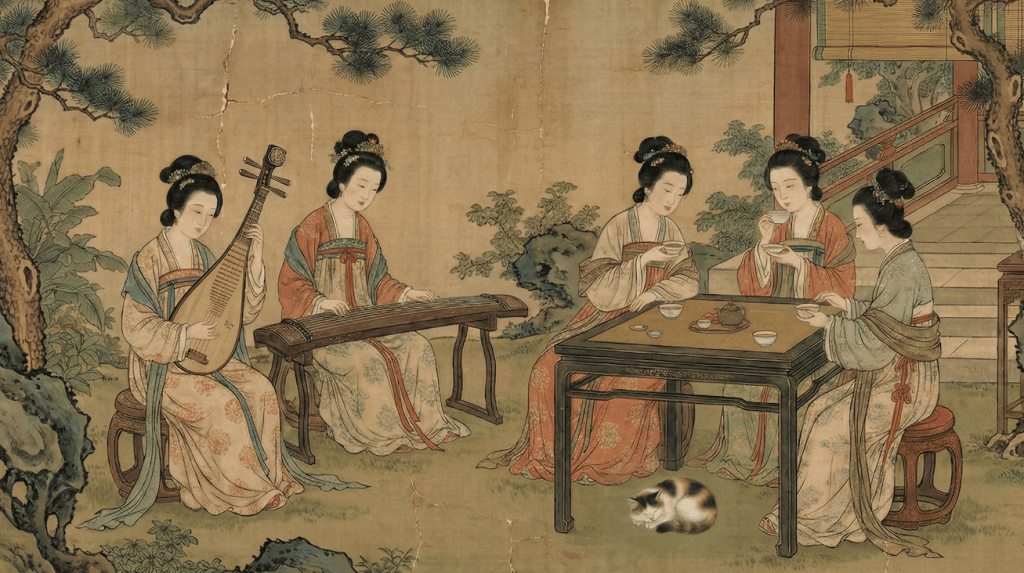
I am a chemist who loves history and finds tea at the intersection of both. Student of Tea is a space that treats tea as a daily practice. A simple way to slow down, pay attention, and reconnect through a cup of tea.
Longjing tea comes from the hills around Hangzhou, and once you are there, it quickly becomes clear that the city grew up around it. The tea fields spill down toward West Lake, temples sit just above the terraces, and narrow paths wind through villages that still smell faintly of roasted leaves in spring.
Longjing is not just something to taste here. It gives structure to the landscape and a rhythm to daily life. For centuries, these hills supplied tea to monks, scholars, and emperors, and the same routes once used to move tea now make some of the most rewarding walks in the city. Along the way, you will find tea houses tucked beside the lake or hidden in the hills, places meant for lingering.
In this article, I put together tea-centered hikes and walks that move through Hangzhou’s history. It focuses on beautiful tea fields, relaxed tea houses, and the stories that connect them. At the end, I include a simplified itinerary with maps, and I list the local Chinese names for each stop, which is especially helpful if you prefer using Chinese map apps for route planning.
I will continue to update this guide as I discover more tea walks around Hangzhou, so feel free to subscribe if you would like to follow along as new routes are added.
Traditionally, West Lake Longjing tea was described as having five production categories: Shi 狮 (Lion), Long 龙 (Dragon), Yun 云 (Cloud), Hu 虎 (Tiger), and Mei 梅 (Plum). The modern day system groups Mei 梅 together with Yun 云, leaving four officially recognized production areas used today for geographic indication and labeling. The first route I share below focuses on three of these tea production areas, Shi 狮 (Lion), Long 龙 (Dragon), and Mei 梅 (Plum)/Yun 云 (Cloud), and it would take around 2 – 3 hours depending on your pace.
Meijiawu Village 梅家坞村 sits on the western side of West Lake and is one of the largest and most active Longjing tea producing villages in Hangzhou. Tea has been grown here for centuries, and today the hills surrounding the village are almost entirely covered in neatly terraced tea fields. Historically, Meijiawu was classified separately as Mei 梅, before later being grouped under Yun 云 in modern usage. Beyond the tea fields, the village is lined with casual tea houses and local restaurants, making it an easy and comfortable place to start the day before heading into the hills.
We will begin the hike by navigating to the [1] Meijiawu Village 梅家坞村 bus stop. There is a memorial arch that says Ten Li Langdang Ridge 十里琅珰.
Ten Li Langdang Ridge 十里琅珰 takes its name from the old mountain path, which was traditionally measured at about ten li, roughly five kilometers. Langdang 琅珰 is a classical term associated with the clear, resonant sound of jade ornaments, and here it is used poetically to describe a long, elevated ridgeline where wind, footsteps, and voices carry clearly as the trail winds through tea fields and forest.
This is the path we will be taking all the way up to [2] Sanfencha 三分叉, a quiet three-way junction in the hills that once connected tea farmers’ paths between villages and tea fields. At the junction (red arrow down below), you may take a small detour towards a viewing point at [3] Ten Li Langdang Lookout or head directly down towards [4] the Longjing Village 龙井村.
Modified image. Source Xiaohongshu, user 周末去拍照.
Longjing Village 龙井村 sits at the heart of the West Lake Longjing landscape and is closely associated with both Long 龙 and Shi 狮 production areas. Tea grown around the village itself falls under the Long 龙 designation, while the nearby slopes of Shifeng 狮峰 (Lion Peak) produce Shi 狮 tea, traditionally regarded as the highest and most prized style of West Lake Longjing.
Today, Longjing Village is an easy place to slow down, with tea houses and small restaurants serving local dishes prepared with tea and seasonal ingredients, such as the famous Longjing prawns 龙井虾仁.
If the day is still young and you have more energy, you can take a short walk from Longjing Village 龙井村 to visit the China National Tea MuseumLongjing campus for free. The museum is China’s only national level museum dedicated entirely to tea and tea culture with clear English signage and a well curated exhibition on tea in China and around the world. Check out their website before you go. The museum also has a second campus, Shuangfeng, that is 30 minutes away by foot.
You may choose to do this route in reverse order, but know that the terrain around Longjing Village is steeper and more compact than in Meijiawu Village, with smaller plots, rockier soils, and older tea bushes, factors often credited with producing teas of greater depth and balance. If you end your trip in Meijiawu village 梅家坞 instead, it makes a nice stopping point to rest with a cup of tea or a full meal at Yunjing Tianzhu 云径天竹, a tea house and restaurant overlooking a full sweep of terraced tea fields.
Tiger Spring to Misty Village (4 – 5 hours)
Hupao 虎跑, originally called 虎刨, is best known for its water. Since the Tang dynasty (618 – 907 AD), it has been regarded as one of Hangzhou’s finest sources for brewing tea, especially Longjing. According to local legend, a Tang dynasty monk named Xingkong 性空, troubled by the lack of water for his temple, dreamed of two tigers digging into the earth. When he awoke, a spring had appeared at the spot. The site was first called Tiger Dug Spring (虎刨), using the character for digging, and later evolved into Tiger Run Spring虎跑, for the two words sound similar. Today, this area is a fitting place to begin a longer hike (4 – 5 hours) and marks the final stop among the four West Lake Longjing production areas, Hu 虎 (Tiger).
Navigate to [1] the east entrance of Hupao Scenic Area on Hupao Rd 虎跑路. After passing a stone tiger, you will arrive at [2] Hupao Temple 虎跑寺, first founded in 819 AD during the Tang dynasty. This temple has been destroyed and then rebuilt many times and is remembered today for its links to famous monks such as Ji Gong and Hong Yi. The site itself now functions as a public park preserving both Buddhist heritage and natural scenery. If you see people carrying empty bottles, follow them to the actual Hupao Spring and taste it for yourself!
Image source Xiaohongshu. User: 松节油里游泳的鱼.
Continue along the paved path and follow the signs toward [3] Guiren Pavilion 贵人阁. From here, you get a rare panoramic view that takes in both West Lake and the Qiantang River, with Hangzhou’s modern skyline rising in the distance.
Image source Xiaohongshu. User 孤独山客.
Stepping down the pavilion, continue towards [4] Ma’er Shan Ridge 马儿山岗. Along the way, on the river facing slopes below, you can also spot tea terraces belonging to the Hu 虎 (Tiger) production area of West Lake Longjing. Ma’er Shan Ridge is a three-way intersection, where you will then take the direction of [5] Li’an Temple 理安寺.
Image source Xiaohonghu. User o牛角尖的牛角包.
Li’an Temple is a Buddhist monastery tucked along an old mountain path. It was first founded during the Five Dynasties period (907 – 960 AD), renamed during the Southern Song (1127 – 1279) after an imperial visit, rebuilt in the Ming dynasty (1368 – 1644), expanded to its height during the Qing dynasty. Today, the complex is a wonderful place to enjoy osmanthus blossoms in early autumn and autumn foliage later in the season.
From Li’an Temple 理安寺, take the direction towards [6] Jiuxi Yancun 九溪烟村. Jiuxi Yancun 九溪烟村, often translated as Nine Creeks in Misty Village, takes its name from the way fog and cooking smoke once drifted through the valleys where nine small streams converge. Historically, this area was a quiet agricultural settlement connected by winding waterways, tea fields, and footpaths, with villages tucked low among the hills. From here onward, the route simplifies into a single main path that leads all the way out toward the Qiantang River. You can choose to walk the entire way or hop on a park shuttle from the village (and two stops on the way), with tea fields lining much of the route.
Baoshi Mountain (~1 hour)
If you enjoy an early morning hike, Baoshi Mountain 宝石山 is a great place to begin the day. In the summer, the trails start filling with local elders soon after sunrise, but at that hour the air is still cool and the city feels far away. There are several paths that lead up the mountain, and I will share a route that I have taken many times. This route is about 2 km, short and sweet and can get you to the peak within 20 – 30 minutes. Shoes with good grip are recommended and I wouldn’t go up there during or after rain.
Start on the north side of Baoshi Mountain from Shuguang Rd. 曙光路 near the Zhejiang Library[1]. You will enter through the Yellow Dragon Cave 黄龙洞 scenic area. Shortly after, you will pass by [2] the Folk Culture Park 黄龙洞圆缘民俗园, and you will continue along a small path to the right of the park.
Yellow Dragon Cave has been documented as a religious site since the Song dynasty (960 – 1279 AD). The name itself, however, comes from local tradition. According to legend, a Buddhist monk named Huikai built a temple here. One day, a thunderclap split the mountain, releasing a clear spring from the rock. A yellow dragon emerged and followed Huikai, giving the cave its name. Another well known folk story tells of two yellow dragons living nearby. When the elder dragon brought destruction to the city of Hangzhou, the younger dragon sacrificed itself to stop him by flooding the cave with water from West Lake. A small waterfall marked the place where the young dragon was buried and a carved dragon head was later placed there in its memory.
By the late Qing dynasty, Yellow Dragon Cave had become one of Hangzhou’s prominent Daoist temple complexes, a role that continues until today.
A few steps ahead, the trail enters a bamboo forest. Towards the end, the walkway becomes unpaved. At an intersection, you will see signage. Follow the sign for [3] Chuyang Platform 初阳台. You may then follow the signs toward [6] Baochu Pagoda 保俶塔.
The name of the Chuyang Platform simply means the platform of the first sun. It can be traced back to the Eastern Jin dynasty (317 – 420 AD). The legend has it that the platform was built by the Daoist master Ge Hong for alchemy. By the Yuan dynasty in the 13th century, written records already described it as Hangzhou’s finest viewpoint for watching the sunrise.
On the way, you will first pass [4] the Baopu Daoist Temple 抱朴道院 and then [5]Hama Peak 蛤蟆峰, where you can drink in the panoramic view of the entire West Lake.
Image source Xiaohongshu, user 没想好名字.
Baopu Daoist Temple 抱朴道院 is also closely associated with the Daoist scholar and alchemist Ge Hong. While no precise founding year is recorded, the site is generally traced to the Eastern Jin dynasty (317 – 420 AD), when Ge Hong is believed to have practiced alchemy and medicine here. What began as a small retreat gradually developed into an important Daoist complex, reaching its height during the Tang dynasty (618 – 907), the Five Dynasties period (907 – 960), and the Song dynasty (960 – 1279). Its growth was shaped by Daoist traditions that emphasized healing, cultivation, and working in harmony with the surrounding landscape.
While [6] Baochu Pagoda 保俶塔 is a solid brick pagoda and cannot be entered or climbed, it is one of Hangzhou’s most recognizable landmarks. The pagoda was first built in the Five Dynasties period (907 – 960), traditionally dated to 948 AD, during the Wuyue Kingdom. Its name, which can be translated as “Pagoda Protecting Chu,” is commonly linked to local legends about safeguarding the kingdom and its people.
Once you are past the pagoda, walk downhill toward West Lake. Along the way, you can stop to view [7] the Baoshi Mountain stone carvings 宝石山造像. These are Buddhist figures carved directly into the cliff faces, most dating to the late Southern Song and Yuan periods, around the 13th and 14th centuries. These carvings are very weathered and are easy to miss if you are not looking closely. They reflect a period when Buddhist practice extended beyond formal temples into the surrounding landscape, turning mountain paths themselves into spaces for devotion and contemplation.
Eventually, you will reach [8] Beishan Rd. 北山路 along the northern shore of West Lake. Turn right and follow the road as it curves gently along the water. Use your map to help find a tea house called [9] Gugong Youxi 顾宫有喜, a small, tucked away tea house that also serves coffee and sweets. It is housed within the grounds of the former Manao Temple 玛瑙寺, a setting that gives the space a calm, slightly removed feeling from the busy lakeside. It is a good place to sit down, rest your legs, and let the morning walk settle before continuing on.
Image source Xiaohongshu. User 日暮向晚.
As I explore more of the hills and tea paths around Hangzhou, I will keep updating this guide with new hikes and city walks.
Tea may appear simple, but every cup is the result of a carefully balanced cocktail of molecules. From bitterness and sweetness to aroma, color, and even the bubbles and foam that sometimes form on the surface, the sensory experience of tea is shaped by a wide range of compounds that originate in the leaf and evolve through processing. In this article, I take a look inside the tea leaf, introducing the major classes of molecules that define how tea tastes, smells, and looks, and showing how chemistry connects growing conditions, processing choices, and what ultimately ends up in the cup.
Methylxanthines
General chemical structure of methylxanthines.
Methylxanthines are a small family of nitrogen-containing alkaloids built on a shared xanthine backbone (see structure above). In tea, this group includes caffeine, theobromine, and theophylline. All three act as stimulants because their xanthine structure closely resembles that of the adenosine molecule. This similarity allows them to bind to and block adenosine receptors in our brains. Their subtle structural differences lead to differences in potency, and all three compounds contribute to tea’s characteristic bitterness.
Caffeine
Chemical structure of caffeine.
Caffeine, the most widely consumed psychoactive substance globally, is a bitter-tasting molecule naturally synthesized by the tea plant.
Contrary to the common belief that black tea contains less caffeine than green, caffeine levels do not strictly follow tea type. As discussed in my article on the evolution of major tea types, all teas come from the same plant, Camellia sinensis. What sets them apart is how the leaves are processed. Because caffeine is a heat-stable compound, the various heating steps used in tea making, including steaming, pan-firing, or roasting, do not destroy this molecule, and therefore do not fundamentally change its content in the tea leaves.
Tea brewing is an infusion process that extracts caffeine from the tea leaf into water. The natural level of caffeine varies by the cultivar, leaf age, position on the shoot, and the leaf-to-stem ratio of the harvested material. In addition, the degree of leaf breakage during processing (for example, tea bags versus loose leaf) and brewing conditions such as water temperature and steep time, all determine how much caffeine ultimately ends up in your cup.
Caffeine is highly water-soluble and diffuses rapidly; most of it is released into the brew within the first two to three minutes of steeping. Most Camellia sinensis tea leaves contain about 10 – 40 mg of caffeine per gram of dry leaf. A typical cup of tea prepared with 3 grams of dry leaves can deliver up to 30 – 120 mg of caffeine. In traditional Chinese brewing styles, tea is often steeped for 15, 30, or 45 seconds per infusion, producing lighter cups while allowing the same leaves to be re-steeped a few times. This way, caffeine is released gradually across the successive brews.
While caffeine helps dispel drowsiness and improve cognitive function, its half-life in healthy adults averages about 3 – 7 hours. Even moderate tea consumption later in the day can therefore interfere with sleep quality, which is why tea is generally best enjoyed earlier in the day.
Theobromine and Theophylline
Chemical structure of Theobromine and Theophylline.
Alongside caffeine, tea contains theobromine and theophylline, both present in much smaller amounts than caffeine and having less effect on the central nervous system.
Both compounds relax airway muscle (bronchial smooth muscle) and have long been recognized for their bronchodilating effects. Theophylline in particular has been used clinically in the treatment of respiratory diseases such as asthma, although at doses far higher than those encountered in tea. From a sensory perspective, theobromine contributes a softer, more rounded bitterness, while theophylline, present only in trace amounts, has little direct impact on flavor. Together, they play a secondary role, subtly shaping tea’s bitterness and physiological profile without defining it.
Amino Acids
All known life depends on amino acids, and the tea plant Camellia sinensis is no different. In tea, these small molecules play an outsized role in shaping sweetness, umami, and overall mouthfeel.
L-theanine
Chemical structure of L-theanine.
L-theanine is an amino acid that won’t be part of any proteins but gives tea part of its smooth, umami character. It is a distinctive compound found almost exclusively in Camellia sinensis, with only trace amounts detected in a few mushroom species.
L-theanine is made in the roots of the tea plants and then transported upward through the xylem (plant’s plumbing system) to young shoots and buds. Besides the cultivar and leaf maturity, light exposure strongly influences the abundance of this chemical. Cultivation in shaded conditions significantly increases L-theanine levels in the leaves.
Unlike caffeine, L-theanine changes in response to different steps of tea preparation. The initial enzyme inactivation through steaming or pan-firing at 100-120 °C has little effect on this compound. However, roasting at over 150 °C can markedly reduce L-theanine through Maillard reactions. Amino acids and sugars react to form melanoidin, the brown molecule that gives tea its nutty or caramel notes. During the production of some teas such as oolong, leaves undergo withering and rolling, which exposes internal tissues and leads to leaching and partial breakdown of L-theanine. As a result, you might find 10-30 mg of L-theanine in 5 g of dry green tea leaves, but very little in the same amount of aged Pu’er.
Several small randomized trials have reported that L-theanine can promote relaxation and reduce stress without causing drowsiness. When taken together with caffeine, it appears to further enhance attention and reaction time. While supplement makers like to advertise L-theanine’s ability to support the immune function and reducing inflammation, evidence from well-designed double-blind, randomized trials remains limited and inconclusive.
Glutamic acid
Chemical structure of glutamic acid.
Glutamic acid is another free amino acid in tea that contributes to umami, though in a more direct and sharper way than L-theanine. Yes, this is the same glutamate that gives the flavor enhancer, MSG, its umami taste! While L-theanine provides a smooth, lingering savoriness, glutamic acid adds a straightforward savory note that can be perceived as brothy or soup-like at higher concentrations.
Young leaves tend to contain more glutamic acid, and shaded cultivation can modestly increase its levels by favoring nitrogen-rich metabolites. In tea processing, glutamic acid is relatively stable during steaming or pan firing, but extended withering, oxidation, and roasting can reduce its presence as it participates in browning reactions or is lost through leaching.
In most teas, glutamic acid does not stand out on its own. Instead, it works alongside L-theanine and other amino acids to deepen umami and soften bitterness, contributing to the savory backbone that is especially noticeable in high quality green teas and lightly oxidized oolongs.
Alanine, Glycine, Serine, Threonine
Tea also contains several free amino acids that contribute subtle sweetness and smoothness. The most relevant are alanine, serine, glycine, and threonine. Rather than tasting sweet on their own, these amino acids soften bitterness and astringency, giving tea a rounder and more balanced mouthfeel.
Alanine is the most important of this group and provides a mild, clean sweetness, especially in high-quality green teas and lightly oxidized oolongs. Serine and threonine contribute gentle sweetness and smoothness, while glycine plays a minor supporting role due to its low abundance. Their levels are highest in young leaves and shaded teas and tend to decline with heavier processing and roasting as they are lost or transformed during tea-making.
Aspartic Acid
Chemical structure of Aspartic Acid.
Aspartic acid is the primary amino acid in tea associated with sourness. Compared with glutamic acid, it is less savory and more directly acidic. In brewed tea, it can add a faint sharpness, even though its concentration is usually low. (For the chemistry geeks, this is because the side-chain carboxyl group of glutamic acid has a higher pKa than that of aspartic acid. As a result, aspartic acid donates protons more readily at the mildly acidic pH of tea, typically around pH 5 to 6.)
In most teas, aspartic acid does not stand out on its own. Its contribution is subtle, adding a slight edge or brightness rather than overt sourness. This effect is more noticeable in later harvests and older leaves, where the balance of amino acids shifts away from sweetness and umami.
Aspartic acid is relatively stable during green tea processing steps such as steaming or pan firing. During prolonged withering, oxidation, and roasting, its sensory impact tends to fade as other taste active compounds become more prominent. As a result, aspartic acid plays a minor but balancing role, fine tuning acidity rather than defining the flavor profile of tea.
Polyphenols
One example of polyphenol: Epigallocatechin gallate (EGCG) found in green tea.
Polyphenols really sound like a chemist’s word, but they are actually a large group of natural molecules that plants make to protect themselves against insects, microbes, and UV light. The term phenol refers to a chemical structure where a hydroxyl (-OH) group is attached to an aromatic benzenoid ring (see example above with various -OHs around three hexagons). For us tea drinkers, these same compounds give much of tea’s taste, mouthfeel as well as color.
Flavan-3-ols, theaflavins and thearubigins
Chemical structure of flavan-3-olStructures of (epi)catechin, (epi)catechin gallate, (epi)gallocatechin and (epi)gallocatechin gallate.
Under the umbrella of polyphenols, flavan-3-ols share a three-ring backbone (see above). That same structure forms the backbone of tea chemistry.
The four major flavan-3-ols are epicatechin (EC), epigallocatechin (EGC), epicatechin gallate (ECG), and epigallocatechin gallate (EGCG). Together, they account for around 10% of the dry weight of tea leaves. Among them, EGCG and ECG are found in particularly high abundance in tea and are often used as chemical markers to authenticate tea extracts. Their abundance in tea varies with cultivar, leaf maturity, light exposure as well as season, reflecting how the plant balances growth and defense under different conditions.
Flavan-3-ols are the source of much of tea’s bitterness and astringency. These molecules bind to proteins in saliva, tightening our mouth’s tissues and creating the dry sensation that lingers on the tongue. As early as 659 CE, the Tang court pharmacopeia Xin Xiu Ben Cao recorded that tea picked in autumn is more bitter, an observation that aligns neatly with what we know about the seasonal chemistry of tea! These same polyphenols also help reduce the perception of greasiness after a meal. Fatty foods coat the tongue and dull taste receptors, and polyphenols can interact with that oily film, breaking up the sensation and making the mouth feel cleaner.
Speaking of season, the color of tea owes much to what happens to flavan-3-ols after harvest. In living tea leaves, these molecules are colorless. After the leaves are plucked from the tree and especially when the leaves are rolled and bruised, an enzyme called polyphenol oxidase (PPO) comes into contact with these flavan-3-ols and oxygen. Much like how a banana bruises and turns brown, the oxidized flavan-3-ols form theaflavins, which give tea liquor its bright golden-orange hue.
As oxidation continues, these theaflavins polymerize into thearubigins, deepening the color toward reddish brown and softening the astringency. Because thearubigins are heterogeneous polymers rather than a single defined compound, their exact molecular structure remains undetermined despite decades of research.
In contrast, green tea processing begins with a step called shaqing 杀青, which literally means “arresting the green”. This step involves briefly heating the freshly picked leaves, either by steaming (traditional method used before the 1300s in China) or pan firing (the modern approach) to inactivate polyphenol oxidase. By halting the enzyme’s activity, shaqing prevents the oxidation of flavan-3-ols, preserving their colorless state and allowing the leaves natural green color to shine through. As a result, green teas also taste brisker and more astringent than oxidized teas.
These compounds should not be confused with the flavan-3-ols we just discussed, even though their structures are similar and their names sound alike. Some of the major flavonols in tea are quercetin, kaempferol, and myricetin. Tea is highlighted here because these compounds are also prevalent in fruits and vegetables.
These compounds are produced directly in the tea leaves as part of their defense system against UV light. As a result, their levels are strongly influenced by sunlight exposure. Buds and young leaves grown under full sun tend to accumulate more flavonols than those on shaded plants.
Interestingly, most flavonols in tea are stored as glycosides, meaning a sugar unit is attached to the flavonol backbone. Attaching a sugar makes flavonols much easier to dissolve in water than their original, unsugared forms, while also protecting them from premature oxidation. The sugar attachment softens the intrinsic bitterness of the parent flavonols. Still, during brewing these ‘sweetened’ flavonols dissolve more slowly than flavan-3-ols, and therefore their impact on the overall flavor profile is modest and easily overshadowed by the stronger astringency of catechins.
Flavonols have been studied widely for their potential health benefits. As antioxidants, many studies point to their ability to modulate inflammation and protect cells from oxidative stress, therefore having a positive effect on diseases including cardiovascular disease, rheumatoid arthritis, various cancers, and neurodegenerative disorders. It’s worth noting that while these compounds are generally considered safe to consume, high-quality clinical trials capable of demonstrating clear and consistent benefits remain limited.
Phenolic acids
Chemical structure of gallic acid, a type of phenolic acid.
These molecules are produced in the leaves as part of the plant’s general stress response. Their levels reflect a combination of genetics, leaf age, and environmental factors such as sunlight and temperature. Gallic acid in particular plays a central role in tea chemistry because it forms the gallate group seen in many catechins, including EGCG and ECG. During processing, some oxidation of gallated catechins can release free gallic acid, which is why black teas often contain higher amounts of it.
Compared with other polyphenols, phenolic acids contribute less to bitterness and astringency, and add only a faint tart or sharp edge. This is not the clear sourness you would experience with citric acid in a lemon, but rather a light tightening effect on the palate. While these acids have a mild flavor themselves, their more important sensory roles are indirect. They influence color development as well as taste through their interaction with oxidized flavan-3-ols (see section above).
Phenolic acids are abundant in many fruits, grains, and vegetables, so tea is only one dietary source among many. They too are widely studied for their antioxidant and anti-inflammatory properties (I am sensing a theme here), although they occur in tea at significantly lower levels compared with the flavonols.
Hydrolysable tannins are another group of tea polyphenols, although they occur at much lower levels than all categories discussed above. They are larger molecules built from a central sugar, usually glucose, that is connected to (esterified with) several phenolic acids. When exposed to heat, acid, base, or certain enzymes, these ester bonds can break apart. This susceptibility to breakage is why they are called hydrolyzable.
Two main families are found in tea. Gallotannins are formed when multiple gallic acid units attach to a glucose core. Ellagitannins arise when some of these gallic acid units couple to form larger structures before binding to glucose. When these tannins break down, they release gallic acid or ellagic acid, both of which can be found in small amounts in brewed tea.
Hydrolysable tannins contribute only lightly to taste, adding a gentle drying sensation that is far weaker than the astringency caused by flavan-3-ols. Their chemical significance is greater than their sensory impact. Gallotannins supply the gallic acid needed to form gallated catechins such as ECG and EGCG. During tea processing, oxidation and heat can also break down these tannins, subtly altering the balance of phenolic acids in the leaf.
Hydrolysable tannins are well known from fruits such as pomegranate and berries, where they can influence both taste and texture. Tea contains them too, but at levels too low to define the flavour profile on their own. They are nevertheless part of the broader network of phenolic molecules that shape tea chemistry, from the gallate groups on catechins to the slow release of gallic acid during oxidation and aging.
Volatile aroma compounds
While the molecules discussed above shape much of tea’s taste, mouthfeel, and color, they contribute very little to its aroma. The scents we associate with different teas come from an entirely different group of chemicals known as volatile aroma compounds. These molecules are present in only trace amounts, yet they evaporate and get picked up by our noses readily.
Even though these molecules do not meaningfully affect the nutritional or health profile of tea, they shape much of our sensory experience when we drink tea. They are responsible for the floral, fruity, grassy, or roasted notes that rise with the steam and play a key role in how we perceive the character of each tea.
Terpenoids are a major family of aroma molecules in tea and are responsible for many of the floral, citrus-like, and fruity notes in both oolong and black teas. Among them, three compounds appear most consistently. Linalool provides orchid, lily, and citrus notes and is especially prominent in high quality oolongs and many black teas. Geraniol contributes sweet, rose like floral notes and and plays a strong role in the perfume of many lightly oxidized oolongs. Nerol and citronellol add softer green citrus, lemony or slightly minty accents.
Besides cultivar, leaf age and sunlight exposure, the process of tea making also impacts the abundance of these terpenoids, as expected.
Withering is a central step in the making of oolong and black teas, where leaves are intentionally rested to encourage biochemical changes that increase the amount of linalool and geraniol. When the leaves are rolled or lightly bruised, as is typical in oolong processing and during the early stages of black tea manufacture, the disruption of cell structure allows additional terpenoids to be released and formed, strengthening both floral and citrus like notes. Light oxidation in oolong and black tea further modifies these compounds and forms linalool oxides that add complexity to the aroma. In teas that undergo roasting or high heat finishing, some of the brightest floral terpenoids decline as they shift into warmer, sweeter aromatic products, which gently softens the high floral character.
Benzenoid and phenylpropanoid volatiles form another important group of tea aroma molecules. Many of them trace back to the amino acid phenylalanine and share a benzene ring in their structure. Phenethyl alcohol is one of the most characteristic members, contributing sweet, honey like, rose floral notes that appear in many oolongs and black teas. Benzyl alcohol adds a softer floral sweetness, while benzaldehyde gives a hint of almond or cherry pit. Methyl salicylate, which some readers may recognize as the smell of wintergreen, can appear as a cool, minty or medicinal top note, especially in certain high mountain oolongs and some aged teas.
Green Leaf Volatiles (GLVs)
Green leaf volatiles are a group of aroma compounds responsible for the fresh, grassy, leafy notes commonly associated with green teas and lightly processed teas. The most representative members include hexanal, trans-2-hexenal, cis-3-hexen-1-ol, and cis-3-hexenyl acetate. Together, they create aromas reminiscent of freshly cut grass, green apple skin, crushed leaves, or cucumber.
Young leaves tend to produce more green leaf volatiles and thus have more pronounced green notes, while older leaves often have a more muted profile. Environmental factors such as temperature and water availability can also affect membrane composition and, in turn, the potential for these aromas to form.
Tea processing plays a decisive role in shaping green leaf volatiles. In green tea manufacture, leaves are intentionally heated early through shaqing 杀青 to inactivate enzymes, preserving a portion of the fresh green aroma before extensive oxidation can occur. Minimal rolling or gentle shaping helps retain these notes. In contrast, during oolong and black tea production, withering and prolonged oxidation allow green leaf volatiles to dissipate or transform into other aroma compounds, reducing grassy character. Heavy rolling and bruising initially generate green leaf volatiles, but continued processing quickly shifts the aroma away from fresh green notes. Roasting or high heat finishing further suppresses these compounds, replacing them with warmer, toasted aromas.
Pigments
Chemical structure of a type of chlorophylls and cerotenoids.
While pigment molecules do not shape taste, they play an important role in the sensory experience by defining the color of the tea leaves and the liquor, which in turn influences how aroma and flavor are perceived.
Chlorophylls give fresh tea leaves their green color and are most abundant in green teas and lightly processed oolongs. These molecules absorb light strongly in the red and blue regions of the visible spectrum, reflecting green wavelengths back to our eyes. During green tea processing, early heating through shaqing 杀青 helps preserve green color by inactivating polyphenol oxidase (PPO), which oxidizes polyphenols and causes browning, preventing brown pigments from masking chlorophyll. Chlorophyll itself is not protected by enzyme inactivation alone, and its stability still depends on careful control of heat. In more heavily processed teas, extended heating and processing allow chlorophyll to gradually degrade, dulling the bright green color and contributing olive or brown tones in the leaf.
Because chlorophyll is not water-soluble, it remains largely in the leaf rather than dissolving into the brew, influencing the color of the leaves far more than the color of the liquor, except in powdered teas such as matcha where the leaf itself is consumed.
Carotenoids
Carotenoids are a second major class of pigments in tea leaves and are responsible for yellow to orange hues. Unlike chlorophylls, carotenoids absorb light mainly in the blue region of the visible spectrum, which allows yellow and orange wavelengths to dominate. In fresh tea leaves, carotenoids are present alongside chlorophyll and contribute subtle warm undertones to leaf color, although their visual impact is often masked by the much higher abundance of chlorophylls.
During tea processing, carotenoids are more chemically fragile than chlorophylls and readily degrade during withering, oxidation, and aging. This breakdown does not strongly affect leaf color on its own, but it plays an important indirect role in aroma formation. As carotenoids decompose, they generate smaller volatile molecules that contribute floral, fruity, and honey-like notes, particularly in oolong and black teas. Like chlorophylls, carotenoids are not water-soluble and remain largely in the leaf, meaning their primary contribution to brewed tea is indirect, linking leaf color and processing history to aromatic potential rather than directly influencing the color of the liquor.
Saponins
Saponins (Latin for soap) are the bubble-making molecules in tea. These molecules act a bit like natural soap, allowing air to be trapped and stabilized when tea is poured, shaken, or whisked.
Their effect becomes most obvious when tea is agitated, and especially in matcha, where the entire leaf is suspended in water and whisked. The fine, persistent foam on a well made bowl of matcha is supported in part by saponins, along with fine leaf particles and proteins.
Saponins have little impact on aroma and only a minor influence on taste, sometimes adding a faint bitterness at higher concentrations. Their contribution is mainly physical and visual, adding a tactile element to the drinking experience and reminding us that tea is perceived through more than just taste and smell.
In Chinese food culture, an ideal dish or drink is often described as 色香味俱全, meaning that it should appeal to the eyes, the nose, and the taste buds. Tea follows the same principle. Its pigments define color, volatile compounds shape aroma, and non-volatile molecules build taste and mouthfeel. Only when all of these elements come together does tea feel whole. What may appear to be a simple cup is, in fact, a carefully balanced expression of chemistry that satisfies all three senses at once.
Before moving further into the art of tea, it is worth returning to where written tea culture began. The Classic of Tea (茶经) was written by Lu Yu (陆羽) during the Tang dynasty (618 to 907 AD). It is the first known monograph on tea and tea culture in the world.
In ten chapters, Lu Yu described everything from the origin of the tea plant and the soils where it grows, to the tools, water, brewing methods, and even the moral character of those who drink it. He transformed tea from an everyday drink into a subject of ritual, philosophy, craftsmanship, and self-cultivation, setting the foundation for all later traditions.
The work that follows is my humble attempt to translate The Classic of Tea into English. For each section, I include the original classical text (based on Song edition) in bold, followed by the modern Mandarin interpretation in italics, based on the edition annotated by Liu Yanchun 刘艳春. My English translation appears last, following each section of text, paragraph by paragraph. I also try to do my best to include primary and secondary sources as embedded links to clarify obscure characters, historic figures, phrases, and geographic regions.
I will update this link as I finish each chapter.
May this work bring you some enjoyment, or perhaps inspire your own way of reading, tasting, and practicing tea.
Chajing, Song edition. Chapter 1. Image source: http://www.360doc.com/content/23/0413/21/472255_1076396560.shtml Note: The original text reads from right to left and top to bottom. The smaller fonts will be listed throughout my translation as Annotation, to distinguish from my personal comment.
Tea is a fine plant native to the South (China). It grows one or two chi tall, and some times reaching several tens of chi tall (1 chi ≈ 30 cm). In the Dabashan Mt. and Three Gorges area, there are tea trees with trunks so thick that two grown men are needed to encircle them, and so tall that their branches must be cut down to reach the leaves. The tea tree’s form resembles that of the gualu tree; its leaves like gardenia, its flowers like white roses, its fruit like palm, its calyx like the clove, and its roots like the walnuttrees.
Annotation: Gualu trees are from Guangzhou; the leaves look like tea, but tastes extremely bitter. The palm plant belongs to the Arecaceae family, and its seed resembles tea seed. The walnut and the tea grow alike. They both send roots deep into the earth, and when those roots strike the gravel below, new shoots rise and break through the soil above.
Annotation: When classified under the grass radical, it writes as 茶, recorded in the Tang text Phonetic and Semantic Glosses of the Characters of the Kaiyuan Era (713 – 741 AD). Under wood radical, it writes as [木茶](a single character that is no longer used), first noted in the Great Pharmacopoeia. When carrying both radicals, it writes as 荼, as documented in the ancient dictionary Erya.
Annotation: The Duke of Zhou 1042–1035 BC once said jiǎ refers to bitter tea. Yang Xiong 53 BC – 18 AD observed that in southwest Sichuan, people call tea shè. Guo Pu 267 AD remarked when leaves are picked early, they are called chá; when picked late, míng, or chuǎn.
The finest tea grows in soils of weathered rocks. Tea of the middling quality comes from sandy earth, and the poorest from heavy yellow clay. Cultivating tea requires both skill and care, much like planting melons. After three years, the leaves may be harvested. Wild tea is superior to cultivated tea and tea trees thrive on south-facing slopes with gentle shade. Leaves tinged with purple are finer than those of plain green. Shoots plump as bamboo tips are preferred to the shorter, thin buds. Leaves that curl inward are more prized than those that spread wide. Tea from shaded gullies or north-facing slopes should not be gathered at all. Those leaves are stagnant in nature (a concept in Traditional Chinese medicine), and tend to leave the drinkers bloated and uneasy.
Tea is cool in nature (a concept in Traditional Chinese medicine). As a drink, it best suits those of who live simply and with integrity. When one suffers from overheat and thirst, headaches, dry eyes, restless limbs, or stiff joints, just take four, five sips of tea. It rejuvenates the spirit like Sarpir-manda (purified ghee) or sweet dew does.
If tea is plucked out of season, processed without care, or mixed with weeds or withered leaves, drinking it could breed illness. Tea, when misused, burdens the body much as ginseng does. The finest ginseng comes from Shangdang (in modern-day Shanxi Province); the next best roots come from Baekje and Silla; followed by those grow in Goguryeo. Roots grow in Zezhou (Jincheng, Shanxi), Yizhou (around Yi county, Hubei), Youzhou (around Beijing), or Tanzhou (in Miyun District, Beijing) have no healing power at all. Let alone those of still poorer quality. The plant qini (Adenophora trachelioides) has roots that look like ginseng. But taking qini roots instead would delay the treatment of various illnesses.
Tea pickers carry on their back a basket called yíng to hold fresh plucked leaves. The yíng, also known as lán, lóng, or jǔ, is a woven bamboo container. Its size varies. Some ying hold five sheng (≈ 3 L), others others one, two, or three dou (1 dou ≈ 6 L).
Annotation: The word yíng (basket) appears in the Book of Han: “A ying filled with books is worth more than a ying filled with gold.” Tang scholar Yan Shigu has also explained that “Ying is a bamboo vessel with a capacity of about four sheng (≈ 2.4 L).”
Comment: To keep freshly picked tea leaves tender, the container used during harvesting should be well-ventilated and resistant to crushing. Until this day, people use woven baskets from bamboo or rattan with open meshes to let air pass through.
The stove ,zào, for tea brewing should have no chimney, that would dissipate heat away from the cauldron. The cauldron, fǔ, should have a flared lip to rest snugly upon stove’s rim, retaining heat.
The steam pot, zèng, is made of wood or earthenware. Its waist should not protrude beyond the cauldron (fu), and the gap should be sealed tightly with clay to trap steam. Tea leaves are placed inside a bamboo steamer basket, called dān, which can be lift in and out of the steam pot with the bamboo strips tied to its sides. When the cauldron dries up, add water through the steam pot.
Annotation: Since the steam pot is sealed with clay on the cauldron, it doesn’t need to be tied down.
After steaming, the tender tea buds should be gently loosened with a three-pronged fork made from branches of the paper mulberry to preserve their essence.
Comment: The final action of loosening steamed tea leaves releases the heat trapped within, preventing residual heat from continuing to cook the leaves. The “essence” Lu Yu refers to is in modern terms, the aromatic compounds, amino acid and other soluble substances would otherwise be degraded or squeezed out if the leaves remain bundle and overheated. I discussed the chemistry of steaming (enzyme deactivation) 杀青 in my assay on the evolution of the six major tea types.
To press tea cakes, first lay a piece of cloth on the table, set the mold on top, and press the tea leaves within it. The mold used here is called guī, also known as mó or quān. It is made of iron and comes in many forms: round, square, or shaped like a flower. The table chéng, also known as tái or zhēn, is made of stone, or sometimes of locust or mulberry wood. When made of wood, half of the block should be buried in the ground to keep it steady during use. The table cloth yán, also called yī, can be made from silk, rain cloak, or any worn single-layer garment. When one cake is finished, simply lift the mold and move on to the next.
From bottom to top by the tea makers: 承 cheng, table; 檐, yan, table cloth; 规, gui, mold. Setting on the left side is 芘莉 pili, bamboo rack, displaying pressed tea cakes on top. Image source: https://zhuanlan.zhihu.com/p/661590311
Pressed tea cakes are laid out on a bamboo rack called pílì, also known as yíngzǐ or péngláng. Its frame made with two slender bamboo rods, each about three chi in length (≈ 90 cm). The body measures two chi and five cun long (75 cm), with handles of five cun (≈ 15 cm). The woven surface is made of thin bamboo strips interlaced in a square pattern, much like a farmer’s soil sifter.
Pressed tea cakes are first pierced with a qǐ, a pointed knife with a handle made of hard wood, making stringing them easier (described below).
By the tea maker on his knees: 棨 qi, pointed knife (Right) and 扑 pu, woven bamboo cord (Left). On the right: 焙 bei, rectangular drying pit. 棚 peng, wooden rack (above the pit). 贯, guan, drying skewers (sitting on the rack). Image source: https://zhuanlan.zhihu.com/p/661590311
Once pierced, the tea cakes are threaded onto a cord of woven bamboo strips, called pū, or biān. This string of tea cakes is easier to move around. To dry the tea cakes, a drying pit, bèi, is dug into the ground, two chi and five cun wide, one zhang long and two chi deep (roughly 75 cm by 2.67 m by 60 cm). The pit is lined with a short wall (≈ 60 cm), its surface plastered smooth with clay to retain heat. During drying, the tea cakes are threaded onto skewers called guàn, carved from bamboo about two chi and five cun long (≈ 75 cm) long.
Above the pit sits a two-tiered wooden rack called péng, also known as zhàn. The tiers space one chi apart (≈ 30 cm). The skewered tea cakes first rest on the rim of the clay wall. Half way through drying, they are moved to the lower tier of the rack. Once fully dried, the tea cakes will be transferred to the upper tier.
Comment: While both used to thread through the holes in tea cakes, the difference between pū (used for transport) and guàn (used for drying over the fire pit) lies in their structure: pū is a flexible cord of woven bamboo, while guàn is a rigid skewer set above the pit.
Ultimately, tea cakes are transported on a different cord called chuān. In Jiangdong (south bank of the Yangtze River) and Huainan (south bank of the Huai River), this cord is made from split bamboo. In Dabashan Mt and Three Gorges area, tea makers use the bark of the paper mulberry for its flexibility.
Chuàn also serves as a counting unit for tea cakes. In Jiangdong, a string of tea cakes weighing one jin (≈ 600 g) is called a ‘topchuan’; a half-jin (≈300 grams) string is a ‘middle chuan’, and those of four or five liang (≈ 120-150 grams), a ‘small chuan’. The Three Gorges area saw much heavier bundles: a 120-jin (≈72 kg!) string is a ‘top chuan’, an 80-jin (string ‘middle chuan’ and a 50-jin string ‘small chuan’.)
The character chuan 穿 used to be written as 钏, the word for bracelet, or sometimes as guàn chuàn (to string together). As for pronunciation: like grind, fan, pluck, bore and sew, when chuan is used as a verb meaning to thread, it takes the first tone (chuān); when used as a noun meaning a string of, it reads in the fourth tone (chuàn).
Finally, the tea cellar, Yù. Yu is made with a wooden frame, its sides woven from bamboo strips and then covered with paper. Inside the chest are partitions: a lid on top, a tray below, and a small door on the side. At the center sits a vessel filled with charcoal ash, giving off a steady, flameless warmth. During the rainy season in Jiangnan (the region south of the lower Yangtze River), a small fire may be kindled within the tea cellar to drive away moisture.
Annotation: Yù takes its name from its function: to nurture and preserve.
Comment: This is a fairly rare utility in modern tea preparation. Storage conditions in ancient times are fairly limited. People built such enclosures with gently heated chambers to keep goods dry, books and fabrics included. The Yu discussed here, however, is purpose-built specifically for tea.
Tea is harvested between the second and fourth lunar months (roughly March to May). The finest leaves are called sǔn (shoots), plump single-bud tips resembling bamboo shoots. They grow in fertile soils of weathered rock, reaching four or five cun (≈ 12–15 cm) in height. The tender buds are as delicate as the first leaves of bracken or fern, and should be plucked early in the morning while still moist with dew.
The next best leaves are called yá (buds). They are thin, small, and sprout from the bushier part of the tea plant, where three, four, or five new sprigs may grow from an old branch. Only the upright ones should be plucked. Tea should be gathered only on clear, sunny days, and never on rainy or even cloudy days. After picking, the leaves are steamed, pounded, pressed into cakes, dried, strung together, and wrapped up, and thus the tea is made.
Comment: In Chapter 1, Lu Yu described how the bamboo shoots are prized higher than the buds (笋者上,芽者次). In modern tea tasting, these roughly correspond to the single bud shoots and the bud-with-leaf shoots.
Tea cakes come in countless forms. Roughly speaking, some resemble the wrinkled boots of northern tribesmen. (Annotation: Marked with carved arrow-line patterns.) Some look like the smooth, firm chest of a wild ox, with undulating folds. Others resemble clouds rolling out from the mountains, or ripples stirred by a light breeze brushing over water. Some are as fine and smooth as the purified clay, washed and settled in water (Annotation: this clay is called chengni.) Some resemble freshly leveled earth after a heavy rain, ridged and furrowed where torrents have passed. These are all hallmarks of fine teas.
At times, the tea leaves have tough stems like bamboo sheaths, that makes it hard to steam and pound. The finished cakes therefore appear coarse and uneven, like the mesh of a wicker sieve. (Phonetic annotation lí and shī for the word ‘sieve’.) Others are like lotus leaves after frost, withered and drooping, their appearance altered and lifeless. This is poor, old tea.
The making of tea takes seven steps from harvest to packing. From the finest tea resembling wrinkled boots to the poorest tea suffered from frost, tea is divided into eight grades. The poorest appraisers think bright, black, and smooth tea cakes are the best. A middling approach is to look for wrinkled, yellow and uneven cakes. But the true connoisseur can recognize both the beauty and the flaws in a tea. Why do I say that? A glossy surface shows that the tea’s juices have been pressed out, while a wrinkled tea cake still holds its essence within. Freshly processed tea is yellow in color. When left out overnight, it turns black. A flat tea cakes comes from heavy steaming and pressing, while one left to settle naturally takes on an uneven surface. In a way, tea is just like any other leaves. The true art of tea appraisal lies in a secret lore passed down by word of mouth.
Comment: Described in the paragraph above, tea was classified into eight types: the wrinkled boots, the ox chest, the floating cloud, the wind over water, the purified clay, the rain washed earth, the bamboo sheath, and then the frosted lotus. The wrinkled boots and the ox chest are the best and the bamboo sheath and frosted locus are the worst.
The wind stove(and ash tray): Cast from copper or iron, the wind stove is shaped like an ancient ding (See Row 1 in Figure of 24 Utensils). The walls of the stove are three fen (≈ 0.9 cm) thick. The stove mouth has a thick lip of nine fen (≈ 2.7 cm), with six fen of that hangs inward over the cavity, that’s lined with clay. The stove stands on three legs, each inscribed with ancient scriptures of twenty-one characters. One leg reads “Kan above, Xun below, Li at the center” (from I Ching 易经, says water above, wind below, fire in the middle). Another “Balanced in the five elements, it dispels all ailments”. The third “Cast in the year after the Tang pacified the foreign rebels” (Referring to the Lushan rebellion that ended in 763 AD).
Between the three legs are three openings, with another hole at the bottom to let air in and ashes fall through. Above the three windows are another set scripts of six characters in total: “Yi Gong”, “Geng Lu” and. “Shi Cha”, together meaning “Yi Gong‘s soup, Lu Yu‘s tea”. Inside the stove, tea kettle sits on top of a grating, that is divided into three sections. One bears a pheasant bird, a bird of fire, represented by the bagua trigram Li ☲. One bears a fierce beast called biao, a beast of wind, thus marked with the trigram Xun ☴. The last section is a fish, a creature of water, thus marked with the trigram Kan ☵. Xun governs wind, Li governs fire and Kan governs water: wind stirs the fire, fire heats the water and thus all three must be present. The stove is adorned with designs of flowers, vines, flowing water, and geometric motifs. Some are forged of wrought iron, others molded from clay. The ash tray below is a three-legged iron tray that supports the stove.
Comment: Tea drinking is a spiritual enjoyment. The utensils must be meticulously made and they have to be both functional and aesthetically pleasing. One of the earliest depictions of the wind stove discussed above appears in this paining below by Yan Liben (600 – 673 AD, Shaanxi). The scene shows two attendants brewing the tea beside a three-legged stove.
Jǔ: ju is a woven bamboo basket (See Row 1 in Figure of 24 Utensils) that’s seven cun (≈ 21 cm) in diameter and one chi and two cun (≈ 36 cm) tall. Some baskets are made by first shaping a wooden mold in the form of a basket, then weaving bamboo stripes around it with hexagon weaves. The base and the lid are trimmed smooth and even like the mouth of a finely crafted chest.
Tàn ? (obsolete character see original text above) refers to a charcoal poker made from a hexagonal iron rod about one chi long (≈ 30 cm). It tapers from a pointed top and a thicker middle to a slender handle, which is fitted with a small metal disk for ornament. It resembles the wooden clubs once carried by soldiers from the Helong region (in modern day Gansu and Shaanxi province). Some versions are shaped like a hammer or an axe, according to personal preference.
The fire tongs, huǒ cè, also known as zhù, are the common tongs. They are made of straight, round rods (like chopsticks) about one chi and three cun long (≈ 39 cm). The tips are flat and even. Unlike ornate tools decorated with knobs or hooks, these are plain in design, made simply of iron or wrought copper.
The kettle (Phonetic annotation as fǔ) is made of raw cast iron, known today among ironworkers as quick iron. The iron used comes from melted and recast farming tools. The metal is smelted from worn-out farming tools and recast. In casting the pot, clay is applied to the inside and sand to the outside: the clay gives the interior a smooth surface that’s easy to clean, while the sand leaves the exterior rough, helping it absorb heat. The handles are made square, for steadiness and proper balance. The rim is made broad, to allow for spreading. The belly, or “navel,” is made deep and centered, so that the water boils from the middle. This is key to pure and mellow water as when boiling begins at the center, the froth rises more easily. In Hongzhou (around modern day Nanchang, Jiangxi Province), kettles are made of porcelain; in Laizhou (Shandong Province), stones. Both materials produce elegant vessels, yet they lack strength and do not endure. Silver pots are perfectly clean, but overly luxurious. While they are refined and pure, iron remains the most practical and lasting choice.
The cross stand (jiāochuáng) consists of two crossed wooden beams supporting a flat board with a circular opening in the center, made to hold the kettle securely above the fire. (See the last item in Row 1 in Figure of 24 Utensils.)
Tea tongs (different from the fire tongs) are made from young bamboo, about one chi and two cun long (≈ 36 cm). (See Row 2 in Figure of 24 Utensils.) Simply find a segment of bamboo with a node, cut one cun above the node (≈ 3 cm), and split below the node. This tong can then be used to roast tea cakes over fire. When heated, fresh bamboo releases a clean, subtle fragrance that enhances the aroma of the tea. Such bamboo can only be found in forested valleys. Some instead use finely wrought iron or copper, which last longer.
The paper pouch is made from two layers of thick, white Shan-teng paper, sealed along the edges to store the roasted tea and preserve its fragrance.
Note: Shan-teng paper is a traditional handmade paper with techniques originated in Three Kingdoms period 220 – 280 AD. It was produced form wild rattan vines native to Shan Creek valley (in modern day Zhejiang province. The paper is prized for its thin yet durable texture, its soft whiteness, and its smooth, supple feel. As bamboo paper rose to prominence and rattan resources dwindled, the craft was lost by the Ming dynasty. Modern artisans revived the technique in 2016, and the paper is now used in calligraphy, painting, cultural preservation, and restoration of ancient books.
Grinder and feather brush: The grinder, called niǎn, is best made from mandarin trees, though pear, mulberry, empress tree, or Mandarin melon berry wood may also be used. Its trough is round on the inside and square on the outside: the round interior allows smooth movement, while the square exterior prevents tipping. Inside fits a wooden roller called duo, shaped like a spokeless wheel mounted on an axle. The axe is nine cun long (≈ 27 cm), one cun seven fen wide (≈ 5 cm). It is square in the middle for stability but round at the ends. The roller, duo, is three cun eight fen (≈ 11 cm) in diameter. In the middle, the roller is one cun thick (≈ 3 cm), and at the edge, only half a cun (≈ 1.5 cm). A powder sweep, fú mò, is a brush made from bird feather. It is used to sweep up the powdered tea after grinding.
Comment: During the Tang dynasty, fu mo was made from bird feathers. This practice later spread to Jpan along with Chinese tea culture, and is still preserved today in Japanese tea ceremony. After the Song dynasty, palm fiber brushes gradually replaced feathers in China.
Lidded sifting box, luó hé: The sifted tea powder is stored in a box, together with a small measuring spoon called a ze. The tea sieve (luo) is made by splitting a large piece of bamboo and bending it into a circular frame, over which fine silk or gauze is stretched. The box is made from a bamboo node, or from thin cypress wood bent and lacquered. The box stands three cun high (≈ 9 cm) in total with a one cun (≈ 3 cm) lid, and wo cun (≈ 6 cm) base, and its mouth measures four cun (≈ 12 cm) across.
The ze, measuring spoon, can be made from sea shells of conch or clam, or from copper, iron, or bamboo. The word ze means measure, standard, or scale. For brewing, one sheng (≈ 200 ml) of water takes a spoonful of powdered tea that is roundly one cun (≈ 3 cm) across. Adjust the amount of the tea to taste.
Tang dynasty gilded silver measuring spoon with flying-goose motif discovered at Famen Temple (Baoji, Shaanxi). In collection of Famen Temple Museum.
水方,以椆木、槐、楸、梓等合之,其里并外缝漆之,受一斗。
水方,用椆、槐、楸、梓等木料制作,内侧和外侧的缝隙都用油漆涂抹,能盛一斗的物体。
The water chest, shuǐ fāng (water cube) is made from planks of elm, locust, catalpa, or zelkova wood. Both the inside and outside seams are sealed with lacquer. It holds one dou (≈ 10 liters) of water. (See Row 2 in Figure of 24 Utensils.)
The water filter bag (lù shuǐ náng), like those in common use, has a frame cast from raw copper. This material resists tarnish and prevents the growth of green oxidized copper or the absorption of foul, metallic odors. Refined copper tends to get oxidized, while iron leaves a fishy, astringent taste in the water. Hermits living deep in the mountains sometimes make theirs from bamboo or wood. However, they are not durable and unsuitable for travel, hence the preference for raw copper. Woven bamboo strips are rolled into pouch, which is then lined and sewn with fine green silk. It is decorated with small jade-green ornaments, and finally stored in an oiled green silk bag. The filter bag measures five cun in diameter (≈ 15 cm), with a handle one cun and five fen long (≈ 4.5 cm).
The ladle (piáo), also known as xī sháo, is made by splitting a gourd or hollowing out wood. Du Yu of the Jin dynasty (266 – 420 AD) wrote in his Rhapsody on Tea “Scooped with a gourd”. Hù is such a ladle. It has a wide mouth, thin shell and a short handle. During the Yongjia era of the Jin dynasty, a man named Yu Hong from Yuyao (in Zhejiang Province) went to Mount Waterfall to gather tea. There he met a Daoist who said, “I am Dan Qiuzi (see note below). Someday, when you have tea left over in your cup (ou) or ladle (xi), I hope you will save some with me.” The xi refers to a wooden ladle, which today is commonly carved from pear wood.
Note: Dan Qiuzi (丹丘子) is not a historical person but a literary and Daoist epithet for an immortal or reclusive sage, first appearing in Chu Ci to symbolize a transcendental tea-drinking hermit.
The zhújiā, bamboo tongs, are often fashioned from peach wood, willow, palm wood, or persimmon heartwood. They are one chi long (≈ 30 cm), with both tips sheathed in silver.
Salt container (spatula): Cuó guǐ is a container to store salt. The salt vessel is made of porcelain, round in shape, about four cun in diameter (≈ 12 cm). Some resemble small boxes, others take the form of bottles or jars (lei), used for storing fine salt. The bamboo spatula (jie) is four cun and one fen long and nine fen wide (≈ 12.3 by 2.7 cm). The jie is a thin, flat utensil used for scooping salt.
Comment: Yes, people took their tea with salt in Tang dynasty!
The shú yú is used to hold heated or boiled water (differs from the water chest described earlier). It may be made of porcelain or clay and has a capacity of about two sheng (≈ 400 ml).
The tea bowls from Yuezhou (in Zhejiang) is the finest in quality, followed by those from Dingzhou (in Henan) and Wuzhou (in Zhejiang). Next come those from Yuezhou (in Hunan), with Shouzhou (in Shandong) and Hongzhou (in Jiangxi) somehwhat inferior. Some claim that Xingzhou (in Hebei) ware surpasses that of Yuezhou (Zhejiang), but I disagree. Xingzhou (Hebei) ware to Yuezhou (Zhejiang) ware is like silver to jade and snow to ice. Jade and ice are finer and purer. Xingzhou bowls, being white, bring out the red tones of tea. Yuezhou bowls, with their blueish-green glaze, further enhances tea’s fresh green color. Once again, Yuezhou ware prevails. As Du Yu (Jin dynasty) wrote in his Rhapsody on Tea “Among ceramic vessels, the finest come from Dong’ou.” Ou refers to Yuezhou (Zhejiang). The ou-type bowl produced there has an unrolled rim, a slightly curved shallow base, and holds less than half a sheng (≈ 100 ml). The porcelain of Yuezhou (Zhejiang) and Yuezhou (Hunan) is bluish green, which brings out the color of tea leaves, making tea (water) appear pale white with a hint of red. Xingzhou (Hebei) ware is white in color, bringing out the red tone in tea; Shouzhou (Shandong)’s porcelain is yellow, turning the tea purplish; Hongzhou ware is brown, making the tea dark and blackish. Therefore, none of them are suitable for serving tea.
Comment: The original character used for the bowl is obsolete and was replaced here with the modern character for bowl (see below).
Běn (the basket) is woven from white bulrush and can hold ten bowls inside. Sometimes, people use a bamboo basket (jǔ) lined with paper wrap, made of shan-teng paper. It can also hold ten bowls.
zhá is a tea brush made by twisting fibers of palm bark into cords. These are then clamped between pieces of cornel wood and bound tightly. Sometimes a piece of bamboo is used instead, with palm fibers tied around it, forming a shape like a giant ink brush.
Comment: While the purpose of this tea brush isn’t explicitly mentioned in this text, today it is used to gently clean tea wares.
The dí fāng (translates into rinse cube) is a rinse chest used to collect the water left from washing. It is made of catalpa wood, the same way as one would make the water chest. The rinse chest holds up to eight sheng (≈ 1.6 liters) of water.
滓方,以集诸滓,制如涤方,处五升。巾,以絁为之,长二尺,作二枚互用之,以洁诸器。
滓方,用来盛茶渣。制作的方法和涤方相似,最多能盛物五升。
The zǐfāng (translates into waste cube) is a waste chest used to collect tea dregs. It is made in the same manner and holds up to five sheng (≈ 1 liter).
巾,以絁为之,长二尺,作二枚互用之,以洁诸器。
巾,用粗厚似布的绸子制成,长二尺,分做两块,可互替使用,用来清洁擦拭各种茶具。
The tea cloth is made of thick silk, two chi long (≈ 60 cm). It is cut into two pieces for alternating use. It wipes and cleans all the tea utensils.
The display stand (jù liè) comes in different forms: some shaped like a low table, others like a rack. It may be made of wood, bamboo, or a combination of both. The stand is lacquered in yellow and black, and fitted with a latch to close from the outside. The stand is three chi in length, two chi in width, and six cun in height (≈ 90 cm by 60 cm by 18 cm). The two characters in ju lie literally mean ‘all’ and ‘display’, because all the tea utensils can be stored within and neatly displayed upon it.
The basket (dōu lán) is named for its capacity to hold all the tea implements together. It is woven from bamboo strips with triangular or square mesh patterns. The exterior is reinforced with two wide bamboo strips running lengthwise and one narrow strip crosswise, interwoven in alternating layers to create a lattice pattern that is delicate and elegant. The basket stands one chi five cun high, two chi four cun long, and two chi wide (≈45 cm by 72 cm by 60 cm), with a narrower base that is one chi wide (≈ 30 cm) and two cun high (≈ 6 cm).
Never roast tea cakes over a flickering or drafty fire. The unsteady flames are like darting drills, heating the tea unevenly. Hold the cake close to the fire, turning it frequently. When its surface begins to blister like the back of a toad, move it five cun (≈ 15 cm) away from the flame. Once the curled edges loosen and flatten again, roast it once more as before. If the tea is fire-dried, stop when the tea gives off heat. If it’s sun-dried, stop while the texture is still soft.
At the beginning of tea preparation, the tenderest leaves are steamed and then pounded while still hot. The leaves are crushed first, yet the buds and shoots remain. If one merely relies on brute strength, even a pestle weighing a thousand jin (extremely heavy) would fail to crush them. It is like trying to grasp small lacquer tree seeds. No matter how strong the man, they slip away. Once roasted, the tea’s texture becomes soft, like a baby’s arm. While still warm, it is sealed in paper bags so that none of its fragrance and essence escape. As it cools, the tea is ground into powder.
Annotation: The finest powder is as even as grains of rice; the inferior kind is coarse, like pieces of water chestnuts.
For roasting tea cakes, charcoal is best; next is strong, dry firewood. (Annotation: such as mulberry, locust, paulownia, or chestnut.) Charcoal that has been used for roasting meat, or wood tainted with grease and smoke, must never be used. Nor should decayed or discarded wooden utensils.(Annotation: Oily woods include cypress, cassia, or juniper; discarded plasterers’ trowels fall into the latter category.) The ancients spoke has long spoken about the fuel wood spoiling the flavors. It is indeed true.
For making tea, mountain spring water is the best, rivers water ranks second, and well water is least desirable. (Annotation: As the Rhapsody on Tea says “Draw from the pure streams that flow from Mount Min.”)
Among mountain springs, choose those that flow gently or spread over stone pools. Avoid torrents or rushing cascades, for drinking such water over time may cause illness of the neck. One should not use still water that gathers in the valleys, even if it appears clear. From midsummer to prior to shuangjiang (frost descent, see Chinese solar terms), hidden creatures that dwell within can contaminate the water. If such water must be sourced, first open a channel to drain the stagnent water and let fresh springs replenish it. For river water, source it from places far away from human habitation; for well water, take it from frequently drawn wells.
Comment: Only in 1670 did Robert Hooke and Antonie van Leeuwenhoek first discover microorganisms under a microscope. Nearly a millennium earlier (around 760 – 762), tea drinkers had already learned through trial and error that water could harbor unseen agents of illness. How clever indeed!
The boiling of water for tea has three stages. The first boil is when small bubbles appear like fish eyes, accompanied by a faint murmur. As it grows hotter, the second boil reaches as streams of bubbles cling to the rim and rise like strings of pearls. The third boil is reached when the whole surface begin to surge and rolls in waves, striking against the side of the pot. Beyond the third boil, water is too hot to make tea as it tastes stale.
When the water first begin to boil, season the water with appropriate amount of salt. Sip and taste it. (Annotation: Chuo, means taste. it is pronounced chuò or shuò in another reading.) Don’t make it too salty, as over seasoning drowns all subtlety, leaving only a single monotonous flavor. (Annotation: the two obsolete characters used here describes bland.)
At the second boil, ladle out a scoop of water and set it aside. Stir the water with bamboo tongs in a circular motion to create a whirlpool. Measure tea powder with the ze (tea scoop), and pour the powder straight down into the center of the whirlpool. Shortly after, when the water surges and splashes with foam, pour the reserved water back in to calm the boil. This process preserves and nurtures the delicate hua on the surface.
Comment: Hua is the light froth regarded as the very essence of the tea (see below).
When drinking the tea, pour it into the bowls so that the mò bō, the froth, spreads evenly. (Annotation: TheDictionary of Charactersand theMateria Medica explain that bo refers to the froth of tea.) The mo bo is the very essence of the tea. The thin layer is called mo, the thick layer bo, and the light, fine froth are called flower. The shape of the essence resembles jujube blossoms floating upon a round pond; and the first green duckweed emerging among winding pools and islet; and scales of cloud scattered across a clear, bright sky. The thin froth is like moss floating by the river banks, or chrysanthemum petals fallen into a cup. The thick froth forms when tea dregs are boiled. As water bubbles vigorously, a thick layer of white froth gathers, pure as freshly fallen snow. As The Rhapsody on Tea says “Bright as piled snow, radiant as the blossoms of spring.” It is indeed the case.
When the water first comes to a boil, remember to skim off the froth and remove the thin film on the surface. This film glimmers like black mica and would spoil the taste of tea. The first pour of tea is the finest brew, described as “juan yong”. (Annotation ‘Juan’ means flavor, while ‘yong’ means lasting. Together, they describe supremely fine flavor. As recorded in theBook of Han, Kuai Tong wrote a work titled “Juanyong”.) This first pour is sometimes stored in a shú yú (See Chapter 2) for later use, to preserve the frothy essence or to calm the boil of later cups of tea.
The first, second, and third pour each diminish slightly in quality. Unless one is very thirsty, there’s no point drinking beyond the fourth and fifth pours. One sheng ( ≈ 600 mL) of water is usually enough for dive pours (Annotation: sometimes as few as three, sometimes as many as five. If there are many guests, even up to ten, two kettles should be used.) The tea must be drunk while still hot. When hot, the heavier, murky particles settle below while the pure essence floats on the surface. Once cooled, its essence fades with the steam; when drinking too slowly, the same happens.
Tea by nature is restrained; it does not favor excess. When made with too much water, its flavor turns dull and faint. Just as a full bowl of tea loses its taste halfway through, how much more so when diluted. Its color is pale yellow (xiang). Its fragrance is rich and all-pervading. The ancients called it finest kind of aroma (Annotation: the aroma is an obsolete character, pronounced as bèi). When it tastes sweet, it’s called jia; only bitter, then chuan. When the first sip is bitter and the after taste is sweet, it is then called tea. The real deal.
Annotation: as recorded in theMateria Medica “When the taste is bitter and not sweet, it is called jia; when sweet and not bitter, chuan.”
“Boiling Tea” painted by Wang Wen of the Ming dynasty (1368 – 1644). Collection of the National Palace Museum
Birds in the sky, beast on the ground, and human who speak all live between heaven and earth. All lives are sustained by eating and drinking. How deep and far-reaching is the meaning behind the simple act of drinking! To quench thirst, one drinks water; to ease sorrow, one drinks alcoholic; to dispel drowsiness and clear the mind, one drinks tea.
Tea as a drink began with the Shennong (a pre-historic Chinese ruler). By the time of the Duke of Zhou (1042 – 1035 BC)of the state of Lu (Northern Shandong), tea was already well known. In the Spring and Autumn period (770 – 481 BC), there was Yan Ying of the state of Qi (in Southern Shandong); in the Han dynasty (202 BC – 220 AD), Yang Xiong and Sima Xiangru; in the state of Wu (Three Kingdoms period 220 – 280 AD), Wei Yao; and in the Jin dynasty (266 – 420 AD), Liu Kun, Zhang Zai, my ancestor Lu Na, Xie An, and Zuo Si, all of whom drank tea. Over time, the custom of tea drinking spread ever more widely, and by our own Tang dynasty (618 – 907 AD) it flourished. In both capitals, Chang’an and Luoyang, as well as throughout the regions of Jing and Yu (modern Hubei and Sichuan), tea has become a drink enjoyed in every household.
Note: Most of these figures were among China’s foremost philosophers, poets, statesmen, and musicians, whose appreciation of tea intertwined with their pursuit of refinement and intellect.
For one, there are various forms of teas such as coarse, loose, crushed and pressed tea cakes that are cut, boiled, roasted or pounded before storing in jars. Then, boiling water is poured over, which makes it stepped tea. Even worse, someone people would boiled tea with scallions, ginger, jujubes, tangerine peel, dogwood berries, or mint. They either boil the mixture a hundred times over, or lift and pour the brew back and forth to make it smooth, or skim off the froth while it boils. Such tea is essentially waste water in a ditch. Unfortunately, this practice just can’t seem to stop. What a shame.
Heaven creates all things with uniqueness and perfection. People, on the other hand, are skillful in crafting the simple things. Shelters, clothings, food and drinks are produced with the utmost care to perfection. Tea has challenges in nine aspects: the production, the appraisal, the utensils, the management fire and heat, the choice of water, the roasting, the grinding, the boiling, and finally the drinking. Picking tea on cloudy days and baking it at night, isn’t right. Judging a tea by chewing or smelling alone, isn’t right. Using kettle or bowls with remnant odor of fish or meat, isn’t right. Using greasy firewood or tainted charcoal, isn’t right. Using water from rushing torrents or stagnant pools, isn’t right. Roasting only the outside layer of tea cakes and leaving the inside raw, isn’t right. Grinding tea too fine into greenish pale dust, isn’t right. Stirring the pot hastily and without skills, isn’t right. Drinking tea only in the summer but neglects it in the winter, isn’t right.
In Tang tea gatherings, the number of bowls corresponded to both quality and proportion. Tea of the finest fragrance and flavor yields three bowls per brew. Tea of the next grade needs to be made into five bowls. When guests were many, tea was shared evenly so each received the essence. One may serve three bowls of tea across five guests, or five bowls across seven guests. For groups of six or smaller, there’s doesn’t have to be a fixed number of bowls. If any portion is missing, simply replenish with the concentrated first pour “juan yong“. (See Chapter 5: Boiling.)
Important note: This chapter collects early mentions of tea across the written records. From lexicons, gazetteers, and pharmacopoeias to poems, anecdotes, and court documents, these sources show tea as medicine, daily drink, tribute, gift, and even a stand-in for wine. The mentions span mythic beginnings to the Tang, and range across China, revealing how tea moved from remedy to ritual to culture. Notably, this is the only chapter where the order does not exactly follow Lu Yu’s original text. Because the first appearance of a person’s name is not always immediately followed by their cited work or story, I have grouped related references together and arranged them as closely to chronological order as possible.
Shennong, the Yan (Flame) Emperor, is one of the legendary Three Sovereigns of ancient China.
The Shennong Classic of Food records “Long-term tea consumption strengthens the body and invigorate the spirit.
Note: The Shennong Classic of Food is an ancient text generally believed to have been written by a Confucian scholar of the Western Han period, who attributed it to the legendary Shennong. The text concerned topics of food, diet, and medicinal nourishment. The book is now lost, with the earliest known citation appearing in TheClassic of Tea (this very book you are reading)!
The Erya (first surviving Chinese dictionary) by Duke of Zhou states “Jia refers to bitter tea.” Yanzi Annals recorded “when Yan Ying served as the Prime Minister, he ate unpolished grain rice, along with a few roasted fowls and eggs. Other than those, he only had vegetables and tea.
Note: Bitterness is a unique flavor in Yunnan cuisine, and in tea alike. The Wa people (ethnic minority) living Yunnan Province have a bitter tea tradition, passed down for generations. The bitterness comes from a strong brew, so intense that outsiders rarely dare to try it.
The Immortal Danqiuzi, the Lord of Mount Huang, Sima Xiangru 179 – 117 BC, the officer of the imperial mausoleum, and Yang Xiong 53 BCE – 18 AD, the attendant of the imperial court.
Comment: Only thirty-eight characters from Sima Xiangru’s Fanjiang Pian survive today, preserved thanks to Lu Yu’s citation in the Classic of Tea. It provides one of the earliest known written references to tea, under the ancient name chuan, and showed that tea was treated as a medicinal herb.
《方言》:“蜀西南人谓荼曰蔎。”
汉朝扬雄所著《方言》里记载:“蜀西南一带的人们,将茶叶叫作蔎。”
Scholar Yang Xiong wrote in the earliest known comparative dictionary of dialects, Fangyan, “People in the southwestern regions of Shu (modern day Sichuan) refer to tea as shè.”
In the Record of Tongjun (written by the end of 220 AD), it says “In the regions of Xiyang, Wuchang , Lujiang, and Jinling, people enjoy drinking tea. In the east, it’s customary to prepare clear tea (without ginger, scallion, etc). The tea forms a light froth on top, that is healthy to drink. Typically, people would brew plants leaves. When it comes to Chinese asparagus and China root, their stem and roots are also good for the body. Badong (in modern day Wanxian, Sichuan) produces fine teas. When boiled, it keeps one awake through the night. Locals also boil sandalwood leaves together with pods of the Chinese honey locust to make tea, both are of cooling nature. Down South, there is a plant called gualu (mentioned in Chapter 1). Its leaves resemble tea leaves but are extremely bitter and astringent. Ground it into powder and brewed it like tea. It can keep one wide awake all night. Salt makers depend on this drink to stay alert. In Jiaozhou and Guangzhou, this beverage is well regarded. When hosting guests, this tea is first served along with some herbs and spices for additional flavoring.
According to the dictionary Guangya (written during 227 – 232 AD), in the regions of Jing and Ba (area across modern Hubei, Hunan, and Sichuan), people pick tea leaves and press them into cakes. When the leaves are old, rice paste is added to help bind them. To prepare tea for drinking, the cakes are first roasted until reddish, then pounded into powder. The powdered tea was placed in a ceramic vessel, over which boiling water was poured, together with scallions, ginger, and tangerine peel. This drink was said to dispel the effects of wine and keep one awake.
Sun Hao (the last emperor of Eastern Wu), after surrendering to the Jin dynasty, was granted the title Marquis Guiming (Submission); Wei Yao, style name Hongsi, served as Grand Tutor. In the Book of Wu under Records of the Three Kingdoms 280 AD, there is a story about them. “Whenever Sun Hao held a banquet, all guests were required to drink seven sheng (≈ 4 L) of wine. The cup must be emptied. Wei Yao’s tolerance was no more than two sheng (≈ 1.2 L). Out of respect the scholar, Sun Hao discreetly served him tea instead of wine.”
Comment: This passage recounts what is likely the earliest recorded instance of tea being used as a substitute for alcohol in formal settings. This act of letting tea take the place of wine at formal gatherings, became known as yi cha dai jiu (以茶代酒), later evolved into a refined custom in Chinese etiquette.
华佗《食论》:“苦荼久食,益意思。”
华佗《食论》记载:“坚持长期饮茶,有益思考。”
Huatuo (legendary Chinese physician from 140 – 208 AD) wrote in Treatise on Food “Regularly drinking bitter tea sharpens the mind.”
Tea drinking spread widely among scholars, officials, and monks. Emperor Hui of Jin (Sima Zhong) [1]; His Minister of Infrastructure Liu Kun; Liu Kun’s nephew Liu Yan, Inspector of Yan Province [2]; the scholar Zhang Mengyang [3]; Fu Xian, who served as colonel-director of retainers [4]; Jiang Tong, Attendant to the Crown Prince [5]; and Sun Chu, a military consultant [6]. Others included Zuo Taichong, Secretary of Records; Lu Na of Wuxing and his nephew Lu Shu, administrator of Kuaiji [7]; Xie An, Champion General; Guo Pu, administrator of Hongnong [8]; and Huan Wen, governor of Yangzhou [9]. Du Yu, palace attendant; the monk Fayao of Xiaoshan Temple in Wukang [10]; Xiahou Kai of state of Pei [11]; Yuhong from Yuyao, Zhejiang [12]; Fu Xun of Beidi county (modern day Shaanxi, Ningxia, Gansu) [13]; Hong Junju of Danyang (in modern day Jiangsu) [14]; Ren Zhan (styled Yuchang) of Le’an (in modern day Shandong); Qin Jing of Xuancheng (Anhui) [15]; the monk Shan Daokai of Dunhuang (Gansu) [16]; Chen Wu’s wife from Shan County (Zhejiang) [17]; an old woman from Guangling (Jiangsu) [18]; and Shan Qianzhi of Henei (in modern day Henan) [19].
In The Uprising of the Four Princes of Jin, it is recorded: During the rebellion of the Four princes, Emperor Hui of Jin fled. Later he returned to Luoyang, a palace attendant presented tea to His Majesty in an earthen bowl.
In a letter to his nephew, Liu Kun wrote: “Earlier I received, from Anzhou (in modern day Guizhou), dried ginger, cinnamon, and scutellaria root of one jin (≈ 600 g) each . I love all of them. My mind has been clouded and weary, and I often rely on fine tea to lift my spirits. Please send me more of it.”
In poem Ascending the Tower in Chengdu, Zhang Mengyang wrote: “I wonder where Yang Xiong once lived and what Sima Xiangru‘s residence used to look like. In the old days, the wealthy clans of Cheng and Zhuo amassed fortunes worth a thousand gold; their pride and extravagance rivaled that of dukes. Guests on horseback crowded their gates, all wearing jade-green sashes and prized swords by their waist. Rare delicacies were served at every meal, a hundred flavors artfully blended. Looking out the window, I see people gathering oranges in the groves in autumn; in spring, people fish by the river. Fruits outshine meat; fish surpassed crab sauce. The fine tea of Sichuan tastes better than all other beverages (potentially referring to water, porridge, sweet wine, light wine, plum juice, and sugar water, from Rites of Zhou); its aroma spreads across the nation. If one seeks nothing but comfort and delight in life, this (Sichuan) is the place to be.”
Fu Xian’s Edict as Imperial Inspector documented a story “I have heard that in Sichuan, an old woman made and sold tea porridge. After a local law enforcement smashed her utensils, she turned to selling cakes in the marketplace. Why forbid a woman from selling tea porridge simply because she is from Sichuan?”
Comment: Tea porridge has long been a beloved everyday dish across China and even inspired Japan’s Nara chagayu. In ancient Wuyue dialects, tea and porridge were pronounced the same. In hot summer days, people still brewed tea, simmered it with rice and sugar, and savored its light, fragrant taste that seemed to wash away the heat.
In Family Records of the Jiang Clan from the Liu Song dynasty, it is written “Jiang tong, style name Yingyuan, was promoted to serve as attendant to the Crown Prince Minhuai. He once petitioned that ‘The Western Garden nowadays sells common goods such as vinegar, flour, baskets, vegetables and tea. This undermines the dignity of the the imperial palace and thus the State.’”
Sun Chu‘s Song goes “Dogwood grows atop fragrant trees; carp spring from the clear Luo River. White salt comes from south of the Yellow River; fine fermented soy from the land of Lu State (modern day Qufu, Shandong). Ginger, cinnamon, tea (chá, chuǎn both refer to tea here) from Bashu (modern day Chongqing and Sichuan); pepper, orange and magnolia from the lofty hills. Smartweed and perilla grow in ditches; rice and barnyard grass thrive in the fields.”
According to the book of Jin Zhong Xin Shu by He Fasheng, When Lu Na served as Governor of Wuxing (in modern Zhejiang), general Xie An visited him. (Annotation: According to the book of Jin, Lu Na served as Minister of Personnel.) Lu Na’s nephew, Lu Chu, noticed that his uncle made no preparation for the guest but was scared to question him. So Lu Chu secretly arranged a grand banquet fit for more than ten people. When Xie An arrived, Lu Na served merely tea and fruits. However, Lu Chu presented the elaborate meal he had prepared, ladened with delicacies from both land and sea. After Xie An departed, Lu Na ordered Lu Chu to be beaten forth strokes as a punishment, saying “Since you cannot bring honor to your uncle, why must you tarnish my reputation of simple living?”
Guo Pu wrote in his Annotations to the Erya “Tea trees are small like gardenia. Its leaves remain in winter, can be brewed into beverages. Nowadays, the leaves picked early in the day are called tu, those picked later in the day are called ming. What some would call chuan is referred to as bitter tea in Shu (Sichuan).”
From the Book of Jin: When Huan Wen served as Governor of Yangzhou, he was known for his frugality. At every banquet, he prepared only seven platters of simple refreshments, tea and fruits, and nothing more.
Comment: By the Jin dynasty, serving tea and fruit had already become a respectable and even virtuous form of hospitality.
Shi daoshui documented in his Continued Biographies of Eminent Monks “During Liu Song dynasty, there was a monk named Fayao. His original family name was Yang and he was from Hedong. During the Yuanjia era (424 – 453 AD), Fayao crossed the river and met Daoist master Shen Taizhen at Mount Xiaoshan Temple in Wukang (in modern day Hangzhou). At that time, Fayao was already an elderly and lived on tea in place of food. During the Daming era 457 – 464 AD, the emperor ordered officials of Wuxing (in modern day Hangzhou) to ceremoniously escort him to the capital. At that time, he was seventy-nine years old.
From In Search of the Supernatural: Xiahou Kai died from illness. A clansman’s son named Gou Nu, who had the gift of seeing spirits, caught sight of his ghost. He saw Xiahou Kai coming to claim his horse and caused his wife to fall ill too. The ghost wore a flat-topped headscarf (worn by officials) and a thin robe. Entering the house, Xiahou Kai sat down on the large bed by the west wall, his usual seat when alive, and asked the living for a cup of tea.
The Records of Divine Marvels (Shen Yi Ji) recounts “A man from Yuyao (in Zhejiang) named Yu Hong went into the mountains to pick tea leaves and met a Daoist priest leading three blue oxen. The priest guided him to a place called Waterfall Mountain and said, ‘I am Danqiuzi. I have heard you are skilled in preparing tea and have long wished to try some. There are great tea trees in these mountains that you may harvest from. In return, when you have leftover tea in your cup, please spare me a portion.’ Thereupon, Yu Hong established an altar for offerings and worship. When his family went into the mountains, they indeed found the great tea trees.”
In Fu Xun‘s The Admonition in the Seven Style, it is written:” Peaches from Pu, crabapples from Wan, persimmons from Qi, chestnuts from Yan, yellow pears from Hengyang, red tangerines from Mount Wu, tea seeds from Nanzhong, and rock honey from the far western regions.”
Hong Junju wrote in Treatise on Food “After exchanging pleasantries, one should first serve three cups of fine tea crowned with froth. Then present cups of sugarcane, papaya, plum, bayberry, five-flavor fruit, olive, raspberry, and okra soup.”
From Continued Records of the Search for the Supernatural (by Tao Yuanming): During the reign of Emperor Wu of Jin, a man named Qin Jing from Xuancheng often went into Mount Wuchang to gather tea leaves. One day he encountered a hairy being, standing over one zhang (~2.5 meters) tall. The hairy being led Qin Jing to the foothill, pointed out the tea bushes and went away. Shortly after, the creature returned with oranges and offered them to Qin Jing. Frightened, Qin Jing carried tea on his back and hurried home.
Biographies of Masters of the Arts (from the Book of Jin compiled by Fang Xuanling) says ” Shan Daokai from Dunhuang (in Gansu Province) feared neither cold nor heat. He regularly consumed powdered minerals, and the medicine he took carried essence of pine, cinnamon and honey. Apart from these, he lived on tea and perilla.
In Strange Tales of Tea by Liu Jingshu, it is recorded: In Shan County (in modern day Zhejiang), the wife of Chen Wu was widowed young. She raised two sons on her own. The woman is fond of tea. Since there was an ancient tomb within her courtyard, she would always offer a bowl of tea in sacrifice before taking the drink herself. Her sons argued “How could an old tomb possibly appreciate tea? You are wasting your time.” They wanted to remove the tomb but their mother firmly forbade them. That night, she had a dream. In her dream, a man said to her “I have lived in this tomb for over three hundred years. Your sons want to destroy the tomb. But thanks to your protection and your offering of fine tea, my decayed bones beneath the earth would be forever in your debt.” At dawn, the woman found ten thousands strings of coins, that look ancient in appearance but newly strung together. When she told her sons, they felt deeply ashamed of themselves. Since then, they prayed and made offerings sincerely.
Records of the Elders of Guangling(modern day Yangzhou) says ” During the reign of Emperor Yuan of Jin, there was an old woman who carried a jar of tea to sell on the market each morning. People flocked to her stall for tea. However, from dawn to dusk, the tea in her jar never seemed to diminish. She donate her profit to orphans, the poor, and beggars along the way. Some people found her suspicious and reported her to the local authority who threw her into the prison. At night, the old women took her tea jar and flew out through the prison window.
In Records of Wuxing by Shan Qianzhi it is written: “Mount Wen produces tribute tea for the imperial court. The mountain lies about twenty li (10 km) west of Wucheng County (modern day Huzhou, Zhejiang).”
In The Poem of My Lovely Daughters by Zuo Si 250 – 305 AD, it is written “I have a charming little daughter, fair and bright of complexion. Her nickname is Wansu. Her speech is clear and lively. Her elder sister, Huifang, has features as radiant as a painting. They dart and skip about the garden, plucking fruits before they ripen. Chasing blossoms through wind and rain, they rush back and forth a hundred times. They are excited as the tea being brewed, and they lean over the kettle, blowing gently at the fire.”
During Northern Wei period 386- 535 AD, Wang Su from Langya (modern day Linyi Shandong).
In the Records of the Northern Wei, it is written that “Wang Su of Langya served in the court of Southern dynasties. He was fond of tea and watershield soup. After returning to the north, he came to enjoy mutton and sheep milk. Someone once asked him, ‘How does tea compare to milk?’ Wang Su replied, ‘Tea is not even worthy enough to be milk’s servant.’”
Liu Song Dynasty 420 – 479 AD (Northern and Southern dynasties): Liu Ziluan, Prince of Xin’an; his elder brother Liu Zishang, Prince of Yuzhang [1]; Bao Linghui, sister of the poet Bao Zhao [2]; and the monk Tanji of Mount Bagong (in Anhui) [1].
In Records of the Song Dynasty, it is written “Prince Ziluan from Xin’an and Prince Zishang from Yuzhang went Mount Bagong (in Anhui) to visited a Daoist monk, Tanji. The monk served them tea. After tasting it, Prince Zishang exclaimed, ‘This is nectar! How could it be named merely tea?’”
[2]鲍昭妹令晖著《香茗赋》。
鲍照之妹令晖曾写了一篇《香茗赋》。
Baozhao‘s younger sister, Bao Linghui, once composed Ode to the Fragrant Tea.
In Miscellaneous Poems, Wang Wei 414 – 453 AD wrote “Silent and still, I closed the lofty chambers; empty and vast, the great hall lies cold. I have waited for you, yet you do not return; I turn to tea to ease my sorrow and longing.”
In A New Account of Tales of the World 403 – 444 AD, it is recorded that “Ren Zhan, style name Yuchang, was well regarded in his youth. But after crossing the river to the south, he had grown dazed in spirit. Once, as a guest, he asked if he was served tu or ming. Noticing the puzzled looks on those around him, he quickly corrected that he meant to ask if the tea was hot or cold.”
In his will, Emperor Wu of Southern Qi asked that “At my altar, do not offer animal sacrifices. Simply set out cakes, fruits, tea, rice, wine and meat.”
In his note Thanks to Prince Jian’an for the Gift of Rice and Others, Liu Xiaochuo wrote “Li Mengsun delivered Your Majesty’s gracious decree along with eight gifts: rice, wine, melons, bamboo shoots, pickled vegetables, cured meat, vinegar and tea. Their fragrance and flavors rival the finest harvest from Xincheng and Yunsong (in modern day Hangzhou). The fresh bamboo shoots drawn from river shallows surpass even the rare delicacy of changpu and xingcai herbs. The melon and greens from the field is finer than most produce. These aren’t common deer meat wrapped in white rush, but perch as pure as snow; no jarred river carp, but rice bright as carved jade. The tea matches the quality of the gleaming rice, and the vinegar has the tart sweetness of rice mandarins. Your generous gifts spare me the need to prepare provisions for a long journey, or to store grain for three months. Your humble servant cherishes the favor; your great benevolence will be remembered forever.”
Comment: the letter contains allusions to famous delicacies described in Classic of Poetry, as well as to the Zhuang Zhou story of traveler who must prepare food for a long journey.
[2]陶弘景《杂录》:“苦茶,轻身换骨,昔丹丘子、黄山君服之。”
陶弘景的《杂录》里说:“苦茶可以令人轻身换骨,早时候的丹丘子、黄山君就喝它。”
Tao Hongjing (456 – 536 AD) wrote in his Miscellaneous Records “Bitter tea lightens the body and transforms the bones. In ancient times, the immortals Dan Qiuzi and Master Huangshan both drank tea.”
Yongjia (modern day Wenzhou, Zhejiang) Gazetteer (compiled during the Sui dynasty, now lost) says: “Three hundred li (≈ 150 km) east of Yongjia county, lies Mount White Tea.”
The imperial dynasty (current dynasty): Xu Ji 594 – 669 AD, Duke of the Heroic State.
Comment: He compiled the first government-issued pharmacopoeia, New Bencao (Revised Materia Medica), which is also the earliest official pharmacopoeia in the world. The canon was first published in 659 AD, predating the Europe’s first pharmacopoeia, Nuremberg pharmacopoeia, by over 800 years. During the Tang dynasty, the imperial government made it a required text for medical students, shaping the development of Chinese pharmacology for more than three centuries to come. The two excerpts below are from this text.
In Section on Trees of the New Bencao, it was recorded that “Ming is bitter tea. It has a sweet-bitter taste, is slightly cold in nature, and it is non-toxic. It treats anal disorders, is diuretic, clears phlegm, quenches thirst, dispels heat and makes people less drowsy. When picked in autumn, tea becomes more bitter, which helps regulate qi (body’s vital force) and aid digestion. Xu Ji noted “Tea should be harvested in spring.”
In Sections on Vegetables of the New Bencao, it was recorded that “The bitter herb is called tu, xuan, or you-dong. It grows in the river valleys, hills, and roadsides of Yizhou (in modern day Sichuan). This herb can survive through the harshest winter. Each year, people harvest the leaves on the third of March (lunar calendar), and dry the leaves. In Tao Hongjing‘s Annotation to Shennong Bencao, he referred to this section as “the thing people nowadays call tea, or tu, which keeps the mind alert”. Xu Ji commented here saying that in Classic of Poetry one can find the verses “Who says the tu is bitter?” and “The jin and tu both taste as sweet as sugar (both of which actually refer to bitter herb). What Tao Hongjing called bitter tea must have been a woody plant as opposed to a vegetable. The leaves picked in the spring is called ming, or bitter tree tea.”
Comment: It would seems as though people often confuse tea with other bitter herbs.
The Records Earthly Principles (a now lost geographical treatise attributed to Prince Li Tai, son of Emperor Taizong) mentioned “Three hundred and fifty li (≈ 175km) northwest of Xupu county in Chenzhou lies Mount Wushe. Amongst the local tribes, it’s said that families and clans would gather on the mountain to sing and dance in celebration of auspicious occasions. The mountain is covered with tea trees.”
Prescriptions under the Pillow mentioned “To treat chronic anal disorders, roast bitter tea leaves together with centipedes over fire until fragrant and fully cooked. Grind them into fine powder and split into two equal portions. Use one to boil with licorice, and the decoction can be used to wash affected areas. The other portion can be applied externally as paste.
《孺子方》:“疗小儿无故惊蹶,以苦茶、葱须煮服之。”
《孺子方》中写道:“治疗小儿不明原因的惊厥,可以用苦茶、葱须共同煎水让患儿服用。”
Pediatric Formula mentioned “To treat unexplained seizures in children, boil bitter tea leaves together with scallion roots and serve the patient.
《夷陵图经》:“黄牛、荆门、女观、望州等山,茶茗出焉。”
《夷陵图经》中记载:“黄牛、荆门、女观、望州诸山之上,生产茶叶。”
Yiling (modern day Yichang, Hubei) Gazetteer documented “The mountains in Huangniu, Jingmen, Nüguan, and Wangzhou all produce tea.” (All near by modern day Yichang.)
《淮阴图经》:“山阳县南二十里有茶坡。”
《淮阴图经》里记载:“山阳县以南二十里处,有个茶坡。”
Huaiyin (modern day Huai’an, Jiangsu) Gazetteer documented “Twenty li (≈ 10 km) south of Shanyang County lies a Tea Slope.”
《茶陵图经》:“茶陵者,所谓陵谷生茶茗焉。”
《茶陵图经》里记载:“茶陵,即陵谷中生长着茶树的意思。”
ChalingGazetteer records: “Chaling ‘tea hills’ was so named because tea plants grow naturally in its hills and valleys.”
The gourd immortal (Daoist immortal) documented in Dietary Taboos “Frequent drinking of bitter tea lightens the body, as though one might ascend like an immortal. When taken with leeks, it restore bodily substance and vitality.
Annotation: Their tea comes from the mountain valleys of Nanzhang County and Jiangling County, respectively.
Ranking third is tea from Hengzhou (modern day Hengyang, Hunan), where leaves come from the mountain valleys of Hengshan (Hengyang) and Chaling counties.
Finally, tea from Jinzhou (Ankang, Sha’anxi) and Liangzhou (Hanzhong, Sha’anxi) are of even lower quality.
Annotation: Jinzhou’s tea are mainly from the mountain valleys of Xicheng and Ankang counties, whereas Liangzhou’s tea Baocheng and Jinniu counties.
The finest tea in this region comes from Guangzhou.
Annotation: Tea from Huangtougang in Guangshan county is on par with tea produced in Xiazhou menioned in paragraph above.
Ranking second is team from Yiyang Commandery (modern day Xinyang and Luoshan county, Henan) and Shuzhou (in modern day Anhui)
Annotation: Tea from Mt. Zhongshan in Yiyang matches the quality of Xiangzhou. In Shuzhou, tea from Qianshan in Taihui county matches that from Jingzhou.
Tea from Shouzhou would rank the third tier.
Annotation: Mt. Huo in Shengtang county produces similar tea as ‘Hengyang‘ does. )
Tea from Qizhou (in modern day Qichun, Hubei) and Huangzhou (near modern day Huanggang, Hubei) are of lower quality still.
Annotation:Qizhou produces tea from the mountain valleys of Huangmei County; Huangzhou from Macheng County. Both are on par with tea from Jinzhou (Ankang, Sha’anxi) and Liangzhou (Hanzhong, Sha’anxi).
The finest tea in this region comes from Huzhou area.
Annotation: Tea from Guzhu Mountain, Changcheng county (modern day Changxing) is on par with those from Xiazhou and Guangzhou, discussed above; tea from the two villages of Shansang and Rushi, as well as Baimao Mt’s ridge pass, rival tea found in Xiangzhou, Jingzhou and Yiyang Commandery; tea from Fengting Mountain by Fuyi “Bat” Pavillion, Feiyun “Flying cloud” temple, Qushui “Meandering river” temple, and Zhuomuling “woodpecker hills” are of the same quality as that from Shouzhou; Anji and Wukang county produces tea similar to that found in Jinzhou and Liangzhou.
Ranking second in this region is tea from Changzhou (around modern day Changzhou, Jiangsu).
Annotation: In Yixing county, tea picked from the north slope below Mt. Jun’s ridge pass equals tea from Jingzhou and Yiyang Commandery; Shanquan Temple in Quanling and Shiting Mt. produces tea like that from Shuzhou.
Ranking the third is tea from Xuanzhou, Hangzhou, Muzhou and Shezhou.
Annotation: Mt. Ya in Xuancheng county, Xuanzhou, produces tea similar to that in Qizhou; tea from Shangmu and Linmu in Taiping county rivals tea from Huangzhou; in Hangzhou, Lin’an and Tianmu Mountain, Yuqian county produce tea like that from Shuzhou; tea picked from Tianzhu Temple and Lingyin temple by Qiantang River, valleys in Tonglu county, and the mountain valleys of Wuyuan, Shezhou is on the level of tea from Hengzhou.
Finally, Runzhou and Suzhou produce tea of even worse quality.
Annotation: Mt. Ao in Jiangning county, Runzhou and Dongting Mt. in Changzhou County, Suzhou produce tea similar to that from Jinzhou, Qizhou and Liangzhou.
Pengzhou (near Chengdu Sichuan) produces the best tea in this region.
Annotation: Ma’an Mountain in Jiulong county, Zhide Temple, and Pengkou produce tea rivals that from Xiangzhou.
Ranking the second is tea from Mianzhou (area between modern day Jiangyou and Mianyang) and Shuzhou (area around Chongzhou and Xinjin).
Annotation: In Mianzhou, tea from Songling Pass in Long’an county matches that from Jingzhou; similar is the tea from the western hills of Xichang, Changming and Shenquan; Anything beyond Songling Pass isn’t worth picking. In Shuzhou, tea from Zhangren Mountain in Qingcheng county is similar to tea from Mianzhou. The county produces both loose-leaf and powdered tea.
Qiongzhou (around modern day Qionglai) tea rank the third tier and Yazhou (around modern day Ya’an) and Luzhou the fourth.
Annotation: Tea from Mt Baizhang and Mt Ming in Yazhou as well as Luchuan in Luzhou are on par with tea from Jinzhou.
The lowest quality of tea here come from Meizhou (around modern day Meishan) and Hanzhou (around modern day Deyang).
Annotation: Mt Iron in Danling county, Meizhou and Mt. Bamboo in Mianzhu county, Hanzhou produce tea that are of similar quality as that from Runzhou.
Yuezhou (area around Shaoxing) produces the top grade tea.
Annotation: Yuyao County, tea from Pubuquan Ridge is called Xianming “Immortal Tea”; the large-leaf kind is especially distinctive, while the small-leaf kind is on a par with tea produced in Xiangzhou.
Mingzhou (around modern day Ningbo) and Wuzhou (around modern day Jinhua) produce the next best tea.
Annotation: Yujia Village in Ningbo and Mt. Dongbai in Dongyang county, Wuzhou produce tea like Jingzhou.
Tea from Taizhou is ranked lowest.
Chicheng “Red Town” in Feng county produces similar tea as Shezhou.
Comment: Qianzhong cover parts of today’s upper Qingjiang River in Hubei, upper Yuan River in Hunan, eastern Guizhou from Bijie through Tongzi, Jinsha, and Qinglong, plus portions of Chongqing and Guangxi.
Tea is produced in Ezhou (around modern day Wuhan, Hubei), Yuanzhou (Roughly the Yuanshui River basin west of modern Pingxiang and Xinyu in Jiangxi) and Jizhou (in the Gan River basin between modern Xingan and Taihe, including Anfu and Yongxin in Jiangxi)
I wasn’t able to find details records of tea from these eleven prefectures: Si (modern day Wuchuan, Yanhe, Yingjiang in Guizhou as well as youyang and Xiushan in Chongqing, which are populated by ethnic minorities), Bo (in modern day Lanzhou), Fei (modern day Fuchuan and Fuyang, Guizhou), Yi (modern day Taiwan), E (modern day Wuchang district in Wuhan), Yuan (around modern day Yichun, Pingxiang, Xinyu in Jiangxi), Ji (around modern Luling County, Jiangxi), Fu (Fuzhou, Fujian), Jian (northern Fujian, populated by several ethnic groups), Shao (Shaoguan, Guandong), and Xiang (around Guilin, Guangxi). Although I have tried some of them and their flavor was exceptionally fine as well.
Simplification of tea-making tools: around the time of Cold Food Festival (fire ban) in the spring, groups could meet at a countryside temple or mountain gardens. As a group, they can pluck tea leaves, then steam, pound, dry the leaves over heat. In this case, one will not have to use the seven tools (discussed in Chapter 2): qi, pu, bei, guan, peng, chuan and yu.
Simplification of tea–boilingutensils: If you are in a pine grove, you may set the tea ware on a flat rock and skip the display stand and trays. If you can find dry wood and fallen leaves for fuel and boil water in a tripod cauldron, you can do without the wind stove, ash tray, stirring pestle, fire tongs and the cross stand. If you are near a spring or a stream, you won’t need the water chest, washing chest, or filtering bag. With fewer than five in your group, the tea can be ground very fine, such that sifting strainer is unnecessary. If you must climb over cliffs on vines or pull a thick rope to enter a cave, then you should roast and grind tea at the foothill in advance. That way, you can wrap the tea powder in paper and store it in a box and not have to bring grinding stone and a brush. You can also leave the large carrying basket behind by packing the ladle, bowls, bamboo tongs, spatula, water bowl and salt together into a small hamper.
Comment: Tea seems to have been an essential part of “glamping” over a thousand years ago.
但城邑之中,王公之门,二十四器阙一,则茶废矣。
都市里的王孙贵族家中,假如缺少二十四种器具中的任何一样,那就不能称为真正的饮茶。
However, in the cities, at the households of nobles, a proper tea service can not proceed, if even just one of the twenty-four implements is missing.
Prepare four or six panels of white silk, and write down the content of this book. Display the silk panels by your sitting area. This way you can easily look up and recall the origin of tea, the tools needed to prepare tea, how to make tea, how to boil tea, how to drink tea, as well as the history of tea, regions of the best teas, and a guide on how to simplify tea making at any time.
This is it. From the beginning to the end of my Classic of Tea.
For most of its history, tea was just tea. In the Tang dynasty (618–907 CE), scholars boiled it; in the Song (960–1279 CE), literati ground tea leaves into powder and whisked it into bright green froth. In these early writings, tea wasn’t categorized at all. So how did we get to today’s variety?
Whether loose leaves or ground powder, records suggest that tea was at first green. In The Classic of Tea (茶经760) by Lu Yu 陆羽 is the earliest known text to describe how tea was made. In Book Three: Making Tea, he outlined steps such as steaming, crushing, pressing, and drying the leaves.
When growing on the tree, tea leaves are green because they are rich in a molecule called chlorophyll. Chlorophyll is a pigment that captures sunlight for photosynthesis, in most leafy plants. Much like fruits you buy from the market, tea leaves begin to brown once they are picked off the tree. This browning is caused by an enzyme called polyphenol oxidase (PPO). When the leaf dies, the enzyme is released, allowing it to use oxygen to oxidize the polyphenols and turn them into brown pigments. Wait a minute, you may ask, what are polyphenols? Polyphenols are a family of natural compounds that contain multiple phenol groups. In tea, the main ones are flavonoids, especially catechins, and phenolic acids. When the enzyme PPO comes into contact with polyphenols in the presence of air, it catalyzes a series of oxidation reactions that turn the once-colorless polyphenols into pigments. Catechins, for example, transform into golden theaflavins and reddish-brown thearubigins.
By the time it reaches the cup, tea manages to stay green through heat. When freshly picked leaves are exposed to high temperatures (steaming, pan-firing, or roasting), the heat quickly deactivates the enzyme PPO that causes browning through oxidation. This process, known as “arrest the green” (杀青), stops browning before it begins and locks in the leaf’s natural color, aroma, and fresh taste. Are early Chinese tea makers chemists too?
During the Ming dynasty (14th–17th centuries), tea makers discovered that heating leaves in a dry pan produced brighter color and richer aroma than steaming. The earliest record of this shift appears in Cha Pu (茶谱, ca. 1440), written by Zhu Quan 朱权, the seventeenth son of the Hongwu Emperor. He described pan-fried teas as having a “clear fragrance and bright color,” and noted that they stored better than the steamed kinds. From that point on, frying gradually replaced steaming as the standard way to keep tea green.
Many of China’s most famous green teas were born from this tradition: the Dragon Well (龙井茶) from Hangzhou, Zhejiang; Bi luo chun (碧螺春) from Suzhou, Jiangsu; and Mao Feng (毛峰) from Huangshan, Anhui. Each uses heat to arrest oxidation, but the subtle differences in temperature, timing, and leaf handling give each tea its distinct aroma and texture.
Some tea makers, however, took a gentler path. The term “white tea” 白茶 first appeared in the Song dynasty, when Emperor Huizong 徽宗 in his Treatise on Tea 大观茶论 (1107CE) praised a rare tribute tea whose buds were “the most refined, like silver needles.” Back then, “white tea” referred only to the pale color of tea leaves, and not a specific way to preparation.
Centuries later, in the coastal mountains of Fujian, tea makers learned that tender spring buds could be dried in the sun without any heating at all. The Records of Fujian Products 闽产录异 (1568) first described this process and the Sequel to the Classic of Tea 茶续经 (1734) later called them “sun-dried white tea.” The result was pale and sweet, the fine white hairs on the buds giving the brew a silvery sheen while slow, natural oxidation softened the grassy notes of green tea into gentle hints of honey and hay.
Today you can find Baihao Yinzhen (白毫银针), Bai Mudan (白牡丹), Gong Mei (贡眉) and Shou Mei (寿眉) from Fujian Province; and Moonlight White (月光白) from Yunnan. Variations in leaf age, sunlight, and drying time give every tea its own balance of sweetness, body, and fragrance.
Now, all tea makers make mistakes.
In a book Cha Shu (茶疏, 1597) by Xu Cishu 许次纾, he criticized local tea makers for over-firing their leaves so that “before they even came out of the wok, they were already scorched and withered.” Little did he know that what he saw as a bug, green tea turning yellow, would later become a feature.
Yellow teas began to appear in the late Ming (1600s), when tea makers discovered that gently reheating pan-fried leaves in a warm, humid cloth produced a mellower aroma and golden brew. The earliest surviving reference to a process resembling this is often attributed to Gu Yuanqing’s Cha Shuo (茶说, ca. 1590–1600 CE). Later, the technique gained its official name “sealing to yellow” (闷黄), appearing in the book Sequel to the Classic of Tea (茶续经, 1734) by Lu Tingcan 陆廷灿. In essence, the green pigment chlorophyll slowly faded, and the tea becomes softer, sweeter, and less grassy.
Many delicate yellow teas trace their origin to this discovery: Junshan Yinzhen (君山银针) from Dongting Lake, Hunan; Huoshan Huangya (霍山黄芽) from Anhui, Hunan; and Mengding Huangya (蒙顶黄芽) from Sichuan. Differences in leaf tenderness, heat, and wrapping time give every tea a unique own shade of gold and gentle sweetness.
In Sichuan, green tea had to take a new direction. Merchants traveling the ancient Tea Horse Road (茶马古道) soon realized that green tea’s delicate fragrance and flavor couldn’t survive the long, humid journey across the mountains to Tibet and then central Asia. Dark tea (黑茶) appears in the Veritable Records of the Ming (明实录) as early as 1524. In Chinese, the term 黑茶 literally means ‘black tea,’ but to distinguish it from 红茶 (red tea, known in the West as black tea), it is now translated to dark tea. The official Ming records Collected Statutes of the Ming Dynasty (明会典, 1587) described that “border tea” was steamed and then pressed into cakes for transport. Although the records did not explicitly mention drying, the bricks must have been heated to prevent spoilage. That repeated drying likely deepened both color and aroma through browning reactions between the leaf’s sugars and amino acids. For anyone who enjoys baking bread or searing steak, this is the famous Maillard reaction.
The idea of darkened, durable tea must have spread east. In Hunan, tea makers refined the process further. By mid-18th century, brick teas from Anhua County had developed a new step called wet-piling (渥堆). We now know this process as fermentation, a slow transformation driven by naturally occurring microbes that thrive in the warm, humid piles of tea leaves. As they break down polyphenols and other compounds, the leaves darken, their bitterness softens, and a mellow, earthy aroma emerges.
Many of China’s most famous dark teas uses the same techniques: Fuzhuan tea (伏砖茶) from Anhua, Hunan; Liubao tea (六堡茶) from Wuzhou, Guangxi; and shou Pu’er (熟普洱) from Yunnan. The microbes, moisture, and aging conditions unique to each region give them their distinct flavor and aroma.
As dark teas evolved inland across Sichuan and Hunan, another experiment was unfolding on the southeastern coast. In the rugged Wuyi Mountains 武夷山 of Fujian Province (Yes, the same birth place of white teas), tea makers began to master the art of partial oxidation. Wuyi tea was first praised in writing in 1034 CE, when the statesman Fan Zhongyan 范仲淹 composed his Wuyi Tea Song (武夷茶歌): “By the stream grows a wondrous tea, the finest under heaven, long tended by the immortals of Wuyi”.
Instead of pan-firing leaves immediately after picking, Fujian tea makers allowed them to rest and gently shook them (摇青) in bamboo baskets, bruising the edges while keeping the centers green. The Longxi County Gazetteer (龙溪县志, 1732) seems to be the first record to mention this style of tea as Oolong tea (乌龙茶). The process of shaking and bruising allowed oxygen to reach the enzyme PPO inside the leaf, starting controlled oxidation of polyphenols, just as we discussed in the beginning. Fujian’s Da Hong Pao (大红袍) and Tie Guan Yin (铁观音) are some of the most famous oolongs descend from this tradition enjoyed until today.
By the mid-nineteenth century, Fujian’s oolong tradition had crossed the Taiwan Strait. Immigrants brought their tea bushes and craft to northern Taiwan, where the island’s misty hills gave rise to new classics such as Dong Ding (冻顶乌龙).
Another turning point for tea took place deep in the Wuyi Mountains. In Tongmu Village 桐木关, tea makers began letting freshly picked leaves oxidize completely without heating them first. When the leaves were finally dried, the result was a smooth, copper-red brew. The earliest written evidence of black tea appears in Cha Kao (茶考, 1717) by Xu Cishu 许次纾, who described certain Wuyi teas as “red and fragrant in the cup” (汤色红而香). This brief line marks the first time a tea’s red color and aroma were highlighted as defining qualities. Black tea (Red in Chinese) was born.
While no record I could find clearly describes when this method first began, chemically it marked the far end of the oxidation spectrum. Without the initial “arrest the green” (杀青) step used in green tea production, the enzyme PPO continued to act on the leaf’s polyphenols, transforming them into brown and red pigments. The result was an amber liquor with a mellow, malty aroma.
In Wang Yinchang’s Cha Shuo (茶说, 1815), another key step was described: after withering, the leaves were hand-rolled to release their juices before oxidation. This rolling helped the enzymes and polyphenols mix evenly throughout the leaf, deepening the red color and enhancing the tea’s aroma.
Between 1848 and 1851, the botanist Robert Fortune, officially hired by the British East India Company (EIC), covertly gathered tea seeds, young plants, and processing tools from Fujian and Anhui, along with skilled Chinese tea workers. These were shipped to Kolkata and planted in the cool hills of Darjeeling and Assam. There, the Chinese black tea formed the foundation of India’s tea industry, marking the beginning of large-scale tea cultivation beyond China.
Today, the legacy of China’s red tea lives on in every region: Zheng Shan Xiao Zhong (正山小种) from Tongmu, Fujian, still carries its gentle pine aroma; Keemun (祁门红茶) from Anhui offers a winey fragrance and smooth body; and Dianhong (滇红茶) from Yunnan glows with golden buds and honeyed sweetness. The leaf variety, altitude, and drying method give each its own shade of red and character of taste.
From green to white, yellow to dark, oolong to black, this is how six kinds of tea took shape. Each emerged not from sudden invention but from centuries of small experiments, adjusting heat, humidity, and time, to master the chemistry of a single leaf. What began as one plant became a spectrum of taste and color, its transformations guided by curiosity, patience, and craft.
Around the world, billions of people drink tea. The word for “tea” appears in almost every language on Earth, yet it comes in only two sounds: te and cha.
The word te originated in the Min Nan dialect (闽南语) spoken in Fujian (福建), a coastal province in southeastern China. In the early 1600s, Dutch traders sailing from Fujian’s ports learned the word te from Chinese merchants. They carried both the leaves and the name across the seas. Through the Dutch thee, it became tea in English, thé in French, and tee in German. Closer by in Southeast Asia, Min Nan traders exchanged tea with merchants in the area that is modern-day Malaysia and Indonesia, giving rise to the local word teh.
While te sailed the seas, cha traveled mostly over land. The sound cha came from Mandarin and Cantonese Chinese (茶) and moved westward along the Silk Road. While the Silk Road opened during the Han dynasty (206 BCE–220 CE), the earliest evidence of tea trade along its routes did not appear until the Tang dynasty (618 – 907 CE), when caravans carried tea bricks westward through the Tibetan Plateau toward Central Asia. Persians called it چای (chay), which spread as чай (chai) in Russian and شاي (shai) in Arabic. In India, the same word became चाय (chai), carried through Persian and Urdu into the subcontinent’s many languages. Ironically, the tea itself arrived India much later. In the 19th century, British agents smuggled tea seeds and cultivation knowledge out of China to establish plantations in Assam and Darjeeling. Centuries earlier, in the opposite direction, the word cha had already taken root across East Asia. It entered Korea during the Silla dynasty (7th – 9th centuries) as 차 (cha) and reached Japan during the Heian period (8th – 9th centuries) as お茶 (ocha), with the respectful “o” added before cha.
As the saying goes, all roads lead to Rome. When it comes to tea, all leaves trace back to China.
What many people don’t realize is that nearly all tea, whether green, white, yellow, oolong, black, or dark, comes from the exact same species of plant, Camellia sinensis. The differences come only from how the leaves are prepared (topic for another time).
Scientists have sequenced tea plants, Camellia sinensis, from all over the world and found that the greatest genetic diversity occurs in Yunnan, China. In genetics, this observation tells a story of origin. Imagine you have a deck of cards, each representing a different gene. The plant’s original home holds the full deck. When humans carry tea plants to new places, only part of that deck travels with them. Over time, those distant populations keep playing with fewer cards, resulting in a less diverse genetic profile. This is why scientists believe that Yunnan is the most likely birthplace of tea and tea cultivation.
Chinese legend credits the discovery of tea to Emperor Shennong, the “Divine Farmer,” who lived nearly five thousand years ago. One day, as the story goes, a few wild leaves drifted into his pot of boiling water, releasing a fragrance so pleasant that he decided to taste it, and tea was born. While the tale is beloved, archaeology offers a more tangible record of the early days of tea consumption. In 2016, scientists analyzing remains from the tomb of Emperor Jing of Han (141 BCE) near Xi’an, China identified tea leaves containing caffeine, theanine, and catechins, a combination of chemicals unique to Camellia sinensis. If you aren’t familiar with China’s geography, Xi’an lies more than a thousand miles from tea’s homeland in Yunnan. How the leaves traveled such a distance so early is still a mystery today, but what is clear is that by the 2nd century BCE, tea had already entered the world of the royal courts of China.
You might have noticed my choice of words “tea consumption”, and not “tea drinking”. The truth is, we don’t actually know how tea was used at first, but it was certainly unlike how we drink it today. The earliest Chinese documents that mention tea describe it being boiled and not steeped. In 59 CE, the scholar Wang Bao 王褒 wrote his Contract for a Servant<僮约>, which records a servant’s duty to “boil tea and serve the cups”, the earliest known mention of tea preparation in daily life. A century later, physician Hua Tuo (华佗, 145–208 CE) noted that drinking bitter tea could “clear the head and ease digestion,” describing tea’s medicinal value long before it became a common beverage. By the 4th to early 7th centuries, tea appears frequently in poetry and historical texts under the term jian cha (煎茶), meaning “boiled tea”.
This tradition reached new refinement in the Tang dynasty, when Lu Yu wrote The Classic of Tea (Cha Jing, 760 CE), the world’s first comprehensive treatise on tea. Lu Yu described roasting compressed tea cakes, crushing them into powder, and boiling the powder in water. This powdered tea method continued to evolve in the Song dynasty (10th – 13th centuries). Instead of boiling the powder, people began whisking it in hot water using a bamboo whisk (cha xian, 茶筅), creating a bright green froth. Song scholars and emperors praised this style, known as Whisked Tea (点茶), as the height of refinement. Cai Xiang’s Record of Tea <茶录>, 1051) and Emperor Huizong’s Treatise on Tea <大观茶论>, 1107) both describe this whisked tea in detail. In 1191 CE, a Japanese Buddhist monk named Eisai 栄西 introduced this technique of tea whisking from China to Japan, where it became known as matcha.
Ironically, the practice of whisking powdered tea soon began its decline. By the Southern Song period (1127–1279), people outside the imperial courts were already favoring simpler infusions made from loose tea leaves. Later under Mongol rule (1271–1368), the literati circles that had sustained refined tea culture were displaced. Steeping loose leaves in hot water quietly became the new norm. What finally ended the tradition came in 1391, when the Ming emperor Zhu Yuanzhang (朱元璋), who rose from a peasant background, issued an edict banning compressed and powdered teas from imperial tribute. He viewed the elaborate tea rituals of earlier dynasties as decadent and wasteful, and sought to return tea to a simpler, humbler form. Funny enough, his son Emperor Zhu Di (朱棣) went on and built out the Forbidden City. Decadence, right? The reform effectively ended the dian cha practice in China and cemented the loose-leaf brewing tradition that defines Chinese tea today.
So this is the early story of tea, traced through its genes, its words, and its history. Which part of this journey fascinates you the most?
Whether you are new to the art of tea, or have long practiced this graceful tradition, it is worth taking a moment to learn about the Six Gentlemen (六君子).
The tea scoop, 茶则, one of the earliest named implements in Han Chinese tea ware, already held a defined place by the Tang dynasty. In Lu Yu’s The Classic of Tea (茶经·四之器) written circa 760–780 CE, he recorded: “则,以海贝、蛎蛤之属,或以铜、铁、竹、匕、策之类。” “The scoop (zé) may be made from seashells, clams, copper, iron, bamboo, or similar materials.”
The purpose of the tea scoop is simple yet refined: it lifts tea leaves from the container and pours them neatly into the teapot. The tea scoop embodies the Confucian sense of quiet discipline and order that guide each movement in the art of tea.
2. Tea Spoon (茶匙, chá chí))
The tea spoon 茶匙, also known as 茶扒 (chá pá), is shaped like a small soup spoon with a flat end. It is used to push dry tea leaves from the tea holder or tea scoop into the teapot with precision and grace. In daily use, it can also remove spent leaves after brewing. Practitioners traditionally keep separate spoons for dry and wet use to maintain cleanliness and respect for the tea.
3. Tea Funnel (茶漏, chá lòu)
The tea funnel 茶漏is placed on top of the teapot to guide tea leaves neatly into the narrow opening, preventing spills and waste. It should not be confused with the modern tea strainer, which is used to filter out the tea leaves when pouring tea. The tea funnel assists in precision and grace during preparation and reminds us that the refinement of tea begins with care in every detail.
4. Tea Tong (茶夹, chá jiā)
also known as tea chopsticks (茶筷), the tea tongs茶夹 are used to handle teacups during washing and serving, avoiding direct hand contact and maintaining both cleanliness and decorum. One may also use tea tongs to remove tea leaves or residue from the teapot.
Tea Tong embodies the Confucian virtue of respect, reminding the practitioner that every movement in tea should be guided by mindfulness and courtesy.
5. Tea Needle (茶针, chá zhēn)
The tea needle茶针, also known as 茶通 (chá tōng), is a slender tool used to clear the teapot’s inner mesh or spout when tea leaves obstruct the flow of water. It may also be used to gently adjust the position of leaves inside the pot, allowing whole leaves to remain on top and broken ones to settle below for a balanced infusion. In modern practice, the tea needle can also be used to pry apart compressed teas, such as Pu’er (普洱茶) cakes or bricks, without crushing the leaves.
6. Tea Vase (茶筒, chá tǒng)
The tea vase 茶筒, also known as 茶道瓶,serves as the container that holds and organizes the other five implements discussed above. Traditionally made of bamboo or wood, and in later times of ceramic, metal, or lacquered materials, the tea tube keeps the tools upright, clean, and ready for use. Though often forgotten, the tea vase represents the principle of harmony through structure, again bring home the sense of discipline, care and graceful organization.
Though modest in form, each of the Six Gentlemen (六君子) reflects the harmony, respect, and mindfulness that define the art of Chinese tea. They remind us that even the smallest tools can embody great beauty and meaning when used with intention.
Thank you for reading and please do share your own tool box that brings you joy!