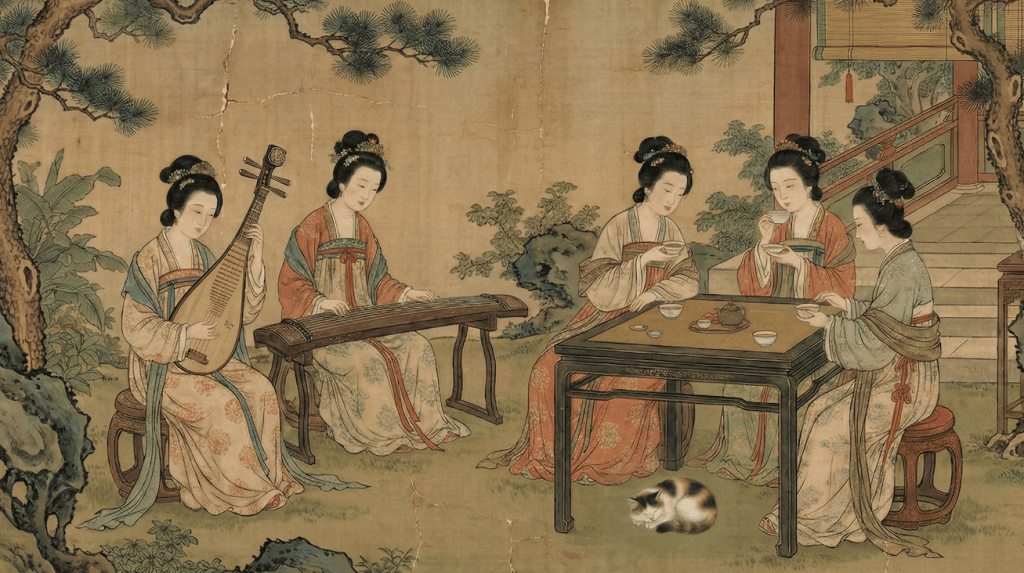
Whether you are new to the art of tea, or have long practiced this graceful tradition, it is worth taking a moment to learn about the Six Gentlemen (六君子).

Source: https://www.sohu.com/a/559039096_121273194
In the traditional Chinese tea ceremony, each mindful brew depend on this set of six implements:
1. Tea Scoop 茶则 (chá zé)

Source: https://www.sohu.com/a/362156449_99926623
The tea scoop, 茶则, one of the earliest named implements in Han Chinese tea ware, already held a defined place by the Tang dynasty. In Lu Yu’s The Classic of Tea (茶经·四之器) written circa 760–780 CE, he recorded: “则,以海贝、蛎蛤之属,或以铜、铁、竹、匕、策之类。”
“The scoop (zé) may be made from seashells, clams, copper, iron, bamboo, or similar materials.”
The purpose of the tea scoop is simple yet refined: it lifts tea leaves from the container and pours them neatly into the teapot. The tea scoop embodies the Confucian sense of quiet discipline and order that guide each movement in the art of tea.
2. Tea Spoon (茶匙, chá chí))
The tea spoon 茶匙, also known as 茶扒 (chá pá), is shaped like a small soup spoon with a flat end. It is used to push dry tea leaves from the tea holder or tea scoop into the teapot with precision and grace. In daily use, it can also remove spent leaves after brewing. Practitioners traditionally keep separate spoons for dry and wet use to maintain cleanliness and respect for the tea.
3. Tea Funnel (茶漏, chá lòu)
The tea funnel 茶漏 is placed on top of the teapot to guide tea leaves neatly into the narrow opening, preventing spills and waste. It should not be confused with the modern tea strainer, which is used to filter out the tea leaves when pouring tea. The tea funnel assists in precision and grace during preparation and reminds us that the refinement of tea begins with care in every detail.
4. Tea Tong (茶夹, chá jiā)
also known as tea chopsticks (茶筷), the tea tongs 茶夹 are used to handle teacups during washing and serving, avoiding direct hand contact and maintaining both cleanliness and decorum. One may also use tea tongs to remove tea leaves or residue from the teapot.
Tea Tong embodies the Confucian virtue of respect, reminding the practitioner that every movement in tea should be guided by mindfulness and courtesy.
5. Tea Needle (茶针, chá zhēn)
The tea needle 茶针, also known as 茶通 (chá tōng), is a slender tool used to clear the teapot’s inner mesh or spout when tea leaves obstruct the flow of water. It may also be used to gently adjust the position of leaves inside the pot, allowing whole leaves to remain on top and broken ones to settle below for a balanced infusion. In modern practice, the tea needle can also be used to pry apart compressed teas, such as Pu’er (普洱茶) cakes or bricks, without crushing the leaves.
6. Tea Vase (茶筒, chá tǒng)
The tea vase 茶筒, also known as 茶道瓶, serves as the container that holds and organizes the other five implements discussed above. Traditionally made of bamboo or wood, and in later times of ceramic, metal, or lacquered materials, the tea tube keeps the tools upright, clean, and ready for use. Though often forgotten, the tea vase represents the principle of harmony through structure, again bring home the sense of discipline, care and graceful organization.
Though modest in form, each of the Six Gentlemen (六君子) reflects the harmony, respect, and mindfulness that define the art of Chinese tea. They remind us that even the smallest tools can embody great beauty and meaning when used with intention.
Thank you for reading and please do share your own tool box that brings you joy!
©2025 Studentoftea.com | All Rights Reserved

Leave a Reply