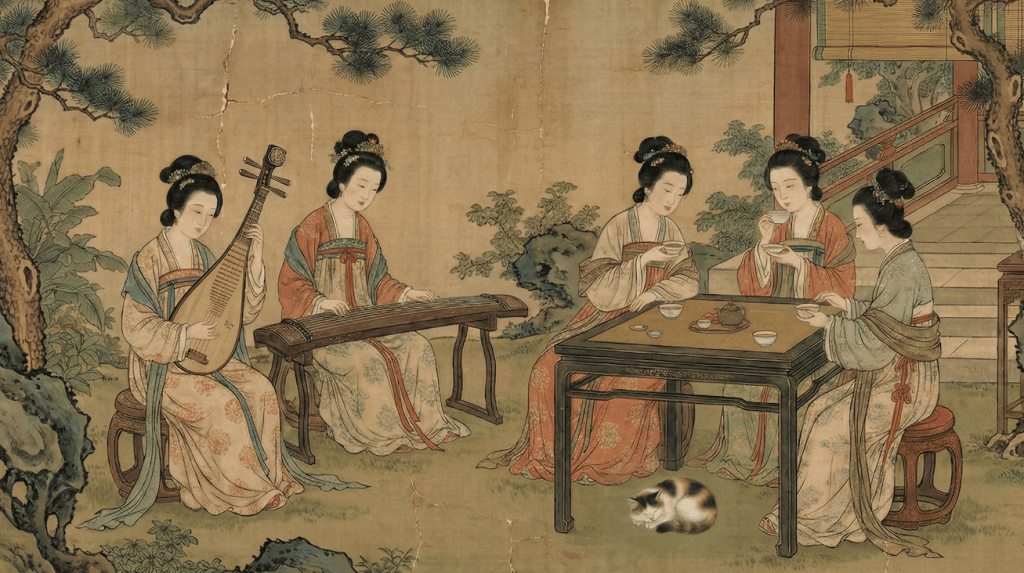
Before moving further into the art of tea, it is worth returning to where written tea culture began. The Classic of Tea (茶经) was written by Lu Yu (陆羽) during the Tang dynasty (618 to 907 AD). It is the first known monograph on tea and tea culture in the world.
In ten chapters, Lu Yu described everything from the origin of the tea plant and the soils where it grows, to the tools, water, brewing methods, and even the moral character of those who drink it. He transformed tea from an everyday drink into a subject of ritual, philosophy, craftsmanship, and self-cultivation, setting the foundation for all later traditions.
The work that follows is my humble attempt to translate The Classic of Tea into English. For each section, I include the original classical text (based on Song edition) in bold, followed by the modern Mandarin interpretation in italics, based on the edition annotated by Liu Yanchun 刘艳春. My English translation appears last, following each section of text, paragraph by paragraph. I also try to do my best to include primary and secondary sources as embedded links to clarify obscure characters, historic figures, phrases, and geographic regions.
I will update this link as I finish each chapter.
May this work bring you some enjoyment, or perhaps inspire your own way of reading, tasting, and practicing tea.
Table of content
- Chapter 1 : The Origin (一之源)
- Chapter 2: The Tools (二之具)
- Chapter 3: The Making (三之造)
- Chapter 4: Utensils (四之器)
- Chapter 5: The Boiling (五之煮)
- Chapter 6: The Drinking (六之飲)
- Chapter 7: The History (七之事)
- Chapter 8: The Growing Regions (八之出)
- 山南 Shannan “South of Qinling Mountains”
- 淮南 Huainan “South of Huai River”
- 浙西 Zhexi “West of Zhe River (Qiantang River)”
- 剑南 Jiannan “South of Jianmen Mt”
- 浙东 Zhedong “East of Zhe River (Qiantang River)”
- 黔中 Qianzhong “Middle of Qian”
- 江南 Jiangnan “South of Yangzi River”
- 岭南 Lingnan “South of Nanling Mountains”
- Others
- Chapter 9: The Simplification (九之略)
- Chapter 10: The Pictorialize (十之圖)
Chapter 1 : The Origin (一之源)

茶者,南方之嘉木也。一尺、二尺乃至数十尺;其巴山峡川有两人合抱者,伐而掇之。其树如瓜芦,叶如栀子,花如白蔷薇,实如栟榈,蒂如丁香,根如胡桃。(瓜芦木,出广州,似茶,至苦涩。栟榈,蒲葵之属,其子似茶。胡桃与茶,根皆下孕,兆至瓦砾,苗木上抽。)
茶是(中国)南方出产的一种优良木本植物。树高有一尺、两尺甚至几十尺的。在巴山峡川一带,有主干粗到两人才能合抱的茶树,砍掉枝条,才能采到茶叶。茶树的外形似瓜芦木,叶子似栀子,花似白蔷薇,种子似棕榈,蒂似丁香,根似胡桃树。(瓜芦木,出产在广州一带,叶似茶,泡茶喝味道苦涩。棕榈是蒲葵类植物,种子像茶籽。胡桃树和茶树一样,都是根向土壤深处生长,碰到非常硬的土中瓦砾,才撑裂地面向上生长。)
Tea is a fine plant native to the South (China). It grows one or two chi tall, and some times reaching several tens of chi tall (1 chi ≈ 30 cm). In the Dabashan Mt. and Three Gorges area, there are tea trees with trunks so thick that two grown men are needed to encircle them, and so tall that their branches must be cut down to reach the leaves. The tea tree’s form resembles that of the gualu tree; its leaves like gardenia, its flowers like white roses, its fruit like palm, its calyx like the clove, and its roots like the walnut trees.
Annotation: Gualu trees are from Guangzhou; the leaves look like tea, but tastes extremely bitter. The palm plant belongs to the Arecaceae family, and its seed resembles tea seed. The walnut and the tea grow alike. They both send roots deep into the earth, and when those roots strike the gravel below, new shoots rise and break through the soil above.
其字,或从草,或从木,或草木并。(从草,当作“茶”,其字出《开元文字音义》;从木,当作“[木茶]”,其字出《本草》。草木并,作“荼”,其字出《尔雅》。)
从字形和部首来说,茶字有归属草部的,有归属木部的,也有同属于草、木两个部首的。(写成“茶”字的,属于草部,唐代《开元文字音义》中收录了此字;写成“[木茶]”的,属于木部,收录在唐代《本草》一书中;同属于草和木部的,是“荼”字,《尔雅》予以收录。)
In its written form, the character for tea may appear with the grass radical (艹), the wood radical (木) or both.
Annotation: When classified under the grass radical, it writes as 茶, recorded in the Tang text Phonetic and Semantic Glosses of the Characters of the Kaiyuan Era (713 – 741 AD). Under wood radical, it writes as [木茶](a single character that is no longer used), first noted in the Great Pharmacopoeia. When carrying both radicals, it writes as 荼, as documented in the ancient dictionary Erya.
其名,一曰茶,二曰槚,三曰蔎,四曰茗,五曰荈。(周公云:“槚,苦荼。” 扬执戟云:“蜀西南人谓荼曰蔎。” 郭弘农云:“早取为荼,晚取为茗,或曰荈耳。”)
茶的名称很多,一为茶,二为槚,三为蔎,四为茗,五为荈。(周公曾说:“槚,指的是苦荼。”西汉的扬雄说:“四川西南部的人们把茶叫作‘蔎’。”东晋的郭璞说:“早采摘的叫茶,晚采摘的叫茗,有的也叫荈。”)
Tea has five names: chá, jiǎ, shè, míng, chuǎn.
Annotation: The Duke of Zhou 1042–1035 BC once said jiǎ refers to bitter tea. Yang Xiong 53 BC – 18 AD observed that in southwest Sichuan, people call tea shè. Guo Pu 267 AD remarked when leaves are picked early, they are called chá; when picked late, míng, or chuǎn.
其地,上者生烂石,中者生栎壤,下者生黄土。凡艺而不实,植而罕茂。法如种瓜。三岁可采。野者上,园者次。阳崖阴林:紫者上,绿者次;笋者上,芽者次;叶卷上,叶舒次。阴山坡谷者,不堪采掇,性凝滞,结瘕疾。
茶树赖以生存的土壤环境,如果是山间碎石堆积的土壤,就会出产上等好茶;如果是砂壤土质,就会出产中等茶;而黄土中只能产下等茶。种茶的时候,凡是种植技术不扎实的,种出来的茶树极少会有生长茂盛的。应该采用种瓜的方法来种茶。通常种植三年即可采摘茶叶。一般来说,野生茶叶的质量最好,园圃里种植的差一些。生长在向阳山坡上有林木遮蔽的茶树:紫色的茶叶品质好,绿色的差一些;芽叶肥硕像竹笋形状的质量好,而新芽展开像牙板形状的差一些;芽叶的周边会反卷的质量好,边缘平展的差一些。生长在背阴山坡或谷地上的茶树,不宜采摘,这样的茶叶性质凝滞,饮用会导致腹胀。
The finest tea grows in soils of weathered rocks. Tea of the middling quality comes from sandy earth, and the poorest from heavy yellow clay. Cultivating tea requires both skill and care, much like planting melons. After three years, the leaves may be harvested. Wild tea is superior to cultivated tea and tea trees thrive on south-facing slopes with gentle shade. Leaves tinged with purple are finer than those of plain green. Shoots plump as bamboo tips are preferred to the shorter, thin buds. Leaves that curl inward are more prized than those that spread wide. Tea from shaded gullies or north-facing slopes should not be gathered at all. Those leaves are stagnant in nature (a concept in Traditional Chinese medicine), and tend to leave the drinkers bloated and uneasy.
茶之为用,味至寒,为饮最宜精行俭德之人,若热渴、凝闷、脑疼、目涩、四支烦、百节不舒,聊四五啜,与醍醐、甘露抗衡也。
茶性寒凉,作为饮品,最适合那些为人精诚、节操高尚而有俭朴美德的人。如果有人燥热口渴,或者胸闷、头疼、眼睛干涩,或者关节不舒展,稍稍喝上四五口茶水,那效果就如饮用醍醐、甘露一般。
Tea is cool in nature (a concept in Traditional Chinese medicine). As a drink, it best suits those of who live simply and with integrity. When one suffers from overheat and thirst, headaches, dry eyes, restless limbs, or stiff joints, just take four, five sips of tea. It rejuvenates the spirit like Sarpir-manda (purified ghee) or sweet dew does.
采不时,造不精,杂以卉莽,饮之成疾。茶为累也,亦犹人参。上者生上党,中者生百济、新罗,下者生高丽。有生泽州、易州、幽州、檀州者,为药无效,况非此者,设服荠苨,使六疾不瘳。知人参为累,则茶累尽矣。
假如采摘茶叶不按时节,制作茶叶的工艺不够精细,茶里充斥着杂草枯叶,这样的茶喝完后会让人生病。茶可能对人体造成的伤害,和人参是一样的。最好的人参产自上党,中等的产自百济、新罗,最次的产自高丽。而产自泽州、易洲、幽州、檀州等地的人参,根本没有任何药用效果,更何况那些还不如它们的人参。如果误把和人参类似的荠苨吃下去,就会延误病情。知道劣质人参或假人参对身体的危害,也就明白了劣茶对人的危害。
If tea is plucked out of season, processed without care, or mixed with weeds or withered leaves, drinking it could breed illness. Tea, when misused, burdens the body much as ginseng does. The finest ginseng comes from Shangdang (in modern-day Shanxi Province); the next best roots come from Baekje and Silla; followed by those grow in Goguryeo. Roots grow in Zezhou (Jincheng, Shanxi), Yizhou (around Yi county, Hubei), Youzhou (around Beijing), or Tanzhou (in Miyun District, Beijing) have no healing power at all. Let alone those of still poorer quality. The plant qini (Adenophora trachelioides) has roots that look like ginseng. But taking qini roots instead would delay the treatment of various illnesses.
Chapter 2: The Tools (二之具)

籝,一曰篮,一曰笼,一曰筥。以竹织之,受五升,或一斗、二斗、三斗者,茶人负以采茶也。(籝,音盈。《汉书》所谓:“黄金满籝,不如一经。”颜师古云:“籝,竹器也,容四升耳。”)
籝,也叫篮,又称为笼或莒,是一种竹编容器,容积大小分为五升、一斗、两斗、三斗。它是采茶人背着采茶叶用的。(籝,读“盈”音,在《汉书》中有“黄金满籝,不如一经”之说。颜师古曾说:“籝,是一种竹器,容量四升。”)
Tea pickers carry on their back a basket called yíng to hold fresh plucked leaves. The yíng, also known as lán, lóng, or jǔ, is a woven bamboo container. Its size varies. Some ying hold five sheng (≈ 3 L), others others one, two, or three dou (1 dou ≈ 6 L).
Annotation: The word yíng (basket) appears in the Book of Han: “A ying filled with books is worth more than a ying filled with gold.” Tang scholar Yan Shigu has also explained that “Ying is a bamboo vessel with a capacity of about four sheng (≈ 2.4 L).”
Comment: To keep freshly picked tea leaves tender, the container used during harvesting should be well-ventilated and resistant to crushing. Until this day, people use woven baskets from bamboo or rattan with open meshes to let air pass through.

灶,无用突者。釜,用唇口者。
制茶之灶,不要带有烟囱,这样能使火力集中于锅底。釜,要用锅口外翻且有唇边的。
The stove ,zào, for tea brewing should have no chimney, that would dissipate heat away from the cauldron. The cauldron, fǔ, should have a flared lip to rest snugly upon stove’s rim, retaining heat.

甑,或木或瓦,匪腰而泥,篮以箪之,篾以系之。始其蒸也,入乎箪;既其熟也,出乎箪。釜涸,注于甑中。(甑,不带而泥之。)又以榖木枝三亚者制之,散所蒸芽笋并叶,畏流其膏。
甑,用木头或陶土制成,用作蒸茶叶的甑腰部不能突出,并用泥巴封固好。甑内放置竹制隔水箪子,用竹篾系在箪子上,以便取放竹箪。蒸的时候,把茶叶放在竹箪上面,蒸好后就从竹箪上倒出来。锅中的水将耗尽时,可以向甑中加水。(甑,腰部不需用捆绑,而是用泥巴封起来。)还需用三杈的榖木做成木杈,用以挑散蒸好的嫩茶叶,以免茶中精华膏汁流失。
The steam pot, zèng, is made of wood or earthenware. Its waist should not protrude beyond the cauldron (fu), and the gap should be sealed tightly with clay to trap steam. Tea leaves are placed inside a bamboo steamer basket, called dān, which can be lift in and out of the steam pot with the bamboo strips tied to its sides. When the cauldron dries up, add water through the steam pot.
Annotation: Since the steam pot is sealed with clay on the cauldron, it doesn’t need to be tied down.
After steaming, the tender tea buds should be gently loosened with a three-pronged fork made from branches of the paper mulberry to preserve their essence.
Comment: The final action of loosening steamed tea leaves releases the heat trapped within, preventing residual heat from continuing to cook the leaves. The “essence” Lu Yu refers to is in modern terms, the aromatic compounds, amino acid and other soluble substances would otherwise be degraded or squeezed out if the leaves remain bundle and overheated. I discussed the chemistry of steaming (enzyme deactivation) 杀青 in my assay on the evolution of the six major tea types.

Image source https://zhuanlan.zhihu.com/p/661590311

Image source http://www.360doc.com/content/25/0526/11/7839659_1154114659.shtml
杵臼,一曰碓,惟恒用者佳。
杵臼,又叫碓,用于捣茶的杵臼是最好的。
The pestle and mortar, called chǔ and jiù respectively, also known as the pounding mill (duì), are best for crushing steamed tea leaves.
规,一曰模,一曰棬。以铁制之,或圆,或方,或花。承,一曰台,一曰砧。以石为之,不然以槐、桑木半埋地中,遣无所摇动。檐,一曰衣。以油绢或雨衫、单服败者为之,以檐置承上,又以规置檐上,以造茶也。茶成,举而易之。
规,又称模,或称棬。用铁制成,有圆形、方形,还有花一样的形状。承,又称台,或称砧。用石头制成,假如用槐树、桑树来做,就要把树木半埋于土中,使其不能摇动。檐,又称衣,用油绢、坏了的雨衣或单衣做成。将“檐”放在“承”上,“模”放在“檐”上,就可用来制造饼茶。茶饼压成后,拿起来,再换一个继续做。
To press tea cakes, first lay a piece of cloth on the table, set the mold on top, and press the tea leaves within it. The mold used here is called guī, also known as mó or quān. It is made of iron and comes in many forms: round, square, or shaped like a flower. The table chéng, also known as tái or zhēn, is made of stone, or sometimes of locust or mulberry wood. When made of wood, half of the block should be buried in the ground to keep it steady during use. The table cloth yán, also called yī, can be made from silk, rain cloak, or any worn single-layer garment. When one cake is finished, simply lift the mold and move on to the next.

Setting on the left side is 芘莉 pili, bamboo rack, displaying pressed tea cakes on top.
Image source: https://zhuanlan.zhihu.com/p/661590311
芘莉,一曰嬴子,一曰篣筤。以二小竹,长三尺,躯二尺五寸,柄五寸;以篾织方眼,如圃人土罗,阔二尺,以列茶也。
芘莉,又称籝或篣筤。用三尺长的两根小竹竿,制成全长两尺五寸,手柄长五寸,宽两尺的工具。用竹篾织成,方眼,类似于菜农常用的土筛,宽二尺,用来放置茶饼。
Pressed tea cakes are laid out on a bamboo rack called pílì, also known as yíngzǐ or péngláng. Its frame made with two slender bamboo rods, each about three chi in length (≈ 90 cm). The body measures two chi and five cun long (75 cm), with handles of five cun (≈ 15 cm). The woven surface is made of thin bamboo strips interlaced in a square pattern, much like a farmer’s soil sifter.

棨,一曰锥刀,柄以坚木为之,用穿茶也。
棨,又称锥刀,柄是由坚实的木料做成,给饼茶穿洞用。
Pressed tea cakes are first pierced with a qǐ, a pointed knife with a handle made of hard wood, making stringing them easier (described below).

On the right: 焙 bei, rectangular drying pit. 棚 peng, wooden rack (above the pit). 贯, guan, drying skewers (sitting on the rack).
Image source: https://zhuanlan.zhihu.com/p/661590311
扑,一曰鞭。以竹为之,穿茶以解茶也。焙,凿地深二尺,阔二尺五寸,长一丈,上作短墙,高二尺,泥之。贯,削竹为之,长二尺五寸,以贯茶焙之。 棚,一曰栈,以木构于焙上,编木两层,高一尺,以焙茶也。茶之半干,升下棚;全干,升上棚。
扑,又称鞭,竹子编成,用来穿茶饼,成串的茶饼方便输送。焙,地上挖深两尺,宽两尺五寸,长一丈的坑。上砌一堵两尺高的矮墙,用泥抹平整。贯,竹子削制而成,长二尺五寸,烘培时用来贯穿茶饼。棚,又称栈,木制而成的架子,放在焙上,分上下两层,相距一尺高,烘焙茶饼用。茶半干时,升到棚的下层;全干后,升到棚的上层。
Once pierced, the tea cakes are threaded onto a cord of woven bamboo strips, called pū, or biān. This string of tea cakes is easier to move around. To dry the tea cakes, a drying pit, bèi, is dug into the ground, two chi and five cun wide, one zhang long and two chi deep (roughly 75 cm by 2.67 m by 60 cm). The pit is lined with a short wall (≈ 60 cm), its surface plastered smooth with clay to retain heat. During drying, the tea cakes are threaded onto skewers called guàn, carved from bamboo about two chi and five cun long (≈ 75 cm) long.
Above the pit sits a two-tiered wooden rack called péng, also known as zhàn. The tiers space one chi apart (≈ 30 cm). The skewered tea cakes first rest on the rim of the clay wall. Half way through drying, they are moved to the lower tier of the rack. Once fully dried, the tea cakes will be transferred to the upper tier.
Comment: While both used to thread through the holes in tea cakes, the difference between pū (used for transport) and guàn (used for drying over the fire pit) lies in their structure: pū is a flexible cord of woven bamboo, while guàn is a rigid skewer set above the pit.
穿,江东、淮南剖竹为之。巴川峡山,纫榖皮为之。江东以一斤为上穿,半斤为中穿,四两、五两为小穿。峡中以一百二十斤为上穿,八十斤为中穿,五十斤为小穿。穿字旧作钗钏之“钏”字,或作贯串,今则不然。如磨、扇、弹、钻、缝五字,文以平声书之,义以去声呼之,其字以穿名之。
穿,江东、淮南用竹篾做成。巴川峡山用韧性好的榖树皮做。江东把贯穿好、一斤重的茶饼叫作“上穿”,半斤叫“中穿”,四两、五两(十六两制)叫“小穿”。峡中将一百二十斤贯穿好的茶饼称为“上穿”,八十斤为“中穿”,五十斤为“小穿”。“穿”古代作钗钏的“钏”,或作贯串。而现在“穿”和磨、扇、弹、钻、缝五字一样,文章中写的是平声,作动词,表示名词时,则要读去声,意思按去声来讲,但字形要写成“穿”。
Ultimately, tea cakes are transported on a different cord called chuān. In Jiangdong (south bank of the Yangtze River) and Huainan (south bank of the Huai River), this cord is made from split bamboo. In Dabashan Mt and Three Gorges area, tea makers use the bark of the paper mulberry for its flexibility.
Chuàn also serves as a counting unit for tea cakes. In Jiangdong, a string of tea cakes weighing one jin (≈ 600 g) is called a ‘top chuan’; a half-jin (≈300 grams) string is a ‘middle chuan’, and those of four or five liang (≈ 120-150 grams), a ‘small chuan’. The Three Gorges area saw much heavier bundles: a 120-jin (≈72 kg!) string is a ‘top chuan’, an 80-jin (string ‘middle chuan’ and a 50-jin string ‘small chuan’.)
The character chuan 穿 used to be written as 钏, the word for bracelet, or sometimes as guàn chuàn (to string together). As for pronunciation: like grind, fan, pluck, bore and sew, when chuan is used as a verb meaning to thread, it takes the first tone (chuān); when used as a noun meaning a string of, it reads in the fourth tone (chuàn).

育,以木制之,以竹编之,以纸糊之,中有隔,上有覆,下有床,旁有门,掩一扇,中置一器,贮煻煨火,令煴煴然,江南梅雨时,焚之以火。(育者,以其藏养为名。)
育,用木制框架,用竹篾编外围,再糊一层纸,中有间隔,上有盖,下有托盘,旁开一扇门,中间放一器皿,盛有火灰,使有火无焰。江南梅雨季节,加火除湿。(育,对茶有很好的保藏养益功能,故此得名。)
Finally, the tea cellar, Yù. Yu is made with a wooden frame, its sides woven from bamboo strips and then covered with paper. Inside the chest are partitions: a lid on top, a tray below, and a small door on the side. At the center sits a vessel filled with charcoal ash, giving off a steady, flameless warmth. During the rainy season in Jiangnan (the region south of the lower Yangtze River), a small fire may be kindled within the tea cellar to drive away moisture.
Annotation: Yù takes its name from its function: to nurture and preserve.

Comment: This is a fairly rare utility in modern tea preparation. Storage conditions in ancient times are fairly limited. People built such enclosures with gently heated chambers to keep goods dry, books and fabrics included. The Yu discussed here, however, is purpose-built specifically for tea.
Chapter 3: The Making (三之造)

凡采茶,在二月、三月、四月之间。茶之笋者,生烂石沃土,长四五寸,若薇蕨始抽,凌露采焉。茶之牙者,发于丛薄之上,有三枝、四枝、五枝者,选其中枝颖拔者采焉。其日有雨不采,晴有云不采,晴,采之。蒸之,捣之,拍之,焙之,穿之,封之,茶之干矣。
农历二、三、四月份,正是采摘茶叶的时节。肥大、健壮如春笋般的嫩芽,生长在肥沃的风化碎石土壤中,长四、五寸,当它们破土而出如薇、蕨嫩芽时,趁着清晨的露水开始采摘。草木夹杂的茶树枝上生长着次一等的芽叶,有的老枝上长出三到四枝,选择长势好、挺拔的采摘,下雨天不采,晴天有云也不采。晴天无云便可采茶,将采摘的芽叶倒入甑中蒸熟,熟后倒出用杵臼捣碎,然后再放到模型里用手压成一定的形状,后焙干,穿成串,密封好,茶叶就制好了。
Tea is harvested between the second and fourth lunar months (roughly March to May). The finest leaves are called sǔn (shoots), plump single-bud tips resembling bamboo shoots. They grow in fertile soils of weathered rock, reaching four or five cun (≈ 12–15 cm) in height. The tender buds are as delicate as the first leaves of bracken or fern, and should be plucked early in the morning while still moist with dew.
The next best leaves are called yá (buds). They are thin, small, and sprout from the bushier part of the tea plant, where three, four, or five new sprigs may grow from an old branch. Only the upright ones should be plucked. Tea should be gathered only on clear, sunny days, and never on rainy or even cloudy days. After picking, the leaves are steamed, pounded, pressed into cakes, dried, strung together, and wrapped up, and thus the tea is made.
Comment: In Chapter 1, Lu Yu described how the bamboo shoots are prized higher than the buds (笋者上,芽者次). In modern tea tasting, these roughly correspond to the single bud shoots and the bud-with-leaf shoots.

Image source: https://zhuanlan.zhihu.com/p/39305473
茶有千万状,卤莽而言,如胡人靴者,蹙缩然(京锥文也);犎牛臆者,廉襜然;浮云出山者,轮囷然;轻飙拂水者,涵澹然;有如陶家之子罗,膏土以水澄泚之(谓澄泥也);又如新治地者,遇暴雨流潦之所经,此皆茶之精腴。有如竹箨者,枝干坚实,艰于蒸捣,故其形籭簁然(上离下师)。有如霜荷者,茎叶凋沮,易其状貌,故厥状委悴然。此皆茶之瘠老者也。
茶饼有千姿百态的形状,粗略地说,有的像褶皱很多的胡人靴子(箭矢刻着的纹理);有的像只有细微褶痕的野牛胸部;有的像浮云盘曲聚拢出山的样子;有的像微风掠过河面激起一道道的涟漪;有的像陶匠筛出细土,再用水淘洗、沉淀出的泥膏那么细腻光滑(陶匠淘洗的泥土称为澄泥);还有的像刚修整过的土地,突遇暴雨急流,被冲刷得凹凸不平。这些都是茶中的精品,属上等茶。有的茶叶像笋壳,枝梗坚硬,不易蒸捣,所以制成的茶饼形状如坑坑洼洼的箩筛;有的像经霜的荷叶,茎叶稀疏,而且改变了原来的相貌,所以制成的茶干枯萎缩,这些茶被称为坏茶、老茶。
Tea cakes come in countless forms. Roughly speaking, some resemble the wrinkled boots of northern tribesmen. (Annotation: Marked with carved arrow-line patterns.) Some look like the smooth, firm chest of a wild ox, with undulating folds. Others resemble clouds rolling out from the mountains, or ripples stirred by a light breeze brushing over water. Some are as fine and smooth as the purified clay, washed and settled in water (Annotation: this clay is called chengni.) Some resemble freshly leveled earth after a heavy rain, ridged and furrowed where torrents have passed. These are all hallmarks of fine teas.
At times, the tea leaves have tough stems like bamboo sheaths, that makes it hard to steam and pound. The finished cakes therefore appear coarse and uneven, like the mesh of a wicker sieve. (Phonetic annotation lí and shī for the word ‘sieve’.) Others are like lotus leaves after frost, withered and drooping, their appearance altered and lifeless. This is poor, old tea.

自采至于封,七经目。自胡靴至于霜荷,八等。或以光黑平正言嘉者,斯鉴之下也;以皱黄坳垤言佳者,鉴之次也。若皆言嘉及皆言不嘉者,鉴之上也。何者?出膏者光,含膏者皱;宿制者则黑,日成者则黄;蒸压则平正,纵之则坳垤。此茶与草木叶一也。茶之否臧,存于口诀。
从茶的采摘到封装制好,共需七道工序。从胡人靴子般的皱缩状到经霜荷叶般的衰萎状,分八个等级。下等的鉴别方法是把光亮、黑色、平整作为好茶的标志;次等的鉴别方法是把皱缩、黄色、凸凹不平作为好茶的特征;最好的鉴别方法是既能指出茶的妙处,又能道出不好之处。为什么这么说呢?因为压出了茶汁的表面就光润,含着茶汁的则皱缩;隔夜制成的色黑,当天制成的色黄;平整是因蒸后压得紧,凸凹是任其自然,压得不紧。这是茶和草木叶子的共同特点。关于茶好坏的鉴定,还有一套口口相传的秘诀。
The making of tea takes seven steps from harvest to packing. From the finest tea resembling wrinkled boots to the poorest tea suffered from frost, tea is divided into eight grades. The poorest appraisers think bright, black, and smooth tea cakes are the best. A middling approach is to look for wrinkled, yellow and uneven cakes. But the true connoisseur can recognize both the beauty and the flaws in a tea. Why do I say that? A glossy surface shows that the tea’s juices have been pressed out, while a wrinkled tea cake still holds its essence within. Freshly processed tea is yellow in color. When left out overnight, it turns black. A flat tea cakes comes from heavy steaming and pressing, while one left to settle naturally takes on an uneven surface. In a way, tea is just like any other leaves. The true art of tea appraisal lies in a secret lore passed down by word of mouth.
Comment: Described in the paragraph above, tea was classified into eight types: the wrinkled boots, the ox chest, the floating cloud, the wind over water, the purified clay, the rain washed earth, the bamboo sheath, and then the frosted lotus. The wrinkled boots and the ox chest are the best and the bamboo sheath and frosted locus are the worst.
Chapter 4: Utensils (四之器)

Image source: http://www.360doc.com/content/23/0413/21/472255_1076396560.shtml

Row 1: 风炉 (灰承) wind stove (ash tray). 筥 basket. 炭[木过] charcoal poker. 鍑 kettle. 交床 cross-stand.
Row 2: 夹 jia, fire tong. 纸囊 paper pouch. 碾(拂末) grinder (feather tea brush),罗合/则 lidded sifting box/measuring spoon,水方 water chest,漉水囊 water filter bag.
Row 3: 瓢 laddle. 竹夹 bamboo tongs. 鹾簋 salt vessel. 熟盂 boiled-water bowl. 碗 bowl. 畚 basket for bowls.
Row 4: 札 brush. 涤方 rinse chest. 滓方 waste chest. 巾 tea cloth. 具列 display stand. 都篮 basket for everything.
Image source: https://zhuanlan.zhihu.com/p/441192436
风炉(灰承): 风炉以铜铁铸之,如古鼎形,厚三分,缘阔九分,令六分虚中,致其杇墁。凡三足,古文书二十一字,一足云“坎上巽下离于中”,一足云“体均五行去百疾”,一足云“圣唐灭胡明年铸”。其三足之间设三窗,底一窗,以为通飙漏烬之所,上并古文书六字:一窗之上书“伊公”二字,一窗之上书“羹陆”二字,一窗之上书“氏茶”二字,所谓“伊公羹,陆氏茶”也。置 臬于其内,设三格:其一格有翟焉,翟者,火禽也,画一卦曰离;其一格有彪焉,彪者,风兽也,画一卦曰巽;其一格有鱼焉,鱼者,水虫也,画一卦曰坎。巽主风,离主火,坎主水。风能兴火,火能熟水,故备其三卦焉。其饰,以连葩、垂蔓、曲水、方文之类。其炉,或锻铁为之,或运泥为之,其灰承,作三足铁柈台之。
风炉,用铜或铁铸成,形似古代的鼎,壁厚三分,炉口上的边缘九分宽,炉内多出六分,其下虚空,抹以泥土。炉的下方有三只脚,铸上籀文,共二十一个字。一只脚上写“坎上巽下离于中”,一只脚上写“体均五行去百疾”,一只脚上写“圣唐灭胡明年铸”。在三只脚间开三个窗口。炉底下一个洞用来通风漏灰。三个窗口上书六个字的籀文,一个窗口上写“伊公”二字,一个窗口上写“羹陆”二字,一个窗口上写“氏茶”二字,意思是“伊公羹,陆氏茶”。炉上设置支撑锅子用的垛,其间分三格。一格上有只野鸡图形。野鸡是火禽,画一离卦。一格上有只彪的图形,彪是风兽,画一巽卦。一格上有条鱼的图形,鱼是水虫,画一坎卦。“巽”表示风,“离”表示火,“坎”表示水。风能使火烧旺,火能把水煮开,所以要有这三卦。炉身用花卉、流水、方形花纹等图案来装饰。风炉也有用熟铁打的,也有用泥巴做的。灰承(接收炉灰的器具),是一个有三只脚的铁盘,托住炉子。
The wind stove (and ash tray): Cast from copper or iron, the wind stove is shaped like an ancient ding (See Row 1 in Figure of 24 Utensils). The walls of the stove are three fen (≈ 0.9 cm) thick. The stove mouth has a thick lip of nine fen (≈ 2.7 cm), with six fen of that hangs inward over the cavity, that’s lined with clay. The stove stands on three legs, each inscribed with ancient scriptures of twenty-one characters. One leg reads “Kan above, Xun below, Li at the center” (from I Ching 易经, says water above, wind below, fire in the middle). Another “Balanced in the five elements, it dispels all ailments”. The third “Cast in the year after the Tang pacified the foreign rebels” (Referring to the Lushan rebellion that ended in 763 AD).
Between the three legs are three openings, with another hole at the bottom to let air in and ashes fall through. Above the three windows are another set scripts of six characters in total: “Yi Gong”, “Geng Lu” and. “Shi Cha”, together meaning “Yi Gong‘s soup, Lu Yu‘s tea”. Inside the stove, tea kettle sits on top of a grating, that is divided into three sections. One bears a pheasant bird, a bird of fire, represented by the bagua trigram Li ☲. One bears a fierce beast called biao, a beast of wind, thus marked with the trigram Xun ☴. The last section is a fish, a creature of water, thus marked with the trigram Kan ☵. Xun governs wind, Li governs fire and Kan governs water: wind stirs the fire, fire heats the water and thus all three must be present. The stove is adorned with designs of flowers, vines, flowing water, and geometric motifs. Some are forged of wrought iron, others molded from clay. The ash tray below is a three-legged iron tray that supports the stove.
Comment: Tea drinking is a spiritual enjoyment. The utensils must be meticulously made and they have to be both functional and aesthetically pleasing. One of the earliest depictions of the wind stove discussed above appears in this paining below by Yan Liben (600 – 673 AD, Shaanxi). The scene shows two attendants brewing the tea beside a three-legged stove.


Image source: http://www.360doc.com/content/23/0413/21/472255_1076396560.shtml
筥,以竹织之,高一尺二寸,径阔七寸。或用藤作木楦(古箱字),如筥形织之,六出圆眼,其底盖若利箧口,铄之。
筥,竹子编制而成,一尺两寸高,直径七寸。有的先做个筥形的木箱,再用藤编外围,而且还要编出六角形的圆眼。筥形木箱的底和盖要像箱子的口一样,削得光滑、平整。
Jǔ: ju is a woven bamboo basket (See Row 1 in Figure of 24 Utensils) that’s seven cun (≈ 21 cm) in diameter and one chi and two cun (≈ 36 cm) tall. Some baskets are made by first shaping a wooden mold in the form of a basket, then weaving bamboo stripes around it with hexagon weaves. The base and the lid are trimmed smooth and even like the mouth of a finely crafted chest.
炭[木过],以铁六棱制之,长一尺,锐上丰中,执细头系一小[钅展],以饰[木过]也。若今之河陇军人木吾也。或作锤,或作斧,随其便也。
炭[木过](生僻字如图),用六棱形的铁棒做成,长一尺,头部尖,中间粗,手握处细,在握的那头套一个形似灯盘的 作为装饰,就像现在河陇地带的军人常用的木棒。有的把铁棒做成锤形,有的则做成斧形,各随其便。
Tàn ? (obsolete character see original text above) refers to a charcoal poker made from a hexagonal iron rod about one chi long (≈ 30 cm). It tapers from a pointed top and a thicker middle to a slender handle, which is fitted with a small metal disk for ornament. It resembles the wooden clubs once carried by soldiers from the Helong region (in modern day Gansu and Shaanxi province). Some versions are shaped like a hammer or an axe, according to personal preference.
火䇲,一名筯,若常用者,圆直一尺三寸,顶平截,无葱台勾锁之属,以铁或熟铜制之。
火䇲,又称箸,就是平常使用的火钳,圆直形,长一尺三寸,顶端平且齐,并没有像葱台、勾锁那样烦琐的装饰,用铁、熟铜制作。
The fire tongs, huǒ cè, also known as zhù, are the common tongs. They are made of straight, round rods (like chopsticks) about one chi and three cun long (≈ 39 cm). The tips are flat and even. Unlike ornate tools decorated with knobs or hooks, these are plain in design, made simply of iron or wrought copper.

鍑(音辅,或作斧,或作鬴),以生铁为之,今人有业冶者,所谓急铁。其铁以耕刀之趄,炼而铸之,内摸土而外摸沙。土滑于内,易其摩涤;沙涩于外,吸其炎焰。方其耳,以正令也;广其缘,以务远也;长其脐,以守中也。脐长则沸中,沸中则末易扬,末易扬则其味淳也。洪州以瓷为之,莱州以石为之,瓷与石皆雅器也,性非坚实,难可持久。用银为之,至洁,但涉于侈丽。雅则雅矣,洁亦洁矣,若用之恒,而卒归于铁也。
鍑 (读斧,或鬴),用生铁做成。“生铁”就是现在冶铁人常说的“急铁”,铸茶锅用的铁是以用坏了的农具炼铸成的。铸造茶锅时,在锅的内侧抹泥,外侧抹沙。内侧抹泥,锅面光滑,容易磨洗;外侧抹沙,锅底粗糙,容易吸热。锅耳做成方的,让其端正。锅边要宽,好伸展开。锅脐要长,且在中心。脐长,水就在锅中心沸腾;在中心沸腾,水沫易于上升;水沫易于上升,水味就淳美。洪州用瓷做锅,莱州用石做锅,瓷锅和石锅都是雅致好看的器皿,但不坚固,不耐用。用银做锅,非常清洁,但不免过于奢侈,雅致固然雅致,清洁确实清洁,但从耐久实用说,还是铁好。
The kettle (Phonetic annotation as fǔ) is made of raw cast iron, known today among ironworkers as quick iron. The iron used comes from melted and recast farming tools. The metal is smelted from worn-out farming tools and recast. In casting the pot, clay is applied to the inside and sand to the outside: the clay gives the interior a smooth surface that’s easy to clean, while the sand leaves the exterior rough, helping it absorb heat. The handles are made square, for steadiness and proper balance. The rim is made broad, to allow for spreading. The belly, or “navel,” is made deep and centered, so that the water boils from the middle. This is key to pure and mellow water as when boiling begins at the center, the froth rises more easily. In Hongzhou (around modern day Nanchang, Jiangxi Province), kettles are made of porcelain; in Laizhou (Shandong Province), stones. Both materials produce elegant vessels, yet they lack strength and do not endure. Silver pots are perfectly clean, but overly luxurious. While they are refined and pure, iron remains the most practical and lasting choice.

Image source: National Museum of China

Image source: https://www.10vows.com/detail/0yaCjjsTXSP
交床,以十字交之,剜中令虚,以支鍑也。
交床,将十字交叉的木架,中间挖空,用来放置煮茶用的锅。
The cross stand (jiāochuáng) consists of two crossed wooden beams supporting a flat board with a circular opening in the center, made to hold the kettle securely above the fire. (See the last item in Row 1 in Figure of 24 Utensils.)

Image source: http://www.360doc.com/content/23/0413/21/472255_1076396560.shtml
夹,以小青竹为之,长一尺二寸。令一寸有节,节已上剖之,以炙茶也。彼竹之筱,津润于火,假其香洁以益茶味,恐非林谷间莫之致。或用精铁、熟铜之类,取其久也。
夹,小青竹制成的器具,长一尺两寸。选一头有一寸长的竹节,把节以上部位剖成两半,然后夹着茶饼放在火上烤炙。这样小青竹洁净的竹液和香气就会从竹子表面溢出,从而增加茶的香气。如果不在山林间炙茶,恐怕很难弄到这种青竹。有的则用经久耐用的上好铁或熟铜来炙茶。
Tea tongs (different from the fire tongs) are made from young bamboo, about one chi and two cun long (≈ 36 cm). (See Row 2 in Figure of 24 Utensils.) Simply find a segment of bamboo with a node, cut one cun above the node (≈ 3 cm), and split below the node. This tong can then be used to roast tea cakes over fire. When heated, fresh bamboo releases a clean, subtle fragrance that enhances the aroma of the tea. Such bamboo can only be found in forested valleys. Some instead use finely wrought iron or copper, which last longer.
纸囊,以剡藤纸白厚者夹缝之,以贮所炙茶,使不泄其香也。
纸囊,用两层白且厚的剡藤纸做成,用来贮放烤好的茶,使香气不散失。
The paper pouch is made from two layers of thick, white Shan-teng paper, sealed along the edges to store the roasted tea and preserve its fragrance.
Note: Shan-teng paper is a traditional handmade paper with techniques originated in Three Kingdoms period 220 – 280 AD. It was produced form wild rattan vines native to Shan Creek valley (in modern day Zhejiang province. The paper is prized for its thin yet durable texture, its soft whiteness, and its smooth, supple feel. As bamboo paper rose to prominence and rattan resources dwindled, the craft was lost by the Ming dynasty. Modern artisans revived the technique in 2016, and the paper is now used in calligraphy, painting, cultural preservation, and restoration of ancient books.
碾(拂末):碾,以橘木为之,次以梨、桑、桐、柘为之,内圆而外方。内圆备于运行也,外方制其倾危也。内容堕而外无余木,堕,形如车轮,不辐而轴焉,长九寸,阔一寸七分,堕径三寸八分,中厚一寸,边厚半寸,轴中方而执圆。其拂末以鸟羽制之。
碾槽(拂末)碾槽,橘木做的最好,其次是梨木、桑木、桐木、柘木。碾槽内圆外方。内圆易运转,外方不易翻倒。槽内正好能放一个碾磙,再无空隙,堕,是木制碾磙,形似车轮,只是没有车辐,中心安一根轴。轴长九寸,宽一寸七分,直径三寸八分,当中厚一寸,边缘厚半寸。轴中间是方的,手握的地方是圆的。拂末,是用鸟的羽毛做成的。
Grinder and feather brush: The grinder, called niǎn, is best made from mandarin trees, though pear, mulberry, empress tree, or Mandarin melon berry wood may also be used. Its trough is round on the inside and square on the outside: the round interior allows smooth movement, while the square exterior prevents tipping. Inside fits a wooden roller called duo, shaped like a spokeless wheel mounted on an axle. The axe is nine cun long (≈ 27 cm), one cun seven fen wide (≈ 5 cm). It is square in the middle for stability but round at the ends. The roller, duo, is three cun eight fen (≈ 11 cm) in diameter. In the middle, the roller is one cun thick (≈ 3 cm), and at the edge, only half a cun (≈ 1.5 cm). A powder sweep, fú mò, is a brush made from bird feather. It is used to sweep up the powdered tea after grinding.
Comment: During the Tang dynasty, fu mo was made from bird feathers. This practice later spread to Jpan along with Chinese tea culture, and is still preserved today in Japanese tea ceremony. After the Song dynasty, palm fiber brushes gradually replaced feathers in China.

https://collection.sina.com.cn/jczs/20140708/0828156669.shtml
罗合:罗末以合盖贮之,以则置合中,用巨竹剖而屈之,以纱绢衣之。其合以竹节为之,或屈杉以漆之。高三寸,盖一寸,底二寸,口径四寸。
罗合:将筛好的茶末放在盒中密封贮藏,把“则”(量器)也放在盒中。将大竹剖开弯曲成圆形茶罗,再在罗底安上纱或绢。盒用竹节部分制成,或将杉树片弯曲成圆形,涂上油漆制成。三寸高的盒,一寸高的盖,二寸底盒,四寸直径。
Lidded sifting box, luó hé: The sifted tea powder is stored in a box, together with a small measuring spoon called a ze. The tea sieve (luo) is made by splitting a large piece of bamboo and bending it into a circular frame, over which fine silk or gauze is stretched. The box is made from a bamboo node, or from thin cypress wood bent and lacquered. The box stands three cun high (≈ 9 cm) in total with a one cun (≈ 3 cm) lid, and wo cun (≈ 6 cm) base, and its mouth measures four cun (≈ 12 cm) across.

则,以海贝、蛎蛤之属,或以铜铁、竹匕、策之类。则者,量也,准也,度也。凡煮水一升,用末方寸匕。若好薄者减之,嗜浓者增之,故云则也。
则,用生活在海洋沿岸的海贝或蛤蜊等生物的壳制成的匙、策,或用铜、铁、竹制成。计量是依“则”为标准的。一般来说,烧一升的水,用正方一寸的匙匕来量取茶末。若喜欢味道淡的茶,就量取少量的茶末;若喜欢浓茶,就多量取些茶末,故此取名为“则”。
The ze, measuring spoon, can be made from sea shells of conch or clam, or from copper, iron, or bamboo. The word ze means measure, standard, or scale. For brewing, one sheng (≈ 200 ml) of water takes a spoonful of powdered tea that is roundly one cun (≈ 3 cm) across. Adjust the amount of the tea to taste.

水方,以椆木、槐、楸、梓等合之,其里并外缝漆之,受一斗。
水方,用椆、槐、楸、梓等木料制作,内侧和外侧的缝隙都用油漆涂抹,能盛一斗的物体。
The water chest, shuǐ fāng (water cube) is made from planks of elm, locust, catalpa, or zelkova wood. Both the inside and outside seams are sealed with lacquer. It holds one dou (≈ 10 liters) of water. (See Row 2 in Figure of 24 Utensils.)

Image source: http://www.360doc.com/content/23/0413/21/472255_1076396560.shtml
漉水囊,若常用者,其格以生铜铸之,以备水湿,无有苔秽腥涩意,以熟铜苔秽,铁腥涩也。林栖谷隐者,或用之竹木。木与竹非持久涉远之具,故用之生铜。其囊织青竹以卷之,裁碧缣以缝之,纽翠钿以缀之。又作绿油囊以贮之。圆径五寸,柄一寸五分。
漉水囊,和平常用的一样,用生铜铸造框架,以免沾水后会附着铜绿和污垢,使水染上腥涩味道。因为熟铜易氧化,会生成铜绿和污垢;用铁会生成铁锈,使水变得腥涩。隐居在山林中的人,也有用竹或木制作。但竹木制品都不耐用,不便携带远行,所以用生铜做。滤水的袋子,用青篾丝编织,卷曲成圆筒形,再裁剪碧绿绢缝制,缀上翠钿作装饰。再用绿色涂有油的绢子做成一种可防水的袋子,用来存放漉水囊。漉水囊的直径五寸,柄长一寸五分。
The water filter bag (lù shuǐ náng), like those in common use, has a frame cast from raw copper. This material resists tarnish and prevents the growth of green oxidized copper or the absorption of foul, metallic odors. Refined copper tends to get oxidized, while iron leaves a fishy, astringent taste in the water. Hermits living deep in the mountains sometimes make theirs from bamboo or wood. However, they are not durable and unsuitable for travel, hence the preference for raw copper. Woven bamboo strips are rolled into pouch, which is then lined and sewn with fine green silk. It is decorated with small jade-green ornaments, and finally stored in an oiled green silk bag. The filter bag measures five cun in diameter (≈ 15 cm), with a handle one cun and five fen long (≈ 4.5 cm).
瓢,一曰牺杓,剖瓠为之,或刊木为之。晋舍人杜育《荈赋》云:“酌之以瓠。”瓠,瓢也,口阔,胫薄,柄短。永嘉中,余姚人虞洪入瀑布山采茗,遇一道士云:“吾丹丘子,祈子他日瓯牺之余,乞相遗也。”牺,木杓也,今常用以梨木为之。
瓢,又称杯勺。有的将葫芦剖开制成,有的则用树木挖成。晋朝杜育在《荈赋》里说:“用瓠舀取”。瓠,就是用葫芦制成的瓢。口阔、身薄、柄短。晋代永嘉年间,余姚人虞洪到瀑布山采茶,遇见一道士对他说:“我是丹丘子,希望你改天把瓯、牺中多出的茶送给我喝。”牺,就是木勺。现在常用的以梨木挖成。
The ladle (piáo), also known as xī sháo, is made by splitting a gourd or hollowing out wood. Du Yu of the Jin dynasty (266 – 420 AD) wrote in his Rhapsody on Tea “Scooped with a gourd”. Hù is such a ladle. It has a wide mouth, thin shell and a short handle. During the Yongjia era of the Jin dynasty, a man named Yu Hong from Yuyao (in Zhejiang Province) went to Mount Waterfall to gather tea. There he met a Daoist who said, “I am Dan Qiuzi (see note below). Someday, when you have tea left over in your cup (ou) or ladle (xi), I hope you will save some with me.” The xi refers to a wooden ladle, which today is commonly carved from pear wood.
Note: Dan Qiuzi (丹丘子) is not a historical person but a literary and Daoist epithet for an immortal or reclusive sage, first appearing in Chu Ci to symbolize a transcendental tea-drinking hermit.

竹筴,或以桃、柳、蒲葵木为之,或以柿心木为之,长一尺,银裹两头。
竹筴,有用桃木做的,也有用柳木、蒲葵木或柿心木做的。长一尺,两头用银包裹。
The zhú jiā, bamboo tongs, are often fashioned from peach wood, willow, palm wood, or persimmon heartwood. They are one chi long (≈ 30 cm), with both tips sheathed in silver.
鹾簋 (揭): 鹾簋, 以瓷为之,圆径四寸。若合形,或瓶或罍,贮盐花也。其揭竹制,长四寸一分,阔九分。揭,策也。
鹾簋(揭): 鹾簋, 用瓷做成,圆形,直径四寸,与盒子相似,也有的作瓶形,小口坛形,用来盛放盐。揭,用竹制成,长四寸一分,宽九分。揭,片状工具,用来取盐。
Salt container (spatula): Cuó guǐ is a container to store salt. The salt vessel is made of porcelain, round in shape, about four cun in diameter (≈ 12 cm). Some resemble small boxes, others take the form of bottles or jars (lei), used for storing fine salt. The bamboo spatula (jie) is four cun and one fen long and nine fen wide (≈ 12.3 by 2.7 cm). The jie is a thin, flat utensil used for scooping salt.
Comment: Yes, people took their tea with salt in Tang dynasty!

熟盂以贮熟水,或瓷,或沙,受二升。
熟盂,用来盛开水,有瓷制成的,也有陶制成的,容量二升。
The shú yú is used to hold heated or boiled water (differs from the water chest described earlier). It may be made of porcelain or clay and has a capacity of about two sheng (≈ 400 ml).

碗,越州上,鼎州次,婺州次;岳州上,寿州、洪州次。或者以邢州处越州上,殊为不然。若邢瓷类银,越瓷类玉,邢不如越一也;若邢瓷类雪,则越瓷类冰,邢不如越二也;邢瓷白而茶色丹,越瓷青而茶色绿,邢不如越三也。晋杜育《荈赋》所谓“器择陶拣,出自东瓯”。瓯,越也。瓯,越州上,口唇不卷,底卷而浅,受半升已下。越州瓷、岳瓷皆青,青则益茶,茶作白红之色。邢州瓷白,茶色红;寿州瓷黄,茶色紫;洪州瓷褐,茶色黑,悉不宜茶。
碗,越州产的品质最好,鼎州、婺州的差些,又岳州的好,寿州、洪州的差些。有人说邢州产的比越州好,我不这样认为。如果说邢州瓷质地像银,那么越州瓷就像玉,这是邢瓷不如越瓷的第一点。如果说邢瓷像雪,那么越瓷就像冰,这是邢瓷不如越瓷的第二点。邢瓷白而使茶汤呈红色,越瓷青而使茶汤呈绿色,这是邢瓷不如越瓷的第三点。晋代杜育在《荈赋》中说“器择陶拣,出自东瓯”(挑拣陶瓷器皿,好的出自东瓯)。瓯(地名),就是越州。瓯(容器名,形似瓦盆),越州产的最好,口不卷边,底卷边而浅,容积不超过半升。越州瓷、岳州瓷都是青色,能增进茶的水色,使茶汤现出白红色,邢州瓷白,茶汤是红色;寿州瓷黄,茶汤呈紫色;洪州瓷褐,茶汤呈黑色,都不适合盛茶。
The tea bowls from Yuezhou (in Zhejiang) is the finest in quality, followed by those from Dingzhou (in Henan) and Wuzhou (in Zhejiang). Next come those from Yuezhou (in Hunan), with Shouzhou (in Shandong) and Hongzhou (in Jiangxi) somehwhat inferior. Some claim that Xingzhou (in Hebei) ware surpasses that of Yuezhou (Zhejiang), but I disagree. Xingzhou (Hebei) ware to Yuezhou (Zhejiang) ware is like silver to jade and snow to ice. Jade and ice are finer and purer. Xingzhou bowls, being white, bring out the red tones of tea. Yuezhou bowls, with their blueish-green glaze, further enhances tea’s fresh green color. Once again, Yuezhou ware prevails. As Du Yu (Jin dynasty) wrote in his Rhapsody on Tea “Among ceramic vessels, the finest come from Dong’ou.” Ou refers to Yuezhou (Zhejiang). The ou-type bowl produced there has an unrolled rim, a slightly curved shallow base, and holds less than half a sheng (≈ 100 ml). The porcelain of Yuezhou (Zhejiang) and Yuezhou (Hunan) is bluish green, which brings out the color of tea leaves, making tea (water) appear pale white with a hint of red. Xingzhou (Hebei) ware is white in color, bringing out the red tone in tea; Shouzhou (Shandong)’s porcelain is yellow, turning the tea purplish; Hongzhou ware is brown, making the tea dark and blackish. Therefore, none of them are suitable for serving tea.
Comment: The original character used for the bowl is obsolete and was replaced here with the modern character for bowl (see below).


Image source: http://www.360doc.com/content/23/0413/21/472255_1076396560.shtml
畚,以白蒲卷而编之,可贮碗十枚。或用筥,其纸帊以剡纸夹缝令方,亦十之也。
畚,又叫草笼,用白蒲草编成,可放十只碗。也有的用竹筥代替草笼来使用。纸帊,用两层剡纸,缝制成方形,也可以放十个碗。
Běn (the basket) is woven from white bulrush and can hold ten bowls inside. Sometimes, people use a bamboo basket (jǔ) lined with paper wrap, made of shan-teng paper. It can also hold ten bowls.
札,缉栟榈皮以茱萸木夹而缚之,或截竹束而管之,若巨笔形。
札,把剥下的棕榈皮搓成线,再用茱萸木夹上棕榈皮,捆紧。或用一段竹子,扎上棕榈纤维,做成大毛笔的样子。
zhá is a tea brush made by twisting fibers of palm bark into cords. These are then clamped between pieces of cornel wood and bound tightly. Sometimes a piece of bamboo is used instead, with palm fibers tied around it, forming a shape like a giant ink brush.
Comment: While the purpose of this tea brush isn’t explicitly mentioned in this text, today it is used to gently clean tea wares.

涤方,以贮涤洗之余,用楸木合之,制如水方,受八升。
涤方,用来盛放洗涤后的水。用楸木制成,制法和水方一样,最多能盛水八升。
The dí fāng (translates into rinse cube) is a rinse chest used to collect the water left from washing. It is made of catalpa wood, the same way as one would make the water chest. The rinse chest holds up to eight sheng (≈ 1.6 liters) of water.
滓方,以集诸滓,制如涤方,处五升。巾,以絁为之,长二尺,作二枚互用之,以洁诸器。
滓方,用来盛茶渣。制作的方法和涤方相似,最多能盛物五升。
The zǐfāng (translates into waste cube) is a waste chest used to collect tea dregs. It is made in the same manner and holds up to five sheng (≈ 1 liter).
巾,以絁为之,长二尺,作二枚互用之,以洁诸器。
巾,用粗厚似布的绸子制成,长二尺,分做两块,可互替使用,用来清洁擦拭各种茶具。
The tea cloth is made of thick silk, two chi long (≈ 60 cm). It is cut into two pieces for alternating use. It wipes and cleans all the tea utensils.
具列,或作床,或作架,或纯木、纯竹而制之,或木、或竹,黄黑可扃而漆者,长三尺,阔二尺,高六寸,具列者,悉敛诸器物,悉以陈列也。
具列,有床形的,有架形的,有木制的,有竹制的,也有木、竹兼用制成的,再用漆涂成黄黑色,并且可以从外上闩。长三尺,宽二尺,高六寸。之所以叫它具列,是因为可以贮放陈列全部器物。
The display stand (jù liè) comes in different forms: some shaped like a low table, others like a rack. It may be made of wood, bamboo, or a combination of both. The stand is lacquered in yellow and black, and fitted with a latch to close from the outside. The stand is three chi in length, two chi in width, and six cun in height (≈ 90 cm by 60 cm by 18 cm). The two characters in ju lie literally mean ‘all’ and ‘display’, because all the tea utensils can be stored within and neatly displayed upon it.

都篮,以悉设诸器而名之。以竹篾,内作三角方眼,外以双篾阔者经之,以单篾纤者缚之,递压双经,作方眼,使玲珑。高一尺五寸,底阔一尺,高二寸,长二尺四寸,阔二尺。
都篮,能装下所有器具,故此得名。用竹篾将里面编成三角形或方形的眼,外面用两道宽篾作经线,一道窄篾作纬线,交替编压在作经线的两道宽篾上,编成方眼,使它精巧玲珑,外形美观。都篮一尺五寸高,两尺四寸长,两尺宽,篮底宽一尺,高两寸。
The basket (dōu lán) is named for its capacity to hold all the tea implements together. It is woven from bamboo strips with triangular or square mesh patterns. The exterior is reinforced with two wide bamboo strips running lengthwise and one narrow strip crosswise, interwoven in alternating layers to create a lattice pattern that is delicate and elegant. The basket stands one chi five cun high, two chi four cun long, and two chi wide (≈45 cm by 72 cm by 60 cm), with a narrower base that is one chi wide (≈ 30 cm) and two cun high (≈ 6 cm).

Chapter 5: The Boiling (五之煮)

Image source: http://www.360doc.com/content/23/0413/21/472255_1076396560.shtml
凡炙茶,慎勿于风烬间炙,熛焰如钻,使炎凉不均。持以逼火,屡其翻正,候炮出培 ,状虾蟆背,然后去火五寸。卷而舒,则本其始又炙之。若火干者,以气熟止;日干者,以柔止。
烤茶饼时,千万不要放在通风的余火上烤炙,因为飘忽不定的火苗像钻子一样,会使茶饼受热不均。应将茶饼靠近火焰,不停地翻动,待到表面出现像蛤蟆背一样的小疙瘩,然后移到离火五寸远的地方。当卷曲的茶饼伸展开后,再照先前的方法烤炙一次。
Never roast tea cakes over a flickering or drafty fire. The unsteady flames are like darting drills, heating the tea unevenly. Hold the cake close to the fire, turning it frequently. When its surface begins to blister like the back of a toad, move it five cun (≈ 15 cm) away from the flame. Once the curled edges loosen and flatten again, roast it once more as before. If the tea is fire-dried, stop when the tea gives off heat. If it’s sun-dried, stop while the texture is still soft.
其始,若茶之至嫩者,蒸罢热捣,叶烂而芽笋存焉。假以力者,持千钧杵亦不之烂。如漆科珠,壮士接之,不能驻其指。及就,则似无穰骨也。炙之,则其节若倪倪如婴儿之臂耳。既而承热用纸囊贮之,精华之气无所散越,候寒末之。(末之上者,其屑如细米;末之下者,其屑如菱角。)
在开始制茶的时候,把那些柔嫩的茶叶,蒸后趁热捣杵,叶捣烂了,茶梗还是完整的,即使用蛮力,用很重的杵杆也捣不烂它。这就如同圆滑的漆树籽粒,虽然轻而小,壮士反而捏不住它。捣好后,达到一条梗子也没有的程度再拿去烤,就变得如婴儿的手臂一样柔软了。烤好了,趁热用纸袋装起来,使它的香气不致散失,等冷却后再碾成末。(好的茶末,形如细米;差的就像菱角)
At the beginning of tea preparation, the tenderest leaves are steamed and then pounded while still hot. The leaves are crushed first, yet the buds and shoots remain. If one merely relies on brute strength, even a pestle weighing a thousand jin (extremely heavy) would fail to crush them. It is like trying to grasp small lacquer tree seeds. No matter how strong the man, they slip away. Once roasted, the tea’s texture becomes soft, like a baby’s arm. While still warm, it is sealed in paper bags so that none of its fragrance and essence escape. As it cools, the tea is ground into powder.
Annotation: The finest powder is as even as grains of rice; the inferior kind is coarse, like pieces of water chestnuts.
其火,用炭,次用劲薪。(谓桑、槐、桐、枥之类也。)其炭经燔炙,为膻腻所及,及膏木、败器,不用之。(膏木为柏、桂、桧也,败器,谓杇废器也。)古人有劳薪之味,信哉!
烤饼茶的火,最好用木炭,其次用火力强的柴(如桑、槐、桐、枥之类)。但是曾经烤过肉,染上了腥膻油腻气味的炭,或有油烟的柴(如柏、桂、桧树)以及朽坏的木器(废弃的瘸朽木器),都不能用。古人说,“用朽坏的木制器具烧煮食物,会有陈旧木材的味道”,确实是这样。
For roasting tea cakes, charcoal is best; next is strong, dry firewood. (Annotation: such as mulberry, locust, paulownia, or chestnut.) Charcoal that has been used for roasting meat, or wood tainted with grease and smoke, must never be used. Nor should decayed or discarded wooden utensils.(Annotation: Oily woods include cypress, cassia, or juniper; discarded plasterers’ trowels fall into the latter category.) The ancients spoke has long spoken about the fuel wood spoiling the flavors. It is indeed true.
其水,用山水上,江水中,井水下。(《荈赋》所谓:“水则岷方之注,挹彼清流。”)其山水,拣乳泉、石池漫流者上;其瀑涌湍濑勿食之,久食令人有颈疾。又多别流于山谷者,澄浸不泄,自火天至霜郊以前,或潜龙蓄毒于其间。饮者可决之,以流其恶,使新泉涓涓然,酌之。其江水,取去人远者;井水,取汲多者。
煮茶的水,用山水最好,江河水次之,井水最差。(《荈赋》中说:取水就取岷江中的清水。)所以,山水最好选取乳泉、石池漫流的水;奔涌湍急的水不要饮用,常喝这种水会使人颈部生病。几处溪流汇合,停蓄于山谷的水,虽澄清,但不流动。从炎夏到霜降前,可能会有虫子潜伏其中,使水质污染,产生毒素。要喝这种水应先挖开缺口,把污秽的水放走,使新的泉水涓涓流入,然后饮用。江河的水,应到离人远的地方去取,井水要从经常汲水的井中汲取。
For making tea, mountain spring water is the best, rivers water ranks second, and well water is least desirable. (Annotation: As the Rhapsody on Tea says “Draw from the pure streams that flow from Mount Min.”)
Among mountain springs, choose those that flow gently or spread over stone pools. Avoid torrents or rushing cascades, for drinking such water over time may cause illness of the neck. One should not use still water that gathers in the valleys, even if it appears clear. From midsummer to prior to shuangjiang (frost descent, see Chinese solar terms), hidden creatures that dwell within can contaminate the water. If such water must be sourced, first open a channel to drain the stagnent water and let fresh springs replenish it. For river water, source it from places far away from human habitation; for well water, take it from frequently drawn wells.
Comment: Only in 1670 did Robert Hooke and Antonie van Leeuwenhoek first discover microorganisms under a microscope. Nearly a millennium earlier (around 760 – 762), tea drinkers had already learned through trial and error that water could harbor unseen agents of illness. How clever indeed!
其沸,如鱼目,微有声,为一沸;边缘如涌泉连珠,为二沸;腾波鼓浪,为三沸。已上水老,不可食也。初沸,则水合量调之以盐味,谓弃其啜余。(啜,尝也,市税反,又市悦反。)无乃“[卤舀]”“[卤监]”而钟其一味乎?( [卤舀],古暂反;[卤监],吐滥反。无味也。)第二沸出水一瓢,以竹夹环激汤心,则量末当中心而下。有顷,势若奔涛溅沫,以所出水止之,而育其华也。
水煮沸了,冒出像鱼眼睛的小气泡,有轻微的响声,称作“一沸”;锅的边缘有连珠般的泡往上冒,称作“二沸”;水波翻腾,称作“三沸”。再继续煮,水老了,味不好,就不宜饮用了。开始沸腾时,按照水量放适当的盐调味,尝过之后把剩下的水倒掉。(啜,尝的意思,市税反,又市悦反)切莫因没有味道而过分加盐,否则,不就成了独有盐味而无其他味道了吗?( [卤舀],古暂反; [卤监],吐滥反。没有味道的意思)第二沸时,舀出一瓢水,再用竹夹在沸水中转圈搅动,用“则”量茶末沿旋涡中心倒下。过一会,待水大开,波涛翻滚,水沫飞溅,把刚才舀出的水掺入,使水不再沸腾,以保养水面生成的“华”。
The boiling of water for tea has three stages. The first boil is when small bubbles appear like fish eyes, accompanied by a faint murmur. As it grows hotter, the second boil reaches as streams of bubbles cling to the rim and rise like strings of pearls. The third boil is reached when the whole surface begin to surge and rolls in waves, striking against the side of the pot. Beyond the third boil, water is too hot to make tea as it tastes stale.
When the water first begin to boil, season the water with appropriate amount of salt. Sip and taste it. (Annotation: Chuo, means taste. it is pronounced chuò or shuò in another reading.) Don’t make it too salty, as over seasoning drowns all subtlety, leaving only a single monotonous flavor. (Annotation: the two obsolete characters used here describes bland.)
At the second boil, ladle out a scoop of water and set it aside. Stir the water with bamboo tongs in a circular motion to create a whirlpool. Measure tea powder with the ze (tea scoop), and pour the powder straight down into the center of the whirlpool. Shortly after, when the water surges and splashes with foam, pour the reserved water back in to calm the boil. This process preserves and nurtures the delicate hua on the surface.
Comment: Hua is the light froth regarded as the very essence of the tea (see below).
凡酌,置诸碗,令沫饽均。(《字书》并《本草》:饽,茗沫也。蒲笏反。)沫饽,汤之华也。华之薄者曰沫,厚者曰饽,细轻者曰花。如枣花漂漂然于环池之上,又如回潭曲渚青萍之始生,又如晴天爽朗有浮云鳞然。其沫者,若绿钱浮于水湄,又如菊英堕于樽俎之中。饽者,以滓煮之,及沸,则重华累沫,皤皤然若积雪耳,《荈赋》所谓:“焕如积雪,烨若春蔜”有之。
喝茶的时候,将茶汤舀入碗里,应让“沫饽”均匀。(《字书》和《本草》说:饽是茶汤的沫。饽,蒲笏反。)“沫饽”是茶汤的精华。薄的叫“沫”,厚的叫“饽”,细轻的叫“花”。“花”的形状,像圆形池塘上浮动的枣花,又像回环曲折的潭水、绿洲间新生的浮萍,还像晴朗天空中的鳞状浮云。那“沫”,好似青苔浮在水边,又如菊花落入杯中。那“饽”,煮茶的渣滓在水沸腾时,浮于表面的一层厚厚的白色泡沫,像积雪一样白洁。《荈赋》中说“明亮似积雪,光彩如春花”,真是这样。
When drinking the tea, pour it into the bowls so that the mò bō, the froth, spreads evenly. (Annotation: The Dictionary of Characters and the Materia Medica explain that bo refers to the froth of tea.) The mo bo is the very essence of the tea. The thin layer is called mo, the thick layer bo, and the light, fine froth are called flower. The shape of the essence resembles jujube blossoms floating upon a round pond; and the first green duckweed emerging among winding pools and islet; and scales of cloud scattered across a clear, bright sky. The thin froth is like moss floating by the river banks, or chrysanthemum petals fallen into a cup. The thick froth forms when tea dregs are boiled. As water bubbles vigorously, a thick layer of white froth gathers, pure as freshly fallen snow. As The Rhapsody on Tea says “Bright as piled snow, radiant as the blossoms of spring.” It is indeed the case.
第一煮水沸,而弃其沫,之上有水膜,如黑云母,饮之则其味不正。其第一者为隽永,(徐县,全县二反。至美者曰隽永。隽,味也。永,长也。味长曰隽永。《汉书》:蒯通著《隽永》二十篇也。)或留熟盂以贮之,以备育华救沸之用。诸第一与第二、第三碗次之,第四、第五碗外,非渴甚莫之饮。凡煮水一升,酌分五碗,(碗数少至三,多至五。若人多至十,加两炉。)乘热连饮之,以重浊凝其下,精英浮其上。如冷,则精英随气而竭,饮啜不消亦然矣。
第一次煮开的水,应把沫上一层黑云母样的膜状物去掉,因其味道不佳。之后,从锅里舀出的第一道水,味美味长,称之为“隽永”,(徐县、全县二反。“隽永”是茶味至美之意。隽指滋味。永指长久。《汉书》:蒯通曾著《隽永》二十篇。)这道水通常贮藏起来,放在“熟盂”里,以作育华止沸之用。以下第一、第二、第三碗,味道略差。第四、第五碗后,若不是渴得厉害,就不值得喝了。通常烧一升水,可以分成五碗,(少的三碗,多到五碗,如多到十人,应煮两炉。)应趁热喝完。因为重浊不清的物质凝聚在下,精华浮在上,茶一冷,精华就随着热气散发出去了,但喝得太多也不好。
When the water first comes to a boil, remember to skim off the froth and remove the thin film on the surface. This film glimmers like black mica and would spoil the taste of tea. The first pour of tea is the finest brew, described as “juan yong”. (Annotation ‘Juan’ means flavor, while ‘yong’ means lasting. Together, they describe supremely fine flavor. As recorded in the Book of Han, Kuai Tong wrote a work titled “Juanyong”.) This first pour is sometimes stored in a shú yú (See Chapter 2) for later use, to preserve the frothy essence or to calm the boil of later cups of tea.
The first, second, and third pour each diminish slightly in quality. Unless one is very thirsty, there’s no point drinking beyond the fourth and fifth pours. One sheng ( ≈ 600 mL) of water is usually enough for dive pours (Annotation: sometimes as few as three, sometimes as many as five. If there are many guests, even up to ten, two kettles should be used.) The tea must be drunk while still hot. When hot, the heavier, murky particles settle below while the pure essence floats on the surface. Once cooled, its essence fades with the steam; when drinking too slowly, the same happens.
茶性俭,不宜广,广则其味黯澹。且如一满碗,啜半而味寡,况其广乎!其色缃也。其馨“ [生僻字:必土欠]”(香至美曰“[生僻字:必土欠] ”,“ [生僻字:必土欠]”音备。)也。其味甘,槚也;不甘而苦,荈也;啜苦咽甘,茶也。(《本草》云:其味苦而不甘,槚也;甘而不苦,荈也。)
茶的性质“俭”,水不宜多放,多了,味道就很淡薄。就像满满一碗茶,喝了一半,味道就觉得差了些,何况水加多了呢!茶汤的颜色浅黄,香气四溢([生僻字:必土+欠] ,音备,香气至美的意思。)茶中味道甜的是槚,苦的是荈;入口时有苦味,咽下去又有余甘的是真正的好茶。(《本草》说:味苦而不甜的是“槚”;甜而不苦的是“荈”。)
Tea by nature is restrained; it does not favor excess. When made with too much water, its flavor turns dull and faint. Just as a full bowl of tea loses its taste halfway through, how much more so when diluted. Its color is pale yellow (xiang). Its fragrance is rich and all-pervading. The ancients called it finest kind of aroma (Annotation: the aroma is an obsolete character, pronounced as bèi). When it tastes sweet, it’s called jia; only bitter, then chuan. When the first sip is bitter and the after taste is sweet, it is then called tea. The real deal.
Annotation: as recorded in the Materia Medica “When the taste is bitter and not sweet, it is called jia; when sweet and not bitter, chuan.”

Chapter 6: The Drinking (六之飲)

Image source: http://www.360doc.com/content/23/0413/21/472255_1076396560.shtml
翼而飞,毛而走,呿而言,此三者俱生于天地间。饮啄以活,饮之时义远矣哉!至若救渴,饮之以浆;蠲忧忿,饮之以酒;荡昏寐,饮之以茶。
飞禽、走兽和人类都生活在天地之间,依靠饮食维持生命活动,这体现出的现实意义多么深远啊!如果要解渴,就得饮水;要消愁,就得饮酒;要消睡醒神,就得喝茶。
Birds in the sky, beast on the ground, and human who speak all live between heaven and earth. All lives are sustained by eating and drinking. How deep and far-reaching is the meaning behind the simple act of drinking! To quench thirst, one drinks water; to ease sorrow, one drinks alcoholic; to dispel drowsiness and clear the mind, one drinks tea.
茶之为饮,发乎神农氏,间于鲁周公,齐有晏婴,汉有扬雄、司马相如,吴有韦曜,晋有刘琨、张载、远祖纳、谢安、左思之徒,皆饮焉。滂时浸俗,盛于国朝,两都并荆俞间,以为比屋之饮。
茶作为饮品,开始于神农氏。鲁周公时代,已为人所知。春秋时期齐国的晏婴,汉代的扬雄、司马相如,吴国的韦曜,晋代的刘琨、张载、陆纳、谢安、左思等人都爱好饮茶。流传广了,便形成风俗,到了唐代,饮茶之风已非常盛行,在东西两都——长安和洛阳以及今湖北、四川一带,家家户户都饮茶了。
Tea as a drink began with the Shennong (a pre-historic Chinese ruler). By the time of the Duke of Zhou (1042 – 1035 BC)of the state of Lu (Northern Shandong), tea was already well known. In the Spring and Autumn period (770 – 481 BC), there was Yan Ying of the state of Qi (in Southern Shandong); in the Han dynasty (202 BC – 220 AD), Yang Xiong and Sima Xiangru; in the state of Wu (Three Kingdoms period 220 – 280 AD), Wei Yao; and in the Jin dynasty (266 – 420 AD), Liu Kun, Zhang Zai, my ancestor Lu Na, Xie An, and Zuo Si, all of whom drank tea. Over time, the custom of tea drinking spread ever more widely, and by our own Tang dynasty (618 – 907 AD) it flourished. In both capitals, Chang’an and Luoyang, as well as throughout the regions of Jing and Yu (modern Hubei and Sichuan), tea has become a drink enjoyed in every household.
Note: Most of these figures were among China’s foremost philosophers, poets, statesmen, and musicians, whose appreciation of tea intertwined with their pursuit of refinement and intellect.
饮有觕茶、散茶、末茶、饼茶者,乃斫,乃熬,乃炀,乃舂,贮于瓶缶之中,以汤沃焉,谓之痷茶。或用葱、姜、枣、橘皮、茱萸、薄荷之属,煮之百沸,或扬令滑,或煮去沫,斯沟渠间弃水耳,而习俗不已,于戏!
饮用的茶有粗茶、散茶、末茶和饼茶,分别用斫开、煎熬、烤炙、捣碎的方法加以处理后存放入瓶罐内。用沸滚的水冲泡,这叫浸泡的茶;或加入葱、姜、枣、橘皮、茱萸、薄荷等,一起煮沸,或扬起汤来使之柔滑,或煮的时候把沫滤掉,这无异于使茶汤变成了沟渠里的废水一般,可这种习俗流传不已,真可惜啊!
For one, there are various forms of teas such as coarse, loose, crushed and pressed tea cakes that are cut, boiled, roasted or pounded before storing in jars. Then, boiling water is poured over, which makes it stepped tea. Even worse, someone people would boiled tea with scallions, ginger, jujubes, tangerine peel, dogwood berries, or mint. They either boil the mixture a hundred times over, or lift and pour the brew back and forth to make it smooth, or skim off the froth while it boils. Such tea is essentially waste water in a ditch. Unfortunately, this practice just can’t seem to stop. What a shame.
天育万物,皆有至妙。人之所工,但猎浅易。所庇者屋,屋精极;所着者衣,衣精极;所饱者饮食,食与酒皆精极之。茶有九难:一曰造,二曰别,三曰器,四曰火,五曰水,六曰炙,七曰末,八曰煮,九曰饮。阴采夜焙,非造也;嚼味嗅香,非别也;膻鼎腥瓯,非器也;膏薪庖炭,非火也;飞湍壅潦,非水也;外熟内生,非炙也;碧粉缥尘,非末也;操艰搅遽,非煮也;夏兴冬废,非饮也。
天生万物都有妙用,而人所讲求的,只是一般的生活。用来避风雨的是房屋,房屋就建造得极精致;用来御寒的是衣服,衣服就做得很讲究;用来充饥的是饮食,食物和酒也制作得非常精美。茶有九难:一是制造,二是鉴别,三是器具,四是火力,五是水质,六是炙烤,七是碾末,八是烹煮,九是品饮。阴天采摘,夜间焙制,则制造不出好茶;凭口嚼辨味,鼻闻辨香,不是鉴别的好办法;风炉和碗沾了膻腥气味,不能用作煮饮茶叶的器具;柴有油烟,炭沾染了油腥气味,不宜用作煮茶的燃料;急流水和死水,都不宜用于调煮茶汤;烤得外熟内生,是烤炙不当;捣得太细,成了青绿色的粉末和青白色的茶灰,是捣碎不当;操作不熟练,搅动过快,就煮不出好茶汤;只在夏天饮茶,不在冬天饮茶,不能说是饮茶。
Heaven creates all things with uniqueness and perfection. People, on the other hand, are skillful in crafting the simple things. Shelters, clothings, food and drinks are produced with the utmost care to perfection. Tea has challenges in nine aspects: the production, the appraisal, the utensils, the management fire and heat, the choice of water, the roasting, the grinding, the boiling, and finally the drinking. Picking tea on cloudy days and baking it at night, isn’t right. Judging a tea by chewing or smelling alone, isn’t right. Using kettle or bowls with remnant odor of fish or meat, isn’t right. Using greasy firewood or tainted charcoal, isn’t right. Using water from rushing torrents or stagnant pools, isn’t right. Roasting only the outside layer of tea cakes and leaving the inside raw, isn’t right. Grinding tea too fine into greenish pale dust, isn’t right. Stirring the pot hastily and without skills, isn’t right. Drinking tea only in the summer but neglects it in the winter, isn’t right.
夫珍鲜馥烈者,其碗数三。次之者,碗数五。若坐客数至五,行三碗;至七,行五碗;若六人已下,不约碗数,但阙一人而已,其隽永补所阙人。
鲜美馨香的茶,一般(一炉)只煮三碗,较次的是煮五碗。假如坐客为五人,只煮三碗分饮;坐客为七人时,则以五碗匀分;坐客在六人以下(实际是说坐客有六个人),可不必计算碗数(意谓照五人那样舀三碗),只要按缺一个人计算,用原先留出的好茶汤来补所缺的人就可以了。
In Tang tea gatherings, the number of bowls corresponded to both quality and proportion. Tea of the finest fragrance and flavor yields three bowls per brew. Tea of the next grade needs to be made into five bowls. When guests were many, tea was shared evenly so each received the essence. One may serve three bowls of tea across five guests, or five bowls across seven guests. For groups of six or smaller, there’s doesn’t have to be a fixed number of bowls. If any portion is missing, simply replenish with the concentrated first pour “juan yong“. (See Chapter 5: Boiling.)

Image source: https://wapbaike.baidu.com/tashuo/browse/content?id=570fd4bbc1c8878aeae3fc1e
Chapter 7: The History (七之事)

Image source: http://www.360doc.com/content/23/0413/21/472255_1076396560.shtml
Important note: This chapter collects early mentions of tea across the written records. From lexicons, gazetteers, and pharmacopoeias to poems, anecdotes, and court documents, these sources show tea as medicine, daily drink, tribute, gift, and even a stand-in for wine. The mentions span mythic beginnings to the Tang, and range across China, revealing how tea moved from remedy to ritual to culture. Notably, this is the only chapter where the order does not exactly follow Lu Yu’s original text. Because the first appearance of a person’s name is not always immediately followed by their cited work or story, I have grouped related references together and arranged them as closely to chronological order as possible.
三皇 Three Sovereigns period (before 4733 BC)
炎帝神农氏。《神农食经》:“荼茗久服,令人有力,悦志。”
神农氏又称“炎帝”,被称为三皇之一。据《神农食经》记载:“坚持长时间饮茶,能让人精神饱满、心情愉悦。”
Shennong, the Yan (Flame) Emperor, is one of the legendary Three Sovereigns of ancient China.
The Shennong Classic of Food records “Long-term tea consumption strengthens the body and invigorate the spirit.
Note: The Shennong Classic of Food is an ancient text generally believed to have been written by a Confucian scholar of the Western Han period, who attributed it to the legendary Shennong. The text concerned topics of food, diet, and medicinal nourishment. The book is now lost, with the earliest known citation appearing in The Classic of Tea (this very book you are reading)!

周 Zhou Dynasty 1046 – 256 BC
鲁周公旦,齐相晏婴。周公《尔雅》:“槚,苦荼。” 《晏子春秋》:“婴相齐景公时,食脱粟之饭,炙三弋、五卵,茗菜而已。”
周时有鲁国的周公(名“旦”),和曾任齐国国相的晏婴。周公写的《尔雅》中记载:“槚,就是苦荼。”《晏子春秋》里记载:“晏婴作齐景公的国相时,吃的是粗粮饭,还有三五样烧烤的禽鸟、蛋类,除过这些,只是吃些茶和蔬菜罢了。”
Duke of Zhou (named ‘Dan’) 1042–1035 BC of from state of Lu and the Prime Minister of the state of Qi, named Yan Ying 578–500 BC.
The Erya (first surviving Chinese dictionary) by Duke of Zhou states “Jia refers to bitter tea.” Yanzi Annals recorded “when Yan Ying served as the Prime Minister, he ate unpolished grain rice, along with a few roasted fowls and eggs. Other than those, he only had vegetables and tea.
Note: Bitterness is a unique flavor in Yunnan cuisine, and in tea alike. The Wa people (ethnic minority) living Yunnan Province have a bitter tea tradition, passed down for generations. The bitterness comes from a strong brew, so intense that outsiders rarely dare to try it.

汉 Han Dynasty 202 BC – 220 AD
仙人丹丘之子,黄山君;司马文园令相如,扬执戟雄。
汉代仙人丹丘子和黄山君,汉文帝陵的陵园令司马相如,给事黄门侍郎(执戟)扬雄。
The Immortal Danqiuzi, the Lord of Mount Huang, Sima Xiangru 179 – 117 BC, the officer of the imperial mausoleum, and Yang Xiong 53 BCE – 18 AD, the attendant of the imperial court.
司马相如《凡将篇》:“鸟喙、桔梗、芫华、款冬、贝母、木檗、蒌、苓草、芍药、桂、漏芦、蜚廉、萑菌、荈诧、白敛、白芷、菖蒲、芒消、莞椒、茱萸。
汉司马相如《凡将篇》,其中药物类篇章中记载有:“鸟嘴、桔梗、芫花、款冬花、贝母、黄柏、山蒌、茱苓草、芍药、肉桂、漏芦、飞廉、萑菌、荈茶、白蔹、白芷、菖蒲、芒硝、花椒、茱萸。”
In the medicinal section of Sima Xiangru’s Fanjiang Pian (character text book), he listed “Bird’s beak, platycodon, Dephne flower, coltsfoot, fritillary, Amur cork tree, piper hancei, Gentiana apiata, Chinese peony, cinnamon, Rhaponticum uniflorum, Feilian (mythical creature), fungus (a special kind that grows by the reed), chuan tea (coarse tea), Ampelopsis japonica (a kind of peppervine), Dahurian angelica, sweet flag, mirabilite, Sichuan pepper, dogwood.”
Comment: Only thirty-eight characters from Sima Xiangru’s Fanjiang Pian survive today, preserved thanks to Lu Yu’s citation in the Classic of Tea. It provides one of the earliest known written references to tea, under the ancient name chuan, and showed that tea was treated as a medicinal herb.
《方言》:“蜀西南人谓荼曰蔎。”
汉朝扬雄所著《方言》里记载:“蜀西南一带的人们,将茶叶叫作蔎。”
Scholar Yang Xiong wrote in the earliest known comparative dictionary of dialects, Fangyan, “People in the southwestern regions of Shu (modern day Sichuan) refer to tea as shè.”
《桐君录》:“西阳、武昌、庐江、晋陵好茗,皆东人作清茗。茗有饽,饮之宜人。凡可饮之物,皆多取其叶,天门冬、拔葜取根,皆益人。又巴东别有真茗茶,煎饮令人不眠。俗中多煮檀叶并大皂李作茶,并冷。又南方有瓜芦木,亦似茗,至苦涩,取为屑茶饮,亦可通夜不眠。煮盐人但资此饮,而交、广最重,客来先设,乃加以香芼辈。”
《桐君录》里记载:“西阳、武昌、庐江、晋陵等地的人爱好饮茶,皆为主人家为客人提供的。茶里面含有汤花的精华,饮用了对人有益处。只要可用来做茶的植物,大部分是用它的叶,而天门冬、菝葜却是用根茎,一样对人有益处。巴东产好茶,煮来饮用令人不能入睡。当地人还喜欢把檀叶和大皂李叶煮来作茶,两者的性质都冷。此外,南方有瓜芦树,它的叶子有些大,也类似茶,但非常苦涩,制作成末,像茶叶那样饮用,也可以让人彻夜无眠。(熬夜)煮盐的人大都依赖喝这种茶来提神,交州和广州一带的人很重视这类茶,客人来了,先用它来款待,还添入一些香料。”
In the Record of Tongjun (written by the end of 220 AD), it says “In the regions of Xiyang, Wuchang , Lujiang, and Jinling, people enjoy drinking tea. In the east, it’s customary to prepare clear tea (without ginger, scallion, etc). The tea forms a light froth on top, that is healthy to drink. Typically, people would brew plants leaves. When it comes to Chinese asparagus and China root, their stem and roots are also good for the body. Badong (in modern day Wanxian, Sichuan) produces fine teas. When boiled, it keeps one awake through the night. Locals also boil sandalwood leaves together with pods of the Chinese honey locust to make tea, both are of cooling nature. Down South, there is a plant called gualu (mentioned in Chapter 1). Its leaves resemble tea leaves but are extremely bitter and astringent. Ground it into powder and brewed it like tea. It can keep one wide awake all night. Salt makers depend on this drink to stay alert. In Jiaozhou and Guangzhou, this beverage is well regarded. When hosting guests, this tea is first served along with some herbs and spices for additional flavoring.

三国 Three Kingdoms Period 220 – 280 AD:
《广雅》云:“荆、巴间采叶作饼,叶老者,饼成以米膏出之。欲煮茗饮,先炙令赤色,捣末置瓷器中,以汤浇覆之,用葱、姜、桔子芼之。其饮醒酒,令人不眠。”
依照《广雅》记述,“荆州、巴州地区,采摘茶叶来作成茶饼,那些芽叶较老的,做茶饼时要添加米糊搅拌才行。假如要煮茶饮用,应先将茶饼炙烤成红色,然后捣碎置于陶瓷器皿中,再加入沸水泡制。或者是把葱、姜、橘子放在一起搅拌浸泡。饮用这样来做的茶,可以醒酒,让人精神振奋不思睡眠。”
According to the dictionary Guangya (written during 227 – 232 AD), in the regions of Jing and Ba (area across modern Hubei, Hunan, and Sichuan), people pick tea leaves and press them into cakes. When the leaves are old, rice paste is added to help bind them. To prepare tea for drinking, the cakes are first roasted until reddish, then pounded into powder. The powdered tea was placed in a ceramic vessel, over which boiling water was poured, together with scallions, ginger, and tangerine peel. This drink was said to dispel the effects of wine and keep one awake.
归命侯,韦太傅弘嗣。《吴志·韦曜传》:“孙皓每飨宴,坐席无不悉以七胜为限,虽不尽入口,皆浇灌取尽。曜饮酒不过二升,皓初礼异,密赐荼荈以代酒。”
吴国的最后一位皇帝孙皓归降后被魏武帝封为归命侯。东吴时的韦曜,字弘嗣,担任太傅之职。三国《吴志·韦曜传》中记载:“孙皓每回设宴,都规定每人要喝足七升酒才行,就算不全部喝下去,也一定要酌取完毕。韦曜的酒量超不过二升。孙皓那时非常尊重他,就暗地赐他茶来代替酒。”
Sun Hao (the last emperor of Eastern Wu), after surrendering to the Jin dynasty, was granted the title Marquis Guiming (Submission); Wei Yao, style name Hongsi, served as Grand Tutor. In the Book of Wu under Records of the Three Kingdoms 280 AD, there is a story about them. “Whenever Sun Hao held a banquet, all guests were required to drink seven sheng (≈ 4 L) of wine. The cup must be emptied. Wei Yao’s tolerance was no more than two sheng (≈ 1.2 L). Out of respect the scholar, Sun Hao discreetly served him tea instead of wine.”
Comment: This passage recounts what is likely the earliest recorded instance of tea being used as a substitute for alcohol in formal settings. This act of letting tea take the place of wine at formal gatherings, became known as yi cha dai jiu (以茶代酒), later evolved into a refined custom in Chinese etiquette.
华佗《食论》:“苦荼久食,益意思。”
华佗《食论》记载:“坚持长期饮茶,有益思考。”
Huatuo (legendary Chinese physician from 140 – 208 AD) wrote in Treatise on Food “Regularly drinking bitter tea sharpens the mind.”
晋 Jin Dynasty 266 – 420 AD
惠帝,刘司空琨,琨兄子兖州刺史演,张黄门孟阳,傅司隶咸,江洗马统,孙参军楚,左记室太冲,陆吴兴纳,纳兄子会稽内史俶,谢冠军安石,郭弘农璞,桓扬州温,杜舍人毓,武康小山寺释法瑶,沛国夏侯恺,余姚虞洪,北地傅巽,丹阳弘君举,乐安任育长,宣城秦精,敦煌单道开,剡县陈务妻,广陵老姥,河内山谦之。
晋惠帝司马衷的司空刘琨,刘琨的侄子衮州刺史刘演,黄门伺郎张孟阳,司隶校尉傅咸,太子洗马江统,参军孙楚,记室督左太冲,吴兴人陆纳,陆纳的侄子会稽内史陆俶,冠军谢安石,弘农太守郭璞,扬州牧桓温,舍人杜育,武康小山寺的和尚法瑶,沛国人夏侯恺,余姚人虞洪,北地人傅巽,丹阳人弘君举,乐安人任瞻,宣城人秦精,敦煌僧人单道开,剡县陈务之妻,广陵的一名老婆婆,河内人山谦之。
Tea drinking spread widely among scholars, officials, and monks. Emperor Hui of Jin (Sima Zhong) [1]; His Minister of Infrastructure Liu Kun; Liu Kun’s nephew Liu Yan, Inspector of Yan Province [2]; the scholar Zhang Mengyang [3]; Fu Xian, who served as colonel-director of retainers [4]; Jiang Tong, Attendant to the Crown Prince [5]; and Sun Chu, a military consultant [6]. Others included Zuo Taichong, Secretary of Records; Lu Na of Wuxing and his nephew Lu Shu, administrator of Kuaiji [7]; Xie An, Champion General; Guo Pu, administrator of Hongnong [8]; and Huan Wen, governor of Yangzhou [9]. Du Yu, palace attendant; the monk Fayao of Xiaoshan Temple in Wukang [10]; Xiahou Kai of state of Pei [11]; Yuhong from Yuyao, Zhejiang [12]; Fu Xun of Beidi county (modern day Shaanxi, Ningxia, Gansu) [13]; Hong Junju of Danyang (in modern day Jiangsu) [14]; Ren Zhan (styled Yuchang) of Le’an (in modern day Shandong); Qin Jing of Xuancheng (Anhui) [15]; the monk Shan Daokai of Dunhuang (Gansu) [16]; Chen Wu’s wife from Shan County (Zhejiang) [17]; an old woman from Guangling (Jiangsu) [18]; and Shan Qianzhi of Henei (in modern day Henan) [19].
[1]《晋四王起事》:“惠帝蒙尘还洛阳,黄门以瓦盂盛茶上至尊。”
《晋四王起事》中记载:晋朝的四王叛乱期间,晋惠帝逃难在外,返回洛阳的时候,黄门拿陶钵盛了茶奉于他饮用。
In The Uprising of the Four Princes of Jin, it is recorded: During the rebellion of the Four princes, Emperor Hui of Jin fled. Later he returned to Luoyang, a palace attendant presented tea to His Majesty in an earthen bowl.
[2] 刘琨《与兄子南兖州史演书》云:“前得安州干姜一斤,桂一斤,黄芩一斤,皆所须也。吾体中愦闷,常仰真茶,汝可致之。”
刘琨在《与兄子南兖州史演书》中说道:“先前时候收到安州的干姜一斤、桂一斤、黄芩一斤,皆是我想要的。我心情烦闷,精神不振,常常需要茶来提气解闷,你可以多采购一些给我。”
In a letter to his nephew, Liu Kun wrote: “Earlier I received, from Anzhou (in modern day Guizhou), dried ginger, cinnamon, and scutellaria root of one jin (≈ 600 g) each . I love all of them. My mind has been clouded and weary, and I often rely on fine tea to lift my spirits. Please send me more of it.”
[3] 张孟阳《登成都楼诗》云:“借问扬子舍,想见长卿庐。程卓累千金,骄侈拟五侯。门有连骑客,翠带腰吴钩。鼎食随时进,百和妙且殊。披林采秋橘,临江钓春鱼。黑子过龙醢,果馔逾蟹蝑。芳荼冠六清,溢味播九区。人生苟安乐,兹土聊可娱。”
张孟阳在《登成都白菟楼》这首诗中说:想问一下先前扬雄的住处在何方,司马相如的旧时住所又是什么模样。往昔程郑、卓王孙两大富豪,骄奢淫逸,比得上任何王侯之家。他们的门前往往是车水马龙,宾客盈门,腰里飘扬着绿色的缎带,佩饰着名贵的宝刀。家中山珍海味,应有尽有,精妙绝伦。实在是声名远扬,极尽富贵!向楼外远眺,富庶的山川一眼望不到边。秋天里,人们在橘林中收获着丰收的柑橘;春天里,人们在江边持竿而钓。果品远胜佳肴,鱼肉极为细嫩。四川的香茶在所有饮品中称得起第一,它的美味在天下都极富盛名。假如一辈子只是苟且地追求安逸,成都倒还是个能供人们尽情享乐的去处。
In poem Ascending the Tower in Chengdu, Zhang Mengyang wrote: “I wonder where Yang Xiong once lived and what Sima Xiangru‘s residence used to look like. In the old days, the wealthy clans of Cheng and Zhuo amassed fortunes worth a thousand gold; their pride and extravagance rivaled that of dukes. Guests on horseback crowded their gates, all wearing jade-green sashes and prized swords by their waist. Rare delicacies were served at every meal, a hundred flavors artfully blended. Looking out the window, I see people gathering oranges in the groves in autumn; in spring, people fish by the river. Fruits outshine meat; fish surpassed crab sauce. The fine tea of Sichuan tastes better than all other beverages (potentially referring to water, porridge, sweet wine, light wine, plum juice, and sugar water, from Rites of Zhou); its aroma spreads across the nation. If one seeks nothing but comfort and delight in life, this (Sichuan) is the place to be.”
[4] 傅咸《司隶教》曰:“闻南方有蜀妪作茶粥卖,为廉事打破其器具,后又卖饼于市,而禁茶粥以蜀妪,何哉?”
傅咸的《司隶教》里记载:“听闻剑南蜀郡那里有一位老婆婆,煮茶来卖,廉事把她的器皿打破了。后来她又在市上卖饼。为什么要作难四川老妇,禁止她卖茶粥呢?”
Fu Xian’s Edict as Imperial Inspector documented a story “I have heard that in Sichuan, an old woman made and sold tea porridge. After a local law enforcement smashed her utensils, she turned to selling cakes in the marketplace. Why forbid a woman from selling tea porridge simply because she is from Sichuan?”
Comment: Tea porridge has long been a beloved everyday dish across China and even inspired Japan’s Nara chagayu. In ancient Wuyue dialects, tea and porridge were pronounced the same. In hot summer days, people still brewed tea, simmered it with rice and sugar, and savored its light, fragrant taste that seemed to wash away the heat.
[5] 宋《江氏家传》:“江统,字应元,迁愍怀太子洗马,尝上疏谏云:‘今西园卖醯、面、蓝子、菜、茶之属,亏败国体。”
宋朝的《江氏家传》里说:“江统,字应元。提升为愍怀太子洗马。曾经上疏谏道:‘现在西园卖醋、面、篮子、菜、茶之类的物品,有损国家体面。’”
In Family Records of the Jiang Clan from the Liu Song dynasty, it is written “Jiang tong, style name Yingyuan, was promoted to serve as attendant to the Crown Prince Minhuai. He once petitioned that ‘The Western Garden nowadays sells common goods such as vinegar, flour, baskets, vegetables and tea. This undermines the dignity of the the imperial palace and thus the State.’”
[6] 孙楚《歌》:“茱萸出芳树颠,鲤鱼出洛水泉。白盐出河东,美豉出鲁渊。姜、桂、荼荈出巴蜀,椒、橘、木兰出高山。蓼、苏出沟渠,精、稗出中田。”
孙楚在《歌》中记载:“茱萸生长树颠上,鲤鱼出自洛水中。白盐出产河东,美豉产自鲁渊。姜、桂、茶来自巴蜀,椒、橘、木兰生长在高山。蓼苏出自沟渠,水稻、稗子生长田中。”
Sun Chu‘s Song goes “Dogwood grows atop fragrant trees; carp spring from the clear Luo River. White salt comes from south of the Yellow River; fine fermented soy from the land of Lu State (modern day Qufu, Shandong). Ginger, cinnamon, tea (chá, chuǎn both refer to tea here) from Bashu (modern day Chongqing and Sichuan); pepper, orange and magnolia from the lofty hills. Smartweed and perilla grow in ditches; rice and barnyard grass thrive in the fields.”
[7]《晋中兴书》:陆纳为吴兴太守时,卫将军谢安尝欲诣纳。(《晋书》云:纳为吏部尚书。)纳兄子俶,怪纳无所备,不敢问之,乃私蓄十数人馔。安既至,所设唯茶果而已。俶遂陈盛馔,珍羞毕具。及安去,纳杖俶四十,云:’汝既不能光益叔父,奈何秽吾素业‘。
《晋中兴书》记载:陆纳做吴兴太守时,卫将军谢安想拜访他。(据《晋书》记载,陆纳当时任吏部尚书一职。)纳的侄子俶怪他没什么准备,但又不敢问他,便私自准备了十多人的肴馔。谢安来后,陆纳仅摆出茶和果品招待,陆俶则摆上丰盛的肴馔,各种山珍海味,样样俱全。等到谢安走后,陆纳打了陆俶四十大板,说:“你既不能使你叔父增加光彩,为什么破坏我廉洁的名声呢?”
According to the book of Jin Zhong Xin Shu by He Fasheng, When Lu Na served as Governor of Wuxing (in modern Zhejiang), general Xie An visited him. (Annotation: According to the book of Jin, Lu Na served as Minister of Personnel.) Lu Na’s nephew, Lu Chu, noticed that his uncle made no preparation for the guest but was scared to question him. So Lu Chu secretly arranged a grand banquet fit for more than ten people. When Xie An arrived, Lu Na served merely tea and fruits. However, Lu Chu presented the elaborate meal he had prepared, ladened with delicacies from both land and sea. After Xie An departed, Lu Na ordered Lu Chu to be beaten forth strokes as a punishment, saying “Since you cannot bring honor to your uncle, why must you tarnish my reputation of simple living?”
[8] 郭璞《尔雅注》云:“树小似栀子,冬生叶,可煮羹饮。今呼早取为茶,晚取为茗,或一曰荈,蜀人名之苦茶。”
郭璞在《尔雅注》说:“茶树矮小如同栀子。冬季不落叶,叶子能够煮羹汤饮用。如今把早上摘的叫‘荼’,晚上摘的叫‘茗’,亦有称其为‘荈’,蜀地的人称其为‘苦茶’。”
Guo Pu wrote in his Annotations to the Erya “Tea trees are small like gardenia. Its leaves remain in winter, can be brewed into beverages. Nowadays, the leaves picked early in the day are called tu, those picked later in the day are called ming. What some would call chuan is referred to as bitter tea in Shu (Sichuan).”
[9] 《晋书》:“桓温为扬州牧,性俭,每宴饮,唯下七奠拌茶果而已。”
《晋书》里记载:“桓温担任扬州太守时,性格上崇尚节俭,每次举办宴会,仅仅设七个盘子的茶食、果馔而已。”
From the Book of Jin: When Huan Wen served as Governor of Yangzhou, he was known for his frugality. At every banquet, he prepared only seven platters of simple refreshments, tea and fruits, and nothing more.
Comment: By the Jin dynasty, serving tea and fruit had already become a respectable and even virtuous form of hospitality.
[10] 释道说《续名僧传》:“宋释法瑶,姓杨氏,河东人。元嘉中过江,遇沈台真君武康小山寺,年垂悬车,饭所饮茶。大明中,敕吴兴礼致上京,年七十九。”
释道说的《续名僧传》里记载:“南朝宋时的和尚法瑶,本姓杨,河东人氏,元嘉年间过江,在武康小山寺见到了沈台真清真君。那时法瑶年事已很高了,以饮茶代饭。南朝齐代永明年间,皇上命令吴兴官吏隆重地把他送进京城,那时他年龄已七十九。”
Shi daoshui documented in his Continued Biographies of Eminent Monks “During Liu Song dynasty, there was a monk named Fayao. His original family name was Yang and he was from Hedong. During the Yuanjia era (424 – 453 AD), Fayao crossed the river and met Daoist master Shen Taizhen at Mount Xiaoshan Temple in Wukang (in modern day Hangzhou). At that time, Fayao was already an elderly and lived on tea in place of food. During the Daming era 457 – 464 AD, the emperor ordered officials of Wuxing (in modern day Hangzhou) to ceremoniously escort him to the capital. At that time, he was seventy-nine years old.
[11] 《搜神记》:“夏侯恺因疾死,宗人字苟奴,察见鬼神,见恺来收马,并病其妻。著平上帻、单衣,入坐生时西壁大床,就人觅茶饮。”
《搜神记》里记载:“夏侯恺因病而死,有位同族之人的儿子苟奴,看到了他的鬼魂。他见夏侯恺来取马匹,还把他的妻子也弄生病了。苟奴看见他头上佩戴着平上帻,身穿一件单衣,进屋后坐到在世时常坐的靠西壁的床位上,向人讨茶来喝。”
From In Search of the Supernatural: Xiahou Kai died from illness. A clansman’s son named Gou Nu, who had the gift of seeing spirits, caught sight of his ghost. He saw Xiahou Kai coming to claim his horse and caused his wife to fall ill too. The ghost wore a flat-topped headscarf (worn by officials) and a thin robe. Entering the house, Xiahou Kai sat down on the large bed by the west wall, his usual seat when alive, and asked the living for a cup of tea.
[12] 《神异记》:“余姚人虞洪,入山采茗,遇一道士,牵三青牛,引洪至瀑布山,曰:‘予,丹丘子也。闻子善具饮,常思见惠。山中有大茗,可以相给,祈子他日有瓯牺之余,乞相遗也。’因立奠祀。后常令家人入山,获大茗焉。”
《神异记》里记载:“余姚人虞洪到山里采茶叶,遇到了一位道士,手里牵着三条青牛。他作为向导领着虞洪来到瀑布山,说:‘我是丹丘子,听闻你擅长煮茶喝,常想借一下你的光。山中有棵大茶树,能够让你采摘。但愿你往后把那喝不完的茶,送一点让我喝。’虞洪于是设奠祭祀,后来他命家人进山,果然找到了那棵大茶树。”
The Records of Divine Marvels (Shen Yi Ji) recounts “A man from Yuyao (in Zhejiang) named Yu Hong went into the mountains to pick tea leaves and met a Daoist priest leading three blue oxen. The priest guided him to a place called Waterfall Mountain and said, ‘I am Danqiuzi. I have heard you are skilled in preparing tea and have long wished to try some. There are great tea trees in these mountains that you may harvest from. In return, when you have leftover tea in your cup, please spare me a portion.’ Thereupon, Yu Hong established an altar for offerings and worship. When his family went into the mountains, they indeed found the great tea trees.”
[13] 傅巽《七诲》:“蒲桃、宛柰,齐柿、燕栗,恒阳黄梨,巫山朱橘,南中茶子,西极石蜜。”
傅巽《七诲》里说:“蒲地的桃子,宛地的沙果,齐地的柿子,燕地的板栗,恒阳的黄梨,巫山的红橘,南中的茶子,西极的石蜜。”
In Fu Xun‘s The Admonition in the Seven Style, it is written:” Peaches from Pu, crabapples from Wan, persimmons from Qi, chestnuts from Yan, yellow pears from Hengyang, red tangerines from Mount Wu, tea seeds from Nanzhong, and rock honey from the far western regions.”

[14] 弘君举《食檄》:“寒温既毕,应下霜华之茗。三爵而终,应下诸蔗、木瓜、元李、杨梅、五味、橄榄、悬豹、葵羹各一杯。”
弘君举的《食檄》中说:“见面问候之后,先请饮用浮着白沫的三杯好茶。再捧出甘蔗、木瓜、元李、杨梅、五味、橄榄、悬豹、葵羹各一杯。”
Hong Junju wrote in Treatise on Food “After exchanging pleasantries, one should first serve three cups of fine tea crowned with froth. Then present cups of sugarcane, papaya, plum, bayberry, five-flavor fruit, olive, raspberry, and okra soup.”
[15]《续搜神记》:“晋武帝时,宣城市人秦精,常入武昌山采茗,遇一毛人,长丈余,引精至山下,示以丛茗而去。俄而复还,乃探怀中橘以遗精。精怖,负茗而归。”
《续搜神记》中写道:“晋武帝的时候,宣城人氏秦精,时常到武昌山采茶。有一回遇见一个毛人,身高一丈多,带领秦精到山下,把一片片茶树丛指给他看了才离开,等了片刻又返回来,由怀中取了橘子送给秦精。秦精很害怕,急忙背了茶叶回家。”
From Continued Records of the Search for the Supernatural (by Tao Yuanming): During the reign of Emperor Wu of Jin, a man named Qin Jing from Xuancheng often went into Mount Wuchang to gather tea leaves. One day he encountered a hairy being, standing over one zhang (~2.5 meters) tall. The hairy being led Qin Jing to the foothill, pointed out the tea bushes and went away. Shortly after, the creature returned with oranges and offered them to Qin Jing. Frightened, Qin Jing carried tea on his back and hurried home.
[16]《艺术传》:“敦煌人单道开,不畏寒暑,常服小石子,所服药有松、桂、蜜之气,所饮茶苏而已。”
《艺术传》里说:“敦煌人氏单道开,冬天不畏冷,夏天不惧热,时常吃些小石子,所吃的药有松、桂、蜜的香气,除此只吃茶叶、紫苏而已。”
Biographies of Masters of the Arts (from the Book of Jin compiled by Fang Xuanling) says ” Shan Daokai from Dunhuang (in Gansu Province) feared neither cold nor heat. He regularly consumed powdered minerals, and the medicine he took carried essence of pine, cinnamon and honey. Apart from these, he lived on tea and perilla.
[17] 《异荈》:“剡县陈务妻,少与二子寡居,好饮茶茗。以宅中有古冢,每饮,辄先祀之。儿子患之,曰:‘古冢何知?徒以劳意!’欲掘去之,母苦禁而止。其夜梦一人云:‘吾止此冢三百余年,卿二子恒欲见毁,赖相保护,又享吾佳茗,虽泉壤朽骨,岂忘翳桑之报!’及晓,于庭中获钱十万,似久埋者,但贯新耳。母告二子惭之,从是祷馈愈甚。”
《异荈》中说:“剡县陈务的妻子,青年时带着两个儿子守寡,喜爱喝茶。由于住处有一古墓,因此每每饮茶总先奉祭一碗。两个儿子不喜欢她的这个做法,说:‘一个古墓,它明白什么?白浪费力气!’想把它挖掉。母亲苦苦相劝,坚决不允许。那天夜晚,她梦见一人说:‘我住在这墓里三百来年了,你的两个儿子总要铲了它,幸好得到你保护,又用好茶祭拜我,我虽然是地下枯骨,但怎么能不报答恩情呢?’天亮后,陈妻在院子里看到十万串钱,像是埋了很长时间的,仅仅穿钱的绳子是新的。母亲把这件事告诉儿子们,两个儿子都很羞愧。自此祭祷更加经常和用心。”
In Strange Tales of Tea by Liu Jingshu, it is recorded: In Shan County (in modern day Zhejiang), the wife of Chen Wu was widowed young. She raised two sons on her own. The woman is fond of tea. Since there was an ancient tomb within her courtyard, she would always offer a bowl of tea in sacrifice before taking the drink herself. Her sons argued “How could an old tomb possibly appreciate tea? You are wasting your time.” They wanted to remove the tomb but their mother firmly forbade them. That night, she had a dream. In her dream, a man said to her “I have lived in this tomb for over three hundred years. Your sons want to destroy the tomb. But thanks to your protection and your offering of fine tea, my decayed bones beneath the earth would be forever in your debt.” At dawn, the woman found ten thousands strings of coins, that look ancient in appearance but newly strung together. When she told her sons, they felt deeply ashamed of themselves. Since then, they prayed and made offerings sincerely.
[18] 《广陵耆老传》:“晋元帝时,有老妪每旦独提一器茗,往市鬻之。市人竞买,自旦至夕,其器不减。所得钱散路旁孤贫乞人,人或异之。州法曹絷之狱中。至夜,老妪执所鬻茗器,从狱牖中飞出。”
《广陵耆老传》中说:“晋元帝时期,有一位老太婆,每天一大早就提着一罐茶到市上去售卖。市上的人争着买来喝。从早到晚,那器具里的茶从不减少。她把赚到的钱施舍给路旁的孤儿、穷人和乞丐。有人把她当成怪人,向官府告发,州府的官吏把她捆起来,关进了监狱。到了夜晚,老太婆提着卖茶的器具,从监狱的窗口飞出去了。”
Records of the Elders of Guangling (modern day Yangzhou) says ” During the reign of Emperor Yuan of Jin, there was an old woman who carried a jar of tea to sell on the market each morning. People flocked to her stall for tea. However, from dawn to dusk, the tea in her jar never seemed to diminish. She donate her profit to orphans, the poor, and beggars along the way. Some people found her suspicious and reported her to the local authority who threw her into the prison. At night, the old women took her tea jar and flew out through the prison window.
[19] 山谦之《吴兴记》:“乌程县西二十里,有温山,出御荈。”
山谦之的《吴兴记》中记载:“吴兴县以西二十里处有温山,提供进贡给朝廷的茶。”
In Records of Wuxing by Shan Qianzhi it is written: “Mount Wen produces tribute tea for the imperial court. The mountain lies about twenty li (10 km) west of Wucheng County (modern day Huzhou, Zhejiang).”
左思《娇女诗》:“吾家有娇女,皎皎颇白皙。小字为纨素,口齿自清历。有姊字蕙芳,眉目灿如画。驰骛翔园林,果下皆生摘。贪华风雨中,倏忽数百适。心为荼荈剧,吹嘘对鼎?。”
西晋左思的《娇女诗》中说:“我家有个乖巧的女儿,长得非常白皙,小名叫纨素,口齿极为伶俐。姐姐叫蕙芳,眉目美如画。在园林里蹦蹦跳跳,果子未成熟就摘下来。爱花哪里顾得上风和雨,跑着进进出出百余次。看到煮茶心里就兴奋,对着茶炉往里面吹气。”
In The Poem of My Lovely Daughters by Zuo Si 250 – 305 AD, it is written “I have a charming little daughter, fair and bright of complexion. Her nickname is Wansu. Her speech is clear and lively. Her elder sister, Huifang, has features as radiant as a painting. They dart and skip about the garden, plucking fruits before they ripen. Chasing blossoms through wind and rain, they rush back and forth a hundred times. They are excited as the tea being brewed, and they lean over the kettle, blowing gently at the fire.”
南北朝 Northern and Southern dynasties 420 to 589 AD
后魏 琅琊王肃。《后魏录》:“琅琊王肃,仕南朝,好茗饮、莼羹。及还北地,又好羊肉、酪浆。人或问之:‘茗何如酪?’肃曰:‘茗不堪与酪为奴。”
后魏时期琅琊人王肃。《后魏录》里记载:“琅琊王肃在南朝做官,爱好饮茶,喝莼羹。待返回到北方,又爱好吃羊肉,饮羊奶。有人问他:‘茶和奶相比,如何呀?’肃说:‘茶连给奶做奴仆的资格都没有。”
During Northern Wei period 386- 535 AD, Wang Su from Langya (modern day Linyi Shandong).
In the Records of the Northern Wei, it is written that “Wang Su of Langya served in the court of Southern dynasties. He was fond of tea and watershield soup. After returning to the north, he came to enjoy mutton and sheep milk. Someone once asked him, ‘How does tea compare to milk?’ Wang Su replied, ‘Tea is not even worthy enough to be milk’s servant.’”
宋 新安王子鸾,鸾兄豫章王子尚,鲍昭妹令晖,八公山沙门昙济。
南北朝时宋新安王刘子鸾,子鸾之兄豫章王刘子尚 ,鲍照之妹鲍令晖 ,八公山的和尚昙济 。
Liu Song Dynasty 420 – 479 AD (Northern and Southern dynasties): Liu Ziluan, Prince of Xin’an; his elder brother Liu Zishang, Prince of Yuzhang [1]; Bao Linghui, sister of the poet Bao Zhao [2]; and the monk Tanji of Mount Bagong (in Anhui) [1].
[1]《宋录》:“新安王子鸾、豫章王子尚,诣昙济道人于八公山。道人设荼茗,子尚味之,曰:‘此甘露也,何言茶茗?”
《宋录》里说:“新安王子鸾、豫章王子尚到八公山拜访昙济道人,道人设茶款待他们。子尚品了品茶说:‘这是甘露啊,为什么要称为茶呢?”
In Records of the Song Dynasty, it is written “Prince Ziluan from Xin’an and Prince Zishang from Yuzhang went Mount Bagong (in Anhui) to visited a Daoist monk, Tanji. The monk served them tea. After tasting it, Prince Zishang exclaimed, ‘This is nectar! How could it be named merely tea?’”
[2] 鲍昭妹令晖著《香茗赋》。
鲍照之妹令晖曾写了一篇《香茗赋》。
Baozhao‘s younger sister, Bao Linghui, once composed Ode to the Fragrant Tea.
王微《杂诗》:“寂寂掩高阁,寥寥空广厦。待君竟不归,收领今就槚。”
王微在《杂诗》中说:“静悄悄,闭上高阁的门;冷清清,大厦空悠悠。盼您啊,您却迟迟不归来;伤心啊,暂去饮茶遣愁思。”
In Miscellaneous Poems, Wang Wei 414 – 453 AD wrote “Silent and still, I closed the lofty chambers; empty and vast, the great hall lies cold. I have waited for you, yet you do not return; I turn to tea to ease my sorrow and longing.”
《世说》:”任瞻,字育长,少时有令名,自过江失志。既下饮,问人云:‘此为荼?为茗?’觉人有怪色,乃自申明云:‘向问饮为热为冷耳。“
《世说新语》中说:“任瞻,字育长,从青年起便有不错的名声,自打过江以后就变糊涂了。有一次到主人家做客,主人端上茶,他问道:‘这是茶,还是茗?’觉察到旁人有疑惑不解的表情,就替自已辩解说:‘方才是问茶是热的,还是凉的。”
In A New Account of Tales of the World 403 – 444 AD, it is recorded that “Ren Zhan, style name Yuchang, was well regarded in his youth. But after crossing the river to the south, he had grown dazed in spirit. Once, as a guest, he asked if he was served tu or ming. Noticing the puzzled looks on those around him, he quickly corrected that he meant to ask if the tea was hot or cold.”
齐 世祖武帝。南齐世祖武皇帝《遗诏》:“我灵座上,慎勿以牲为祭,但设饼果、茶饮、干饭、酒脯而已。”
南朝时期齐世祖武帝萧赜。南齐世祖武皇帝在其遗诏里说:“我死后,灵座上切记勿用杀牲作祭品,只须放点饼果、茶饮、干饭、酒肉即可。”
Southern Qi 479 – 502 AD: Emperor Wu, the Shizong Emperor Xiao Ze.
In his will, Emperor Wu of Southern Qi asked that “At my altar, do not offer animal sacrifices. Simply set out cakes, fruits, tea, rice, wine and meat.”
梁 刘廷尉,陶先生弘景。
南朝时期梁朝廷尉刘孝绰,贞白先生陶弘景。
Liang Dynasty 502 – 557 AD: Liu Xiaochuo, the Minister of Justice Master [1]; Master, Tao Hongjing [2].
[1] 梁刘孝绰《谢晋安王饷米等启》:“传诏李孟孙宣教旨,垂赐米、酒、瓜、笋、菹、脯、酢、茗八种。气苾新城,味芳云松。江潭抽节,迈昌荇之珍。疆埸擢翘,越葺精之美。羞非纯束野麋,裛似雪之鲈;鲊异陶瓶河鲤,操如琼之粲。茗同食粲,酢类望柑。免千里宿舂,省三月粮聚。小人怀惠,大懿难忘。”
梁刘孝绰呈献给上级的《谢晋安王饷米等启》中说:“李孟孙君捎来了您的告谕,您赐我的米、酒、瓜、笋、腌菜、肉干、醋、茗八类食物。酒气馨香,味道淳厚,可与新城、云松的佳酿相媲美。那河溪边生长的新鲜竹笋,比菖蒲和荇菜还要美味可口。那田里肥硕的瓜菜,比平时的瓜好了不止几倍。那用白茅捆扎的野鹿肉虽然好,但何及您赐我的肉脯精美?陶罐所装的黄河大鲤鱼虽好,哪及您赠予的鲊鱼?大米如美玉一般晶莹光亮,茶也与大米一样好。您赠我的醋,看起来就让人想起柑橘般的酸爽可口。您所赐我的食品如此丰盛,就算出行千里,也不用再去准备干粮。我会牢记您给我的恩惠,您的恩德我永记不忘。”
In his note Thanks to Prince Jian’an for the Gift of Rice and Others, Liu Xiaochuo wrote “Li Mengsun delivered Your Majesty’s gracious decree along with eight gifts: rice, wine, melons, bamboo shoots, pickled vegetables, cured meat, vinegar and tea. Their fragrance and flavors rival the finest harvest from Xincheng and Yunsong (in modern day Hangzhou). The fresh bamboo shoots drawn from river shallows surpass even the rare delicacy of changpu and xingcai herbs. The melon and greens from the field is finer than most produce. These aren’t common deer meat wrapped in white rush, but perch as pure as snow; no jarred river carp, but rice bright as carved jade. The tea matches the quality of the gleaming rice, and the vinegar has the tart sweetness of rice mandarins. Your generous gifts spare me the need to prepare provisions for a long journey, or to store grain for three months. Your humble servant cherishes the favor; your great benevolence will be remembered forever.”
Comment: the letter contains allusions to famous delicacies described in Classic of Poetry, as well as to the Zhuang Zhou story of traveler who must prepare food for a long journey.
[2] 陶弘景《杂录》:“苦茶,轻身换骨,昔丹丘子、黄山君服之。”
陶弘景的《杂录》里说:“苦茶可以令人轻身换骨,早时候的丹丘子、黄山君就喝它。”
Tao Hongjing (456 – 536 AD) wrote in his Miscellaneous Records “Bitter tea lightens the body and transforms the bones. In ancient times, the immortals Dan Qiuzi and Master Huangshan both drank tea.”
隋朝 Sui dynasty 581 – 618 AD
《永嘉图经》:“永嘉县东三百里有白茶山。”
《永嘉图经》里记载:“永嘉县以东三百里处,有山名曰白茶山。”
Yongjia (modern day Wenzhou, Zhejiang) Gazetteer (compiled during the Sui dynasty, now lost) says: “Three hundred li (≈ 150 km) east of Yongjia county, lies Mount White Tea.”
唐朝 618 – 907 AD
皇朝 徐英公勣。
唐朝的英国公徐勣。
The imperial dynasty (current dynasty): Xu Ji 594 – 669 AD, Duke of the Heroic State.
Comment: He compiled the first government-issued pharmacopoeia, New Bencao (Revised Materia Medica), which is also the earliest official pharmacopoeia in the world. The canon was first published in 659 AD, predating the Europe’s first pharmacopoeia, Nuremberg pharmacopoeia, by over 800 years. During the Tang dynasty, the imperial government made it a required text for medical students, shaping the development of Chinese pharmacology for more than three centuries to come. The two excerpts below are from this text.
《本草·木部》:“茗,苦茶。味甘苦,微寒,无毒。主瘘疮,利小便,去痰渴热,令人少睡。秋采之苦,主下气消食。注云:‘春采之。’”
《本草·木部》里记载:“茗,亦称为苦荼。味甘苦,性微寒,没有毒性。主要治疗瘘疮,利尿,除痰,解渴,散热,让人睡眠减少。秋天采摘带苦味,可以下气,有助消化。原注里说:‘要在春天采它。”
In Section on Trees of the New Bencao, it was recorded that “Ming is bitter tea. It has a sweet-bitter taste, is slightly cold in nature, and it is non-toxic. It treats anal disorders, is diuretic, clears phlegm, quenches thirst, dispels heat and makes people less drowsy. When picked in autumn, tea becomes more bitter, which helps regulate qi (body’s vital force) and aid digestion. Xu Ji noted “Tea should be harvested in spring.”
《本草·菜部》:“苦菜,一名荼,一名选,一名游冬,生益州川谷山陵道旁,凌冬不死。三月三日采干。”注云:疑此即是今茶,一名荼,令人不眠。《本草注》:按,《诗》云“谁谓荼苦”,又云“堇荼如饴”,皆苦菜也,陶谓之苦茶,木类,非菜流。茗春采,谓之苦[木茶]。
《本草·菜部》里记载:“苦菜,亦称为荼或选、游冬,生长于四川西部的河谷、山陵和路旁,哪怕在凌冰高挂屋檐的寒冬腊月里也挨得住冻,不会枯死。(人们)在每年三月三日采下,晒干。”(陶弘景)注:这应该就是现在人们说的茶,或叫荼,饮用后令人无法入眠。《本草》注说:《诗经》里说“谁说荼苦”,又写道“堇菜、苦荼如糖那般甜”,都指苦菜。陶弘景提的苦茶,应当指一种木本植物茶,而不是菜类。茗,春季时采下,称为苦[木茶]。
In Sections on Vegetables of the New Bencao, it was recorded that “The bitter herb is called tu, xuan, or you-dong. It grows in the river valleys, hills, and roadsides of Yizhou (in modern day Sichuan). This herb can survive through the harshest winter. Each year, people harvest the leaves on the third of March (lunar calendar), and dry the leaves. In Tao Hongjing‘s Annotation to Shennong Bencao, he referred to this section as “the thing people nowadays call tea, or tu, which keeps the mind alert”. Xu Ji commented here saying that in Classic of Poetry one can find the verses “Who says the tu is bitter?” and “The jin and tu both taste as sweet as sugar (both of which actually refer to bitter herb). What Tao Hongjing called bitter tea must have been a woody plant as opposed to a vegetable. The leaves picked in the spring is called ming, or bitter tree tea.”
Comment: It would seems as though people often confuse tea with other bitter herbs.
《坤元录》:“辰州溆浦县西北三百五十里无射山,云蛮俗当吉庆之时,亲族集会歌舞于山上。山多茶树。”
《坤元录》里说:“辰州溆浦县西北三百五十里的地方,有一座无射山,据说当地土人的风俗是遇到吉庆的节日,会亲友聚集一起,在山上载歌载舞。山上有不少的茶树。”
The Records Earthly Principles (a now lost geographical treatise attributed to Prince Li Tai, son of Emperor Taizong) mentioned “Three hundred and fifty li (≈ 175km) northwest of Xupu county in Chenzhou lies Mount Wushe. Amongst the local tribes, it’s said that families and clans would gather on the mountain to sing and dance in celebration of auspicious occasions. The mountain is covered with tea trees.”
《括地图》:“临蒸县东一百四十里有茶溪。”
《括地图》里说:“在距离临蒸县往东一百四十里的地方,有一条茶溪。”
The Comprehensive Gazetteer (by Prince Li Tai) wrote: “One hundred and forty li (≈ 70 km) east of Linzheng County lies a stream called Tea Brook.”
Miscellaneous
《枕中方》:“疗积年瘘,苦荼、蜈蚣并炙,令香熟,等分,捣筛,煮甘草汤洗,以末敷之。”
《枕中方》里记载:“治疗顽固的瘘疾,将茶与蜈蚣置于火上烤熟,等挥发了香气,均分为两份,捣碎后筛出细末,一份加入甘草煮水洗,一份拿来做外敷。”
Prescriptions under the Pillow mentioned “To treat chronic anal disorders, roast bitter tea leaves together with centipedes over fire until fragrant and fully cooked. Grind them into fine powder and split into two equal portions. Use one to boil with licorice, and the decoction can be used to wash affected areas. The other portion can be applied externally as paste.
《孺子方》:“疗小儿无故惊蹶,以苦茶、葱须煮服之。”
《孺子方》中写道:“治疗小儿不明原因的惊厥,可以用苦茶、葱须共同煎水让患儿服用。”
Pediatric Formula mentioned “To treat unexplained seizures in children, boil bitter tea leaves together with scallion roots and serve the patient.
《夷陵图经》:“黄牛、荆门、女观、望州等山,茶茗出焉。”
《夷陵图经》中记载:“黄牛、荆门、女观、望州诸山之上,生产茶叶。”
Yiling (modern day Yichang, Hubei) Gazetteer documented “The mountains in Huangniu, Jingmen, Nüguan, and Wangzhou all produce tea.” (All near by modern day Yichang.)
《淮阴图经》:“山阳县南二十里有茶坡。”
《淮阴图经》里记载:“山阳县以南二十里处,有个茶坡。”
Huaiyin (modern day Huai’an, Jiangsu) Gazetteer documented “Twenty li (≈ 10 km) south of Shanyang County lies a Tea Slope.”
《茶陵图经》:“茶陵者,所谓陵谷生茶茗焉。”
《茶陵图经》里记载:“茶陵,即陵谷中生长着茶树的意思。”
Chaling Gazetteer records: “Chaling ‘tea hills’ was so named because tea plants grow naturally in its hills and valleys.”
壶居士《食忌》:“苦荼久食,羽化。与韭同食,令人体重。”
壶居士在《食忌》中说:“经常饮茶,身轻体健,就如同飘飘欲仙;茶和韭菜一起食用,可以增加身体的重量。”
The gourd immortal (Daoist immortal) documented in Dietary Taboos “Frequent drinking of bitter tea lightens the body, as though one might ascend like an immortal. When taken with leeks, it restore bodily substance and vitality.
Chapter 8: The Growing Regions (八之出)

Image source: http://www.360doc.com/content/23/0413/21/472255_1076396560.shtml

During Zhenguan Era (627 – 649), the Tang imperial court divided the empire into ten circuits 贞观十道 based mostly on geography and transport routes. The hierarchy of the territory in descending order is circuits, circuits (dào 道), prefectures (zhōu 州), and counties (xiàn 县).
山南 Shannan “South of Qinling Mountains”
山南:以峡州上,(峡州生远安、宜都、夷陵三县山谷。)襄州、荆州次,(襄州,生南漳县山谷;荆州,生江陵县山谷。)衡州下,(生衡山、茶陵二县山谷。)金州、梁州又下。(金州,生西城、安康二县山谷;梁州,生褒城、金牛二县山谷。)
山南地区的茶以峡州产的为极品,(峡州的茶产于远安、宜都、夷陵三县山谷。)襄州、荆州产的又逊一等,(襄州的茶产于南漳县的山谷中,荆州的茶产于江陵县的山谷中。)衡州产的茶又要次一等,(衡州的茶产于衡山、茶陵二县的山谷里。)金州、梁州的又次一些。(金州的茶产于西城和安康二县的山谷中。梁州的茶产于褒城和金牛二县的山谷中。)
The finest tea in this region is from Xiazhou (modern day Yichang, Hubei).
Annotation: In Xiazhou, tea grows in the mountain valleys of Yuan’an, Yidu and Yiling county.
Ranking second is tea from Xiangzhou and Jingzhou.
Annotation: Their tea comes from the mountain valleys of Nanzhang County and Jiangling County, respectively.
Ranking third is tea from Hengzhou (modern day Hengyang, Hunan), where leaves come from the mountain valleys of Hengshan (Hengyang) and Chaling counties.
Finally, tea from Jinzhou (Ankang, Sha’anxi) and Liangzhou (Hanzhong, Sha’anxi) are of even lower quality.
Annotation: Jinzhou’s tea are mainly from the mountain valleys of Xicheng and Ankang counties, whereas Liangzhou’s tea Baocheng and Jinniu counties.

淮南 Huainan “South of Huai River“
淮南,以光州上,(生光山县黄头港者,与峡州同。)义阳郡、舒州次,(生义阳县钟山者,与襄州同。舒州,生太湖县潜山者,与荆州同。)寿州下,(盛唐县生霍山者,与衡山同也。)蕲州、黄州又下。(蕲州,生黄梅县山谷;黄州,生麻城县山谷,并与金州、梁州同也。)
淮南地区的茶,以光州出产的为最好,(光山县的黄头港出产的茶与峡州的一样。)义阳郡、舒州出产的稍次,(义阳县钟山产的茶和襄州的一样。舒州的太湖县潜山生产的茶与荆州的一样。)寿州出产的又次,(盛唐县的霍山出产的茶与衡山的一样。)蕲州、黄州出产的更次一点。(蕲州的茶产于黄梅县山谷,黄州的茶产于麻城县山谷,其与金州、梁州的类似。)
The finest tea in this region comes from Guangzhou.
Annotation: Tea from Huangtougang in Guangshan county is on par with tea produced in Xiazhou menioned in paragraph above.
Ranking second is team from Yiyang Commandery (modern day Xinyang and Luoshan county, Henan) and Shuzhou (in modern day Anhui)
Annotation: Tea from Mt. Zhongshan in Yiyang matches the quality of Xiangzhou. In Shuzhou, tea from Qianshan in Taihui county matches that from Jingzhou.
Tea from Shouzhou would rank the third tier.
Annotation: Mt. Huo in Shengtang county produces similar tea as ‘Hengyang‘ does. )
Tea from Qizhou (in modern day Qichun, Hubei) and Huangzhou (near modern day Huanggang, Hubei) are of lower quality still.
Annotation:Qizhou produces tea from the mountain valleys of Huangmei County; Huangzhou from Macheng County. Both are on par with tea from Jinzhou (Ankang, Sha’anxi) and Liangzhou (Hanzhong, Sha’anxi).

浙西 Zhexi “West of Zhe River (Qiantang River)”
浙西,以湖州上,(湖州,生长城县顾渚山谷,与峡州、光州同;生山桑、儒师二坞,白茅山悬脚岭,与襄州、荆州、义阳郡同;生凤亭山伏翼阁、飞云、曲水二寺,啄木岭,与寿州同。生安吉、武康二县山谷,与金州、梁州同。)常州次,(常州义兴县,生君山悬脚岭北峰下,与荆州、义阳郡同;生圈岭善权寺,石亭山,与舒州同。)宣州、杭州、睦州、歙州下,(宣州,生宣城县雅山,与蕲州同;太平县生上睦、临睦,与黄州同。杭州,临安、于潜二县生天目山,与舒州同。钱塘生天竺、灵隐二寺;睦州生桐庐县山谷;歙州生婺源山谷;与衡州同。)润州、苏州又下。(润州,江宁县生傲山;苏州,长洲县生洞庭山,与金州、蕲州、梁州同。)
浙西一带出产的茶,以湖州的为极品,(湖州长城县顾渚山谷产的茶与峡州、光州出产的茶类似;山桑、儒师二坞、白茅山悬脚岭产的茶与襄州、荆州、义阳郡的类似;凤亭山伏翼阁、飞云寺、曲水寺、啄木岭产的茶和寿州的类似。安吉县和武康县出产的茶与金州、梁州的类似。)常州产出的品质差些,(常州义兴县君山悬脚岭北峰下产的茶和荆州、义阳郡类似;圈岭善权寺、石亭山出产的茶和舒州的类似。)宣州、杭州、睦州、歙州产出的次一些,(宣州宣城县雅山出的茶和蕲州的类似;太平县上睦、临睦出的茶与黄州的类似;杭州临安县、于潜县天目山出的茶与舒州的类似。钱塘天竺寺、灵隐寺、睦州桐庐县山谷、歙州婺源山谷出的茶和衡州的类似。)润州、苏州出的又次一些。(润州江宁县傲山,苏州长洲县洞庭山出的茶和金州、蕲州、梁州的类似。)
The finest tea in this region comes from Huzhou area.
Annotation: Tea from Guzhu Mountain, Changcheng county (modern day Changxing) is on par with those from Xiazhou and Guangzhou, discussed above; tea from the two villages of Shansang and Rushi, as well as Baimao Mt’s ridge pass, rival tea found in Xiangzhou, Jingzhou and Yiyang Commandery; tea from Fengting Mountain by Fuyi “Bat” Pavillion, Feiyun “Flying cloud” temple, Qushui “Meandering river” temple, and Zhuomuling “woodpecker hills” are of the same quality as that from Shouzhou; Anji and Wukang county produces tea similar to that found in Jinzhou and Liangzhou.
Ranking second in this region is tea from Changzhou (around modern day Changzhou, Jiangsu).
Annotation: In Yixing county, tea picked from the north slope below Mt. Jun’s ridge pass equals tea from Jingzhou and Yiyang Commandery; Shanquan Temple in Quanling and Shiting Mt. produces tea like that from Shuzhou.
Ranking the third is tea from Xuanzhou, Hangzhou, Muzhou and Shezhou.
Annotation: Mt. Ya in Xuancheng county, Xuanzhou, produces tea similar to that in Qizhou; tea from Shangmu and Linmu in Taiping county rivals tea from Huangzhou; in Hangzhou, Lin’an and Tianmu Mountain, Yuqian county produce tea like that from Shuzhou; tea picked from Tianzhu Temple and Lingyin temple by Qiantang River, valleys in Tonglu county, and the mountain valleys of Wuyuan, Shezhou is on the level of tea from Hengzhou.
Finally, Runzhou and Suzhou produce tea of even worse quality.
Annotation: Mt. Ao in Jiangning county, Runzhou and Dongting Mt. in Changzhou County, Suzhou produce tea similar to that from Jinzhou, Qizhou and Liangzhou.

剑南 Jiannan “South of Jianmen Mt”
剑南,以彭州上,(生九陇县马鞍山至德寺、棚口,与襄州同。)绵州、蜀州次,(绵州龙安县生松岭关,与荆州同,其西昌、昌明、神泉县西山者并佳;有过松岭者,不堪采。蜀州青城县生丈人山,与绵州同。青城县有散茶、末茶。)邛州次,雅州、泸州下,(雅州百丈山、名山,泸州泸川者,与金州同也。)眉州、汉州又下。(眉州丹棱县生铁山者,汉州绵竹县生竹山者,与润州同。)
剑南一带的茶,以彭州出的为极品,(九陇县马鞍山、至德寺、棚口出的茶与襄州的一样。)绵州、蜀州产的茶差点,(绵州龙安县松岭关出的茶同荆州的一样;西昌、昌明和神泉县西山产的茶品质相当;松岭以外的茶就犯不上采摘了。蜀州青城县丈人山出的茶与绵州的一样。青城县出散茶、末茶。)邛州产的茶次点,雅州、泸州的要再次些,(雅州百丈山、名山以及泸州泸川出的茶与金州的一样。)眉州、汉州的更次一些。(眉州丹棱县铁山和汉州绵竹县竹山所出的茶与润州一样。)
Pengzhou (near Chengdu Sichuan) produces the best tea in this region.
Annotation: Ma’an Mountain in Jiulong county, Zhide Temple, and Pengkou produce tea rivals that from Xiangzhou.
Ranking the second is tea from Mianzhou (area between modern day Jiangyou and Mianyang) and Shuzhou (area around Chongzhou and Xinjin).
Annotation: In Mianzhou, tea from Songling Pass in Long’an county matches that from Jingzhou; similar is the tea from the western hills of Xichang, Changming and Shenquan; Anything beyond Songling Pass isn’t worth picking. In Shuzhou, tea from Zhangren Mountain in Qingcheng county is similar to tea from Mianzhou. The county produces both loose-leaf and powdered tea.
Qiongzhou (around modern day Qionglai) tea rank the third tier and Yazhou (around modern day Ya’an) and Luzhou the fourth.
Annotation: Tea from Mt Baizhang and Mt Ming in Yazhou as well as Luchuan in Luzhou are on par with tea from Jinzhou.
The lowest quality of tea here come from Meizhou (around modern day Meishan) and Hanzhou (around modern day Deyang).
Annotation: Mt Iron in Danling county, Meizhou and Mt. Bamboo in Mianzhu county, Hanzhou produce tea that are of similar quality as that from Runzhou.

浙东 Zhedong “East of Zhe River (Qiantang River)”
浙东,以越州上,(余姚县生瀑布泉岭,曰仙茗,大者殊异,小者与襄州同。)明州、婺州次,(明州, 县生榆荚村;婺州,东阳县东白山,与荆州同。)台州下。(台州,丰县生赤城者,与歙州同。)
浙东地区的茶,以越州出的为极品,(余姚县瀑布泉岭出的茶被称作仙茗,叶大的茶很是特别,叶小的茶与襄州的类同。)明州、婺州出的差些,(明州 县榆荚村和婺州东阳县东白山出的茶,与荆州的类似。)台州产的次一点。(台州丰县赤城出的茶,和歙州的类似。)
Yuezhou (area around Shaoxing) produces the top grade tea.
Annotation: Yuyao County, tea from Pubuquan Ridge is called Xianming “Immortal Tea”; the large-leaf kind is especially distinctive, while the small-leaf kind is on a par with tea produced in Xiangzhou.
Mingzhou (around modern day Ningbo) and Wuzhou (around modern day Jinhua) produce the next best tea.
Annotation: Yujia Village in Ningbo and Mt. Dongbai in Dongyang county, Wuzhou produce tea like Jingzhou.
Tea from Taizhou is ranked lowest.
Chicheng “Red Town” in Feng county produces similar tea as Shezhou.

黔中 Qianzhong “Middle of Qian”
黔中,生思州、播州、费州、夷州。
黔中茶,出产于思州、播州、费州、夷州等地。
Tea is produced in Sizhou (centered on today’s Guizhou Yanhe Tujia autonomous county, Wuchuan Gelao and Miao autonomous county, Yinjiang Tujia and Miao autonomous county, and Youyang Tujia and Miao autonomous county), Bozhou (around modern Zunyi and Tongzi), Feizhou (around modern Dejiang and Sinan), and Yizhou (around modern Fenggang, Suiyang, and Meitan).
Comment: Qianzhong cover parts of today’s upper Qingjiang River in Hubei, upper Yuan River in Hunan, eastern Guizhou from Bijie through Tongzi, Jinsha, and Qinglong, plus portions of Chongqing and Guangxi.

江南 Jiangnan “South of Yangzi River“
江南,生鄂州、袁州、吉州。
江南的茶,出产地为鄂州、袁州、吉州地区。
Tea is produced in Ezhou (around modern day Wuhan, Hubei), Yuanzhou (Roughly the Yuanshui River basin west of modern Pingxiang and Xinyu in Jiangxi) and Jizhou (in the Gan River basin between modern Xingan and Taihe, including Anfu and Yongxin in Jiangxi)

岭南 Lingnan “South of Nanling Mountains”
岭南,生福州、建州、韶州、象州。(福州,生闽县方山之阴。)
岭南一带,出产地是福州、建州、韶州、象州等地。(福州的茶,产自闽县境内方山之北地区。)Tea in this region is produced in Fuzhou (and modern day Putian), Jianzhou (Jianyang, Fujian), Shaozhou (around modern Qujiang, Wengyuan, and Ruyuan Yao Autonomous County in Guangdong) and Xiangzhou (and Wuxuan in Guangxi).

Others
其思、播、费、夷、鄂、袁、吉、福、建、韶、象十一州未详,往往得之,其味极佳。
我对思、播、费、夷、鄂、袁、吉、福、建、韶、象这十一州所产的茶,尚不是很了解,但有幸时常得到一些,也多数品尝过,感觉味道非常不错。
I wasn’t able to find details records of tea from these eleven prefectures: Si (modern day Wuchuan, Yanhe, Yingjiang in Guizhou as well as youyang and Xiushan in Chongqing, which are populated by ethnic minorities), Bo (in modern day Lanzhou), Fei (modern day Fuchuan and Fuyang, Guizhou), Yi (modern day Taiwan), E (modern day Wuchang district in Wuhan), Yuan (around modern day Yichun, Pingxiang, Xinyu in Jiangxi), Ji (around modern Luling County, Jiangxi), Fu (Fuzhou, Fujian), Jian (northern Fujian, populated by several ethnic groups), Shao (Shaoguan, Guandong), and Xiang (around Guilin, Guangxi). Although I have tried some of them and their flavor was exceptionally fine as well.
Chapter 9: The Simplification (九之略)

Image source: http://www.360doc.com/content/23/0413/21/472255_1076396560.shtml
其造具,若方春禁火之时,于野寺山园,丛手而掇,乃蒸、乃舂,乃复以火干之,则又棨、扑、焙、贯、棚、穿、育等七事皆废。
有关制作茶叶的器具,如果当时是春季寒食节前后,在野外寺院或山林茶园,大家一起动手采摘茶叶,马上蒸熟,捣碎,用火烘烤干燥,就能够直接饮用。如此一来,制茶用的棨、扑、焙、贯、棚、穿、育等七种工具就都可以不用了。
Simplification of tea-making tools: around the time of Cold Food Festival (fire ban) in the spring, groups could meet at a countryside temple or mountain gardens. As a group, they can pluck tea leaves, then steam, pound, dry the leaves over heat. In this case, one will not have to use the seven tools (discussed in Chapter 2): qi, pu, bei, guan, peng, chuan and yu.
其煮器,若松间石上可坐,则具列废。用槁薪、?[生僻字]之属,则风炉、灰承、檛、火䇲、交床等废。若瞰泉临涧,则水方、涤方、漉水囊废。若五人以下,茶可末而精者,则罗合废。若援藟跻岩,引絙入洞,于山口灸而末之,或纸包、盒贮,则碾、拂末等废。既瓢、碗、䇲、札、熟盂、鹾簋悉以一筥盛之,则都篮废。
有关煮茶的器具,假如在山间松林,茶具可以放置在石头上,这样一来摆放茶具时用的床或架可以不用。假如用干柴、枯叶、?[生僻字]来烧水,那么,风炉、灰承、檛、火䇲、交床等也都用不着了。假如在泉水溪边,那么水方、涤方、漉水囊也可以不用。假如出游喝茶的人少于五人,则茶可以碾得非常细,罗筛可以弃用。假如要攀藤登山,或顺着粗大绳索进入山洞,就要在山口事先把茶烤好捣细,用纸或盒装好,这种情况下,碾和拂末也可弃用。假如瓢、碗、䇲 、札、熟盂、盐能够同时放在筥中,都篮便可以省去不用。
Simplification of tea–boiling utensils: If you are in a pine grove, you may set the tea ware on a flat rock and skip the display stand and trays. If you can find dry wood and fallen leaves for fuel and boil water in a tripod cauldron, you can do without the wind stove, ash tray, stirring pestle, fire tongs and the cross stand. If you are near a spring or a stream, you won’t need the water chest, washing chest, or filtering bag. With fewer than five in your group, the tea can be ground very fine, such that sifting strainer is unnecessary. If you must climb over cliffs on vines or pull a thick rope to enter a cave, then you should roast and grind tea at the foothill in advance. That way, you can wrap the tea powder in paper and store it in a box and not have to bring grinding stone and a brush. You can also leave the large carrying basket behind by packing the ladle, bowls, bamboo tongs, spatula, water bowl and salt together into a small hamper.
Comment: Tea seems to have been an essential part of “glamping” over a thousand years ago.
但城邑之中,王公之门,二十四器阙一,则茶废矣。
都市里的王孙贵族家中,假如缺少二十四种器具中的任何一样,那就不能称为真正的饮茶。
However, in the cities, at the households of nobles, a proper tea service can not proceed, if even just one of the twenty-four implements is missing.
Chapter 10: The Pictorialize (十之圖)
以绢素或四幅或六幅,分布写之,陈诸座隅,则茶之源、之具、之造、之器、之煮、之饮、之事、之出、之略,目击而存,于是《茶经》之始终备焉。
将《茶经》内容分别写在四幅或六幅的白色丝绢上,然后悬挂于座位旁边。如此一来,茶之起源、采摘制作工具、制茶之法、煮茶方法、饮茶方式、关于茶事的记载、产地以及茶具、茶器的使用方式等内容,时时刻刻都可以看到,从头至尾关于《茶经》的叙述就完备了。
Prepare four or six panels of white silk, and write down the content of this book. Display the silk panels by your sitting area. This way you can easily look up and recall the origin of tea, the tools needed to prepare tea, how to make tea, how to boil tea, how to drink tea, as well as the history of tea, regions of the best teas, and a guide on how to simplify tea making at any time.
This is it. From the beginning to the end of my Classic of Tea.
©2025 Studentoftea.com | All Rights Reserved
Leave a Reply